Color Field Expressionism · 1970
Untitled (Mark Rothko, 1970)
Mark Rothko (1903–1970) made Untitled. It dates from 1970. It belongs to the Color Field Expressionism movement. It is made in acrylic on canvas. It is kept at National Gallery of Art in Washington, USA.
- 1970
- Acrylic On Canvas
- National Gallery of Art, Washington

 Preview

 Hand Made Oil Painting
 Send
 Share
 Fact sheet


 Download
 Similars
 X-Ray
 Diaporama
 Q&A

 Stats
Untitled, in brief
- Title
- Untitled
- Artist
- Mark Rothko (1903–1970)
- Artist born in
- Daugavpils, Latvia
- Date
- 1970
- Medium
- Acrylic On Canvas
- Where to see it
- National Gallery of Art, Washington, USA
- Movement
- Color Field Expressionism
- Period
- Early Medieval
- Subject
- red, color field, rothko, abstraction, emotion, layered
What does Untitled depict?
Mark Rothko’s Untitled: A Meditation on Color and Emotion
Mark Rothko's "Untitled," painted in 1970, is not merely a canvas filled with red; it’s an immersive experience designed to evoke profound contemplation. Born into a world marked by displacement and loss – his early life shaped by the anxieties of a Jewish family in Latvia and the subsequent upheaval of immigration to Portland – Rothko channeled these deeply felt emotions into his work. This particular painting, executed during a pivotal period of his career, exemplifies his signature Color Field technique: vast, luminous rectangles of color stacked upon one another, creating an atmosphere of quiet intensity. The dominant red hues aren’t uniform; they shift in saturation and tone, suggesting layers of feeling – from the fiery urgency of passion to the somber depths of grief and introspection. The subtle variations in paint application—almost imperceptible brushstrokes that add a tactile quality to the seemingly flat surfaces—invite close observation, revealing a deliberate control beneath the apparent simplicity.
The Color Field Movement and Rothko’s Vision
Rothko's work is inextricably linked to the burgeoning Color Field movement of the 1960s. Rejecting traditional representational painting, artists like Rothko, Barnett Newman, and Clyfford Still sought to strip art down to its essential elements: color and form. They aimed to create paintings that would directly affect the viewer’s emotions, bypassing intellectual analysis. Rothko's approach was particularly focused on achieving a sense of transcendence through color. He believed that by reducing forms to their most basic components—large rectangles—he could tap into something primal within the human psyche. The Rothko Chapel in Houston, Texas, commissioned specifically for this purpose, became a crucial site for exploring these ideas, providing a contemplative space where viewers could immerse themselves in his monumental works.
Symbolism and Emotional Resonance
While Rothko famously resisted definitive interpretations of his paintings, suggesting they were meant to be experienced rather than understood, certain symbolic readings have emerged. The deep reds often evoke associations with blood, sacrifice, and the intensity of human experience. The layering of colors can be interpreted as representing layers of memory, emotion, or spiritual yearning. The rectangular forms themselves—simple, geometric shapes—can symbolize stability, eternity, or even the void. It’s important to note that Rothko deliberately avoided providing a narrative framework for his paintings; he wanted them to speak directly to the viewer's own emotional landscape. The painting invites us to project our own feelings and experiences onto its surface, creating a deeply personal encounter.
Technique and Materiality
Rothko’s mastery lay in his meticulous application of paint. He employed a technique known as “thin washing,” applying the pigment directly to the canvas with minimal preparation. This resulted in surfaces that appear almost translucent, allowing light to penetrate through the layers of color and create an ethereal glow. The use of industrial-grade oil paints contributed to the durability and luminosity of his works. He often applied multiple coats of paint, building up the colors gradually over time, creating a sense of depth and richness. This deliberate process—a combination of intuition and technical skill—is evident in the subtle variations within each rectangle, adding to the painting’s complex visual texture. The scale of the work – though unknown precisely – contributes significantly to its immersive quality, enveloping the viewer in a sea of red.
Bringing Rothko's Vision Home: A OriginalUniqueArt Reproduction
A hand-painted reproduction from OriginalUniqueArt captures the essence of "Untitled" with remarkable fidelity. Each brushstroke is meticulously recreated, preserving the subtle nuances and luminous quality of the original painting. The vibrant reds are reproduced with stunning accuracy, while the delicate layering of colors evokes the same sense of depth and atmosphere. Whether adorning a grand living room or a serene bedroom, this reproduction offers a powerful connection to Rothko’s profound exploration of color and emotion – a timeless testament to the enduring power of abstract expressionism.
Which museum holds Untitled?
National Gallery of Art
Washington, USA
Origins and History of the National Gallery of Art The National Gallery of Art was privately established in 1937 for the American people. Its foundation followed a joint resolution of the United States Congress. The institution was conceived by Andrew W.


High-resolution images of Untitled

Protected by copyright: these files are for personal reference, not a licence to republish.
Mark Rothko, Untitled (1970), National Gallery of Art.
Questions on Untitled, answered
Where can I see the original "Untitled" by Mark Rothko?
The original "Untitled" by Mark Rothko is held at the National Gallery of Art, Washington, USA. A reproduction allows the work to be displayed at home.
What is the creation date of "Untitled" by Mark Rothko?
"Untitled" dates from 1970. The date places the work within Mark Rothko's career and its era.
What technique was used for "Untitled" by Mark Rothko?
The medium of "Untitled" by Mark Rothko is acrylic on canvas. Reproductions aim to render the appearance of this technique.
What is "Untitled" about?
"Untitled" by Mark Rothko depicts: red, color field, rothko, abstraction, emotion, layered, minimalism.
Can the image of "Untitled" by Mark Rothko be freely reproduced?
Regarding copyright, "Untitled" is still protected by copyright.
Which artist is "Untitled" attributed to?
"Untitled" is attributed to Mark Rothko.
What style does "Untitled" belong to?
"Untitled" by Mark Rothko belongs to the Color Field Expressionism movement. This movement provides the stylistic context of the work.
Which period of Mark Rothko's career does "Untitled" belong to?
"Untitled" represents the Late Period of Mark Rothko.
What was Mark Rothko's age when "Untitled" was created?
When "Untitled" was created in 1970, Mark Rothko - born in 1903 - was 67 years old.
About the artist, Mark Rothko

1903–1970, Latvia
Mark Rothko
The Early Life of Mark Rothko Mark Rothko was born Markus Yakovlevich Rothkowitz in 1903. He was born in Dvinsk, Russia, in a place now known as Daugavpils, Latvia. His family lived within the Pale of Settlement, a region marked by political unrest and the constant shadow of pogroms. This atmosphere of instability followed the family when they emigrated to the United States in 1913.
Also by Mark Rothko
 White Center1950
 No.1
 No.61 (Rust and Blue)1953
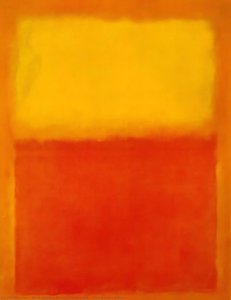 Orange and yellow1956
Essays around Untitled
 The Architecture of Emotion: A Connoisseur’s Guide to the Chromatic Sublimity of Mark RothkoExplore the profound emotional landscapes of Mark Rothko. An expert editorial on Color Field painting, decoding the spiritual depth, techni…
 Mastering Emotion: The Top 25 Most Iconic Mark Rothko ArtworksImmerse yourself in the profound emotion of Abstract Expressionism. Explore our curated guide to the top 25 Mark Rothko masterpieces, from …
 Action Painting vs. Color Field Painting: A Guide to Two Abstract StylesMaster the differences between Action and Color Field painting through expert analysis. Explore these abstract styles now.