Color Field Painting · 1968
Untitled (Mark Rothko, 1968)
Mark Rothko (1903–1970) made Untitled. It dates from 1968. It belongs to the Color Field Painting movement. It is made in acrylic on canvas.
- 1968
- Acrylic On Canvas

 Preview

 Hand Made Oil Painting
 Send
 Share
 Fact sheet


 Download
 Similars
 X-Ray
 Diaporama
 Q&A

 Stats
Untitled, in brief
- Title
- Untitled
- Artist
- Mark Rothko (1903–1970)
- Artist born in
- Daugavpils, Latvia
- Date
- 1968
- Medium
- Acrylic On Canvas
- Movement
- Color Field Painting
- Subject
- rothko, color field, orange, yellow, abstraction, emotion
What does Untitled depict?
The Genesis of a Vision: Mark Rothko and the Weight of Early Life
Mark Rothko's "Untitled" (1968) isn’t merely a painting; it’s an immersion into a deeply felt emotional landscape. Born Markus Yakovlevich Rothkowitz in Dvinsk, Latvia – a region steeped in historical displacement and shifting borders – Rothko carried within him the indelible marks of his early life. The anxieties surrounding his Jewish heritage during the turbulent years of the Russian Empire, punctuated by pogroms and political instability, instilled in him an acute sensitivity to human suffering, a theme that would become a recurring motif throughout his oeuvre. This formative experience, coupled with the subsequent immigration to Portland, Oregon, where his father’s untimely death cast a profound shadow, fueled a lifelong exploration of existential themes – mortality, trauma, and the persistent search for meaning in a world often defined by loss.
The early years in America were marked by assimilation challenges and a constant negotiation between cultural identities. Rothko's father, a pharmacist and intellectual with socialist leanings, fostered an environment of debate and learning, yet the absence of his father at such a crucial juncture left a lasting void. This complex interplay of heritage, loss, and familial influence profoundly shaped Rothko’s artistic vision, informing his later work with its haunting resonance and introspective depth.
Color Field Abstraction: A Revolutionary Approach
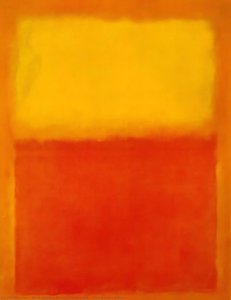
"Untitled" exemplifies Rothko's mastery of the color field style. Developed in the late 1940s and early 1950s, this approach eschewed traditional representational forms in favor of large, luminous expanses of pure color. The painting’s dominant orange hue, layered against a subtle yellow background, isn’t simply decorative; it's an attempt to evoke primal emotions – joy, sorrow, awe – directly through the viewer’s experience of color itself. Rothko believed that by stripping away all visual distractions, he could create paintings that would act as “cathedrals” of feeling, inviting contemplation and a profound connection with the human condition.
The texture of the canvas is deliberately uneven, suggesting an almost palpable physicality to the colors. This isn’t a smooth, polished surface; rather, it's a deliberate layering of paint, creating subtle shifts in tone and depth that draw the eye inward. The lack of sharp edges or defined forms contributes to the painting’s ethereal quality, allowing the colors to bleed into one another and create an immersive visual experience.
Symbolism and Emotional Resonance
While Rothko resisted definitive interpretations of his work, “Untitled” undeniably speaks to themes of spirituality, grief, and the search for transcendence. The vastness of the color fields can be interpreted as a metaphor for the infinite – a space where the boundaries between self and other dissolve, and where one might experience a sense of unity with something larger than oneself. The orange hue itself is often associated with warmth, vitality, and optimism, yet its presence within this context suggests a bittersweet longing or perhaps even a quiet acceptance of mortality.
The painting’s simplicity – the bold colors, the minimal forms – is precisely what gives it its power. Rothko wasn't interested in creating visually stimulating images; he sought to create paintings that would resonate with the viewer on a deeply emotional level, bypassing the intellect and speaking directly to the soul.
A Legacy of Color: Reproductions and Artistic Inspiration
OriginalUniqueArt offers meticulously crafted hand-painted reproductions of Mark Rothko’s “Untitled,” allowing you to experience the painting's profound beauty and emotional depth in your own space. These reproductions capture not only the colors and forms but also the subtle textures and luminous quality that define Rothko’s unique style. Whether adorning a contemporary living room or a sophisticated gallery, this artwork serves as a powerful reminder of the enduring legacy of one of modern art's most influential figures.
High-resolution images of Untitled
Protected by copyright: these files are for personal reference, not a licence to republish.
Mark Rothko, Untitled (1968).
Questions on Untitled, answered
When was "Untitled" made?
"Untitled" by Mark Rothko was created in 1968.
What is "Untitled" made with?
"Untitled" is executed in acrylic on canvas.
What subjects appear in "Untitled" by Mark Rothko?
"Untitled" by Mark Rothko depicts: rothko, color field, orange, yellow, abstraction, emotion, trauma, composition.
Is "Untitled" free of copyright?
Regarding copyright, "Untitled" is still protected by copyright.
Who created "Untitled"?
The artist behind "Untitled" is Mark Rothko. The work is catalogued under Mark Rothko's name.
What style does "Untitled" belong to?
The movement associated with "Untitled" by Mark Rothko is Color Field Painting. This classification situates the work among related artists and artworks.
Which period of Mark Rothko's career does "Untitled" belong to?
Within Mark Rothko's career, "Untitled" falls in the Late Period. The phase helps compare it with the artist's other works.
What was Mark Rothko's age when "Untitled" was created?
Mark Rothko made "Untitled" at the age of 65. The artist was born in 1903 and the work is dated 1968.
Is "Untitled" by Mark Rothko in the public domain, and why?
"Untitled" by Mark Rothko is still protected by copyright. Copyright duration runs from the artist's death, which occurred in 1970.
About the artist, Mark Rothko

1903–1970, Latvia
Mark Rothko
The Early Life of Mark Rothko Mark Rothko was born Markus Yakovlevich Rothkowitz in 1903. He was born in Dvinsk, Russia, in a place now known as Daugavpils, Latvia. His family lived within the Pale of Settlement, a region marked by political unrest and the constant shadow of pogroms. This atmosphere of instability followed the family when they emigrated to the United States in 1913.
Also by Mark Rothko
 White Center1950
 No.1
 No.61 (Rust and Blue)1953
 Orange and yellow1956
Essays around Untitled
 Color Fields of Calm: Transform Luxury Interiors with Minimalist Masterpiece ReproductionsElevate your luxury interiors with museum-quality Mark Rothko reproductions. Discover how hand-painted Color Field masterpieces bring profo…
 The Architecture of Emotion: A Connoisseur’s Guide to the Chromatic Sublimity of Mark RothkoExplore the profound emotional landscapes of Mark Rothko. An expert editorial on Color Field painting, decoding the spiritual depth, techni…
 Color & Emotion: The 25 Most Iconic Masterpieces by Mark RothkoImmerse yourself in the profound emotion of Abstract Expressionism. Explore 25 iconic Mark Rothko masterpieces, from his signature color fi…