

 Preview
 Send
Send Share
Share
 Details
 Guide
Guide

 Download
 Similars
 X-Ray
X-Ray Diaporama
 Stats
StatsWoman with Spade
 Tempera
- Modern Italian Art
 1934
1934 65.0 x 43.0 cm
 Boschi Di Stefano House Museum
 Read More
Giclée / Art Print
Museum-quality giclée or canvas print with fast production and flexible finish options. ( Buy Hand Made Painting Switch to Digital Image)




P118B $10

P118H $10

P118W $10

P438Z $10

P508JH $12

P508YH $12

P805H $10

P805Z $10

P919BZ $10

P919G $10

P919XJ $10

P959ZH $10

P968JZ $12

W106C $8

W218G $10

W218JH $8

W218Y $10

W307PJ $10

W316G $10

W316PJ $8

W316Y $10

W398PJ $8

W4111J $10

W500HY $15

W500JH $15

W692G $12

W849H $8

W940BG $15

W953PJ $8




Pick from our preset sizes that match the artwork's original proportions.

You may enter your own dimensions to fit a specific frame or space. If your selected size does not match the original image's proportions, we will either crop the artwork or extend the image with a mirrored or solid-fill edge. A digital mockup will be sent for your approval before production begins.
Please note that the on-screen preview does not reflect the actual cropping or extension. Only the mockup will accurately show the final composition.
While custom sizes are available, we recommend selecting a dimension from the predefined list to preserve the original proportions.
Worldwide Delivery () in 2 weeks instead of standard 4/5 weeks. (25 September)

Free Worldwide Express Shipping

High-Quality Linen Canvas

Full Shipping Insurance

Customs Tax Refund Guarantee

True Color Matching Guarantee

100-Day Return Policy (Defects Only)

100% Money-Back Guarantee

Bulk Discount Offer
 Glass option is only available in size under 110 CM

Woman with Spade
Giclée / Art Print
Reproduction Size
-


Total Price
$ 81
The Quiet Strength of Labor: Exploring Mario Sironi's "Woman with Spade"
To stand before Mario Sironi’s Woman with Spade is to encounter a moment suspended between the domestic and the elemental. Painted in 1934, this work transcends a mere portrait; it is a meditation on labor, resilience, and the quiet dignity inherent in human connection to the earth. The subject, rendered with an almost monumental stillness, holds a spade—an implement that speaks volumes without uttering a single word. Her expression, captured by Sironi’s masterful hand, is one of profound seriousness, suggesting a deep communion with the task at hand or perhaps a contemplation beyond it. The composition itself draws the viewer into her unwavering gaze, making us complicit in the weight and purpose she carries.
Technique and Materiality: Tempera's Enduring Glow
Sironi chose tempera paint for this piece, a medium that lends an unparalleled luminosity and matte depth to the surface. Unlike the fluidity of oil, tempera demands precision, resulting in colors that possess a jewel-like clarity. The way the light seems to rest upon her brown dress and the dark wood of the spade speaks to the careful layering characteristic of early 20th-century Italian painting. This technical choice contributes significantly to the emotional weight; the paint feels solid, enduring, much like the connection between woman and soil that the artwork celebrates. Owning a reproduction allows one to appreciate this delicate yet robust handling of pigment.
Historical Echoes: Art in the Mid-Century Crucible
Created during 1934, this painting emerges from a period of immense social and artistic upheaval in Italy. While Sironi’s career saw him move through influences like Divisionism and Futurism, Woman with Spade settles into a more grounded, almost Neoclassical sense of human form imbued with modern psychological depth. It reflects a turn away from pure dynamism toward an internal fortitude—a necessary anchor point amidst the turbulent currents of history. The piece grounds itself in timeless human experience rather than fleeting political moments.
Symbolism and Emotional Resonance for the Modern Collector
The spade is perhaps the most potent symbol here. It represents cultivation, beginnings, endings, and the cyclical nature of life itself—the planting, the turning over, the promise of harvest. Paired with her steady demeanor, the woman becomes an archetype: she embodies nurturing power, the foundational strength required to build or sustain a life. For the collector or designer, this piece offers more than mere decoration; it is an infusion of grounded energy into any space. It whispers of purpose and enduring commitment, making it a powerful focal point for rooms seeking depth and meaning.
Artist Biography
Mario Sironi: A Life in Modern Italian Art
Early Life and Education
- Born May 12, 1885, in Sassari, Sardinia, Italy.
- His father was an engineer, and his maternal grandfather, Ignazio Villa, was a respected architect and sculptor – providing early artistic exposure.
- Initially studied engineering at the University of Rome but abandoned it in 1903 following a nervous breakdown. This marked a turning point towards art.
- Began formal artistic training at the Scuola Libera del Nudo of the Accademia di Belle Arti di Roma, where he met his first significant teacher, Giacomo Balla.
Artistic Development and Influences
- Early work was heavily influenced by Divisionism, a technique emphasizing separated colors to create luminosity – exemplified in works like “The Student.”
- Briefly experimented with Futurism around 1914, exhibiting at the Galleria Sprovieri in Rome. However, he quickly moved beyond its focus on speed and dynamism.
- A pivotal shift occurred after WWI, developing a style characterized by massive, immobile forms and geometric shapes. This was influenced by his wartime experiences and a growing sense of isolation.
- Key influences included Giacomo Balla (early training), Giorgio de Chirico & Carlo Carrà (metaphysical painting’s impact on form), and elements of Neoclassicism and Primitivist Classicism.
The Novecento Italiano and Mature Style
- In 1922, Sironi became a founding member of the Novecento Italiano movement – a return to order in post-war European art, emphasizing clarity and tradition.
- His mature style is marked by:
- Emphasis on geometric shapes and simplified forms.
- A deliberately ungainly aesthetic in later works.
- Themes of solitude, alienation, and the human condition.
- Exploration of industrial landscapes and working-class life.
- Notable works from this period include “Venere” (1921-1923) and “Solitudine” (“Solitude,” 1925).
Political Affiliations and Later Life
- Sironi was a supporter of Benito Mussolini and contributed extensively to Fascist publications with over 1700 cartoons.
- He believed in the integration of art and architecture, seeking to create monumental works for public spaces – reflecting the ideals of the Fascist regime.
- Following WWII, his association with Fascism led to a decline in his popularity and critical acclaim.
- He largely withdrew from public life, continuing to paint in relative isolation until his death.
Major Achievements and Historical Significance
- Sironi’s work represents a significant contribution to Italian Modernism, bridging the gap between Futurism and later artistic developments.
- His exploration of themes like solitude and alienation resonated with the anxieties of the 20th century.
- Despite the controversies surrounding his political affiliations, his art has been featured in major exhibitions internationally, including at the Centre Georges Pompidou (1981) and the Royal Academy, London (1989).
- Died August 13, 1961, in Milan.
- His legacy lies in his unique stylistic synthesis and his powerful depictions of the human condition within a rapidly changing world.

Mario Sironi
1885 - 1961 , Italy
Quick Facts
- Birth Date: 1885-05-12
- Birth Place: Sassari, Italy
- Death Date: 1961-08-13
- Influenced By: ['Giacomo Balla']
- Movement:
- Futurism
- Novecento Italiano
- Modernism
- Name: Mario Sironi
- Nationality: Italian
- Notable Works:
- La Lampada (1919)
- Venere (1921-1923)
- Solitudine (1925)
Related Articles

Giovanni Fattori: Realism, Identity & the Tuscan Landscape – A Macchiaioli Master
Explore the life & art of Giovanni Fattori, a leading figure of the Macchiaioli movement. Discover his revolutionary realism, captivating Tuscan landscapes, and lasting impact on Italian painting. Learn more at OriginalUniqueArt.

Carlo Carrà: Futurist Visions & Metaphysical Transformations in Early 20th-Century Italian Painting
Explore the artistic journey of Carlo Carrà, a pivotal figure in Italian Futurism & Metaphysical painting. Discover his dynamic compositions, collaborations with de Chirico, and lasting influence on modern art history.

Drama and Light: A Definitive Guide to the Italian Baroque Masterpieces and the Revolution of Chiaroscuro
Explore the dramatic world of Italian Baroque art. Discover how masters like Caravaggio used chiaroscuro and tenebrism to revolutionize painting through light, shadow, and profound realism. A definitive guide for history lovers and art collectors.
1930s Art: 10 Masterpieces Reflecting a Decade of Change | OriginalUniqueArt
Journey back to the 1930s with OriginalUniqueArt. Explore 10 iconic artworks from Hopper, Kahlo & Magritte reflecting a decade of change. Find museum-quality reproductions and curated decor ideas inspired by Art Deco, Surrealism & more! Discover all masterpieces on OriginalUniqueArt.com
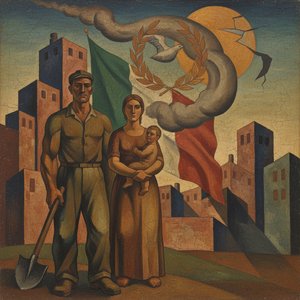
Mario Sironi: A Poetic of Modern Italian Identity Through Symbolism & Social Commentary
Explore the profound works of Mario Sironi, a key figure in Italian Modernism. Discover his evolution from Futurism to Metaphysical painting and his powerful social commentary. Learn about his legacy at OriginalUniqueArt.


