

 Preview
 Send
Send Share
Share
 Details

 Download
 Similars
 X-Ray
X-Ray Diaporama
 Stats
StatsStatues in Niches
 Acrylic On Canvas
- WallArt
- Contemporary Realism
 1947
1947- Modern
 5.0 x 61.0 cm
 Boschi Di Stefano House Museum
 Read More
Giclée / Art Print
Museum-quality giclée or canvas print with fast production and flexible finish options. ( Buy Hand Made Painting Switch to Digital Image)




P118B $10

P118H $10

P118W $10

P438Z $10

P508JH $12

P508YH $12

P805H $10

P805Z $10

P919BZ $10

P919G $10

P919XJ $10

P959ZH $10

P968JZ $12

W106C $8

W218G $10

W218JH $8

W218Y $10

W307PJ $10

W316G $10

W316PJ $8

W316Y $10

W398PJ $8

W4111J $10

W500HY $15

W500JH $15

W692G $12

W849H $8

W940BG $15

W953PJ $8




Pick from our preset sizes that match the artwork's original proportions.

You may enter your own dimensions to fit a specific frame or space. If your selected size does not match the original image's proportions, we will either crop the artwork or extend the image with a mirrored or solid-fill edge. A digital mockup will be sent for your approval before production begins.
Please note that the on-screen preview does not reflect the actual cropping or extension. Only the mockup will accurately show the final composition.
While custom sizes are available, we recommend selecting a dimension from the predefined list to preserve the original proportions.
Worldwide Delivery () in 2 weeks instead of standard 4/5 weeks. (20 September)

Free Worldwide Express Shipping

High-Quality Linen Canvas

Full Shipping Insurance

Customs Tax Refund Guarantee

True Color Matching Guarantee

100-Day Return Policy (Defects Only)

100% Money-Back Guarantee

Bulk Discount Offer
 Glass option is only available in size under 110 CM

Statues in Niches
Giclée / Art Print
Reproduction Size
-


Total Price
$ 81
Mario Sironi’s “Statues in Niches”: A Study in Urban Isolation
This meticulously crafted hand-painted reproduction captures the essence of Mario Sironi's 1947 masterpiece, "Statues in Niches," a work that resonates with a profound sense of melancholy and urban alienation. The painting depicts nine statues arranged within recessed niches, creating an unsettling tableau reminiscent of a forgotten museum or gallery – a space stripped of its original purpose and imbued with a quiet, almost oppressive stillness. Sironi’s masterful use of black and white elevates the image beyond mere representation, transforming it into a powerful meditation on themes of decay, memory, and the human condition.
The Artist's Journey: Sironi and the Echoes of Modernism
Born in Sassari, Sardinia, in 1885, Mario Sironi’s artistic trajectory was shaped by a complex interplay of influences. Initially drawn to engineering, he abandoned his studies following a psychological crisis, a pivotal moment that redirected him towards the burgeoning world of art. His early training at the *Scuola Libera del Nudo* under Giacomo Balla exposed him to Divisionism – a technique prioritizing separated colors for luminous effects – evident in works like “The Student.” Sironi’s brief flirtation with Futurism, characterized by its emphasis on dynamism and speed, quickly gave way to a more introspective approach. This shift solidified after World War I, leading to the development of his signature style: a stark, monumental realism that reflected the disillusionment and fragmentation of the modern era.
Composition and Technique – A Dialogue with Space
The composition of “Statues in Niches” is deliberately unsettling. The statues, varying in height and position, seem to lean against one another, creating a sense of precarious balance and impending collapse. Sironi’s meticulous brushwork contributes significantly to the painting's impact. He employs a smooth, almost polished technique, rendering the stone surfaces with remarkable detail while simultaneously imbuing them with a subtle sense of texture. The use of light and shadow is particularly effective, accentuating the statues’ forms and creating a dramatic interplay between depth and flatness. The black-and-white palette intensifies this effect, eliminating any distractions and focusing the viewer's attention on the formal qualities of the work.
Symbolism and Emotional Resonance – The Weight of History
More than just a depiction of statues, “Statues in Niches” speaks to broader themes of loss, isolation, and the enduring power of memory. The statues themselves can be interpreted as remnants of a vanished civilization, silent witnesses to human folly. Their placement within the niches suggests confinement and a sense of being trapped – mirroring the psychological state of the viewer. The painting’s timeless quality, achieved through its monochrome palette and Sironi's restrained style, allows for endless interpretation, inviting viewers to contemplate their own relationship with history, art, and the human condition. This reproduction offers a unique opportunity to possess a piece of this powerfully evocative artwork.
Artist Biography
Mario Sironi: A Life in Modern Italian Art
Early Life and Education
- Born May 12, 1885, in Sassari, Sardinia, Italy.
- His father was an engineer, and his maternal grandfather, Ignazio Villa, was a respected architect and sculptor – providing early artistic exposure.
- Initially studied engineering at the University of Rome but abandoned it in 1903 following a nervous breakdown. This marked a turning point towards art.
- Began formal artistic training at the Scuola Libera del Nudo of the Accademia di Belle Arti di Roma, where he met his first significant teacher, Giacomo Balla.
Artistic Development and Influences
- Early work was heavily influenced by Divisionism, a technique emphasizing separated colors to create luminosity – exemplified in works like “The Student.”
- Briefly experimented with Futurism around 1914, exhibiting at the Galleria Sprovieri in Rome. However, he quickly moved beyond its focus on speed and dynamism.
- A pivotal shift occurred after WWI, developing a style characterized by massive, immobile forms and geometric shapes. This was influenced by his wartime experiences and a growing sense of isolation.
- Key influences included Giacomo Balla (early training), Giorgio de Chirico & Carlo Carrà (metaphysical painting’s impact on form), and elements of Neoclassicism and Primitivist Classicism.
The Novecento Italiano and Mature Style
- In 1922, Sironi became a founding member of the Novecento Italiano movement – a return to order in post-war European art, emphasizing clarity and tradition.
- His mature style is marked by:
- Emphasis on geometric shapes and simplified forms.
- A deliberately ungainly aesthetic in later works.
- Themes of solitude, alienation, and the human condition.
- Exploration of industrial landscapes and working-class life.
- Notable works from this period include “Venere” (1921-1923) and “Solitudine” (“Solitude,” 1925).
Political Affiliations and Later Life
- Sironi was a supporter of Benito Mussolini and contributed extensively to Fascist publications with over 1700 cartoons.
- He believed in the integration of art and architecture, seeking to create monumental works for public spaces – reflecting the ideals of the Fascist regime.
- Following WWII, his association with Fascism led to a decline in his popularity and critical acclaim.
- He largely withdrew from public life, continuing to paint in relative isolation until his death.
Major Achievements and Historical Significance
- Sironi’s work represents a significant contribution to Italian Modernism, bridging the gap between Futurism and later artistic developments.
- His exploration of themes like solitude and alienation resonated with the anxieties of the 20th century.
- Despite the controversies surrounding his political affiliations, his art has been featured in major exhibitions internationally, including at the Centre Georges Pompidou (1981) and the Royal Academy, London (1989).
- Died August 13, 1961, in Milan.
- His legacy lies in his unique stylistic synthesis and his powerful depictions of the human condition within a rapidly changing world.

Mario Sironi
1885 - 1961 , Italy
Quick Facts
- Birth Date: 1885-05-12
- Birth Place: Sassari, Italy
- Death Date: 1961-08-13
- Influenced By: ['Giacomo Balla']
- Movement:
- Futurism
- Novecento Italiano
- Modernism
- Name: Mario Sironi
- Nationality: Italian
- Notable Works:
- La Lampada (1919)
- Venere (1921-1923)
- Solitudine (1925)
Related Articles

Monochrome Visions: Exploring the Aesthetic & Historical Significance of Black & White Photography
Explore the rich history & artistic power of black and white photography. From early techniques to iconic masters like Ansel Adams, discover why monochrome continues to captivate art lovers today. Expert insights for collectors.

Dark Masterpieces: 10 Iconic Paintings Dominated by Black Tones |
Explore 10 iconic paintings dominated by black tones, from Rembrandt’s chiaroscuro to Goya's dark expressions. Discover the stories behind these masterpieces & find museum-quality art reproductions for your home at .
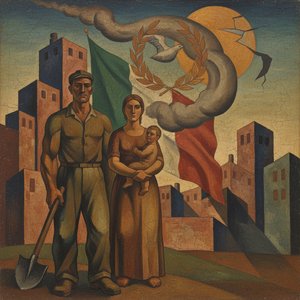
Mario Sironi: A Poetic of Modern Italian Identity Through Symbolism & Social Commentary
Explore the profound works of Mario Sironi, a key figure in Italian Modernism. Discover his evolution from Futurism to Metaphysical painting and his powerful social commentary. Learn about his legacy at OriginalUniqueArt.

Giclée Prints: Archival Quality & Aesthetic Nuances for the Discerning Collector
Explore the world of giclée prints with OriginalUniqueArt. Learn about archival quality, aesthetic nuances & investment potential. Expert guidance for discerning art collectors seeking museum-quality reproductions and lasting value.

White on Canvas: 10 Masterpieces & Timeless Elegance for Your Home Decor
Explore 10 iconic white paintings by Monet, Whistler & Rothko! Discover the stories behind these serene masterpieces and their impact on art history. Find museum-quality reproductions for your home decor at .


