
 Preview
 Send
Send Share
Share
 Details
 Guide
Guide

 Download
 Similars
 X-Ray
X-Ray Diaporama
 Q&A
Q&A Stats
StatsIl lavoratore

- 202.0 x 325.0 cm


 Read More
The artwork displayed on this page is protected by copyright law, which means we cannot legally create or sell an identical reproduction. This protection is enforced under international agreements such as the Berne Convention and by national laws, including those outlined by the U.S. Copyright Law - Title 17.
This method fully complies with copyright regulations because it does not involve copying or duplicating the protected artwork. Instead, it is a creative reinterpretation - a new painting that is influenced by the original but not identical to it.
Giclée / Art Print
Museum-quality giclée or canvas print with fast production and flexible finish options. ( Buy Hand Made Painting Switch to Digital Image)




P118B $10

P118H $10

P118W $10

P438Z $10

P508JH $12

P508YH $12

P805H $10

P805Z $10

P919BZ $10

P919G $10

P919XJ $10

P959ZH $10

P968JZ $12

W106C $8

W218G $10

W218JH $8

W218Y $10

W307PJ $10

W316G $10

W316PJ $8

W316Y $10

W398PJ $8

W4111J $10

W500HY $15

W500JH $15

W692G $12

W849H $8

W940BG $15

W953PJ $8




Pick from our preset sizes that match the artwork's original proportions.

Type the width and the height you need, to fit your frame or your wall. A print can only be cut, never made bigger than the picture, so a size with a different shape loses a part of the image. We send you a digital mockup to approve before we print anything. The picture shown on this page does not show the real cut — only the mockup does.
Worldwide Delivery () in 2 weeks instead of standard 4/5 weeks. (5 November)

Free Worldwide Express Shipping

High-Quality Linen Canvas

Full Shipping Insurance

Customs Tax Refund Guarantee

True Color Matching Guarantee

100-Day Return Policy (Defects Only)

100% Money-Back Guarantee

Bulk Discount Offer
 Glass option is only available in size under 110 CM

Il lavoratore
Giclée / Art Print
Reproduction Size
-


Total Price
$ 81
A Monumental Vision of Labor and Solitude
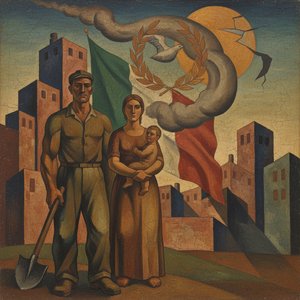
In the profound depths of Mario Sironi’s Il Lavoratore, we encounter more than a mere preparatory study; we witness a monumental dialogue between the individual and the weight of history. Created as a preparatory cartoon for the massive mosaic commissioned for the 1936 Milan Triennial, this work serves as a powerful window into the socio-political soul of Fascist Italy. Yet, beneath the surface-level nod to Mussolini’s vision of a disciplined, industrious citizenry, lies a much more intimate and haunting exploration of the human condition. The painting captures a solitary figure, rendered with a gravity that transcends its original political intent, embodying a sense of profound isolation and the quiet, enduring struggle for meaning amidst the relentless march of industrial progress.
The composition is masterfully structured to command the viewer's attention, utilizing a verticality that emphasizes the weight of the subject. A single figure dominates the space, positioned in a posture that oscillates between humble submission and defiant endurance. Through Sironi’s lens, the act of labor is stripped of its romanticized glory and instead presented as an existential state—a moment of stillness within a world of shifting shadows. For the discerning collector or interior designer, this piece offers a commanding presence, bringing a sense of historical weight and intellectual depth to any curated space.
The Alchemy of Shadow and Form
Technically, Il Lavoratore is a triumph of early Modernist expression, showcasing Sironi’s departure from the luminous, fragmented light of his Divisionist roots toward something far more substantial and somber. The artist employs a palette dominated by earthy ochres, deep blacks, and rich golds, creating a chiaroscuro effect that breathes life into the geometric forms. There is a palpable sense of impasto here; the visible, thick brushstrokes suggest a tactile reality, as if the paint itself were labored over with the same intensity as the subject it depicts.
The style leans heavily into the metaphysical and the expressionistic, where shapes are simplified into powerful, architectural blocks. The lines defining the figure and the surrounding environment are not sharp or clinical but possess a smoky, blurred quality that contributes to a claustrophobic, almost dreamlike atmosphere. This lack of traditional linear perspective flattens the space, forcing the viewer to confront the emotional volume of the figure rather than getting lost in a receding landscape. The interplay of light, appearing to descend from above, casts dramatic shadows that carve out the musculature and the heavy folds of the composition, lending the work an almost sculptural permanence.
Symbolism and the Emotional Resonance
To gaze upon Il Lavoratore is to engage with a complex tapestry of symbolism. The outstretched arms of the figure can be interpreted as a gesture of both vulnerability and strength—a reaching out toward a connection that remains perpetually out of grasp. Sironi, influenced by the psychological depth of Giorgio de Chirico, uses these massive, immobile forms to evoke a sense of timelessness and melancholy. The geometric rigidity of the background elements contrasts sharply with the organic, albeit stylized, form of the human body, mirroring the tension between the individual spirit and the cold, industrial structures of modern society.
For those seeking to incorporate art into a sophisticated interior, this reproduction offers an unparalleled emotional impact. It is a piece that invites contemplation, acting as a focal point that stimulates conversation about identity, resilience, and the passage of time. Whether placed in a quiet study or a grand gallery, Il Lavoratore radiates a somber elegance, making it an exquisite choice for those who appreciate art that speaks to the complexities of the human experience through a lens of monumental beauty.
Questions & Answers
Where is "Il lavoratore" suggested to be displayed, considering its palette?
With its earthy palette, "Il lavoratore" by Mario Sironi is recommended for a living room. The colors are part of the reason for this suggestion.
Where can I buy a hand-painted reproduction of "Il lavoratore" by Mario Sironi?
"Il lavoratore" is available as a hand-painted oil reproduction on linen canvas. The order can be placed on its Hand-Painted Reproduction page, with a choice of sizes.
Is "Il lavoratore" free of copyright?
Regarding copyright, "Il lavoratore" is still protected by copyright.
Artist Biography
Mario Sironi: A Life in Modern Italian Art
Early Life and Education
- Born May 12, 1885, in Sassari, Sardinia, Italy.
- His father was an engineer, and his maternal grandfather, Ignazio Villa, was a respected architect and sculptor – providing early artistic exposure.
- Initially studied engineering at the University of Rome but abandoned it in 1903 following a nervous breakdown. This marked a turning point towards art.
- Began formal artistic training at the Scuola Libera del Nudo of the Accademia di Belle Arti di Roma, where he met his first significant teacher, Giacomo Balla.
Artistic Development and Influences
- Early work was heavily influenced by Divisionism, a technique emphasizing separated colors to create luminosity – exemplified in works like “The Student.”
- Briefly experimented with Futurism around 1914, exhibiting at the Galleria Sprovieri in Rome. However, he quickly moved beyond its focus on speed and dynamism.
- A pivotal shift occurred after WWI, developing a style characterized by massive, immobile forms and geometric shapes. This was influenced by his wartime experiences and a growing sense of isolation.
- Key influences included Giacomo Balla (early training), Giorgio de Chirico & Carlo Carrà (metaphysical painting’s impact on form), and elements of Neoclassicism and Primitivist Classicism.
The Novecento Italiano and Mature Style
- In 1922, Sironi became a founding member of the Novecento Italiano movement – a return to order in post-war European art, emphasizing clarity and tradition.
- His mature style is marked by:
- Emphasis on geometric shapes and simplified forms.
- A deliberately ungainly aesthetic in later works.
- Themes of solitude, alienation, and the human condition.
- Exploration of industrial landscapes and working-class life.
- Notable works from this period include “Venere” (1921-1923) and “Solitudine” (“Solitude,” 1925).
Political Affiliations and Later Life
- Sironi was a supporter of Benito Mussolini and contributed extensively to Fascist publications with over 1700 cartoons.
- He believed in the integration of art and architecture, seeking to create monumental works for public spaces – reflecting the ideals of the Fascist regime.
- Following WWII, his association with Fascism led to a decline in his popularity and critical acclaim.
- He largely withdrew from public life, continuing to paint in relative isolation until his death.
Major Achievements and Historical Significance
- Sironi’s work represents a significant contribution to Italian Modernism, bridging the gap between Futurism and later artistic developments.
- His exploration of themes like solitude and alienation resonated with the anxieties of the 20th century.
- Despite the controversies surrounding his political affiliations, his art has been featured in major exhibitions internationally, including at the Centre Georges Pompidou (1981) and the Royal Academy, London (1989).
- Died August 13, 1961, in Milan.
- His legacy lies in his unique stylistic synthesis and his powerful depictions of the human condition within a rapidly changing world.

Mario Sironi
1885 - 1961 , Italy
Quick Facts
- Name: Mario Sironi
- Movement:
- Futurism
- Novecento Italiano
- Modernism
- Birth Date: 1885-05-12
- Death Date: 1961-08-13
- Birth Place: Sassari, Italy
- Nationality: Italian
- Date Of Birth: 1885
- Date Of Death: 1961
- Influenced By: ['Giacomo Balla']
- Notable Works:
- La Lampada (1919)
- Venere (1921-1923)
- Solitudine (1925)
- Place Of Birth: Sassari, Italy
Related Articles

Beyond Branding: Leveraging Art for Strategic Corporate Relationships & Stakeholder Engagement
Elevate corporate relationships with strategic art gifting. Discover how personalized artwork builds brand loyalty, fosters stakeholder engagement & delivers measurable ROI. Expert guidance and seamless procurement.
Mario Sironi: A Poetic of Modern Italian Identity Through Symbolism & Social Commentary
Explore the profound works of Mario Sironi, a key figure in Italian Modernism. Discover his evolution from Futurism to Metaphysical painting and his powerful social commentary. Learn about his legacy at OriginalUniqueArt.

Elevating Corporate Events Through Artful Gifting: A Concierge Service for Personalized Artwork Selection and Delivery
Elevate your corporate events with personalized artwork! Our art concierge service offers curated collections & bespoke commissions for lasting impressions. Expert guidance, secure delivery & legal compliance guaranteed.

Beyond Swag: Why Personalized Art is the Ultimate High-Impact Corporate Gift
Discover why personalized fine art is the ultimate high-impact corporate gift. Move beyond commodity swag to cultivate lasting prestige and brand loyalty through bespoke, hand-painted masterpieces designed for executives and discerning clients.

Beyond Gifts: Personalized Art for Lasting Corporate Appreciation
Elevate corporate appreciation with personalized art from . Discover bespoke commissions, branded solutions & museum-quality reproductions for lasting impact. Expert consultation & seamless delivery.


