Preview
 Send
Send Share
Share
 Details
 Guide
Guide

 Download
 Similars
 X-Ray
X-Ray Diaporama
 Q&A
Q&A Stats
StatsSt Jerome
 Oil On Panel
- Northern Renaissance
 1541
1541- Renaissance
 78.0 x 107.0 cm
 Koninklijk Museum voor Schone Kunsten
 Read More
Giclée / Art Print
Museum-quality giclée or canvas print with fast production and flexible finish options. ( Buy Hand Made Painting Switch to Digital Image)




P118B $10

P118H $10

P118W $10

P438Z $10

P508JH $12

P508YH $12

P805H $10

P805Z $10

P919BZ $10

P919G $10

P919XJ $10

P959ZH $10

P968JZ $12

W106C $8

W218G $10

W218JH $8

W218Y $10

W307PJ $10

W316G $10

W316PJ $8

W316Y $10

W398PJ $8

W4111J $10

W500HY $15

W500JH $15

W692G $12

W849H $8

W940BG $15

W953PJ $8




Pick from our preset sizes that match the artwork's original proportions.

Type the width and the height you need, to fit your frame or your wall. A print can only be cut, never made bigger than the picture, so a size with a different shape loses a part of the image. We send you a digital mockup to approve before we print anything. The picture shown on this page does not show the real cut — only the mockup does.
Worldwide Delivery () in 2 weeks instead of standard 4/5 weeks. (29 October)

Free Worldwide Express Shipping

High-Quality Linen Canvas

Full Shipping Insurance

Customs Tax Refund Guarantee

True Color Matching Guarantee

100-Day Return Policy (Defects Only)

100% Money-Back Guarantee

Bulk Discount Offer
 Glass option is only available in size under 110 CM

St Jerome
Giclée / Art Print
Reproduction Size
-


Total Price
$ 81
A Vision of Wisdom and Mortality
In the quiet, contemplative depths of Marinus Van Reymerswaele’s 1541 masterpiece, St Jerome, we are invited into a world where the pursuit of divine knowledge meets the heavy reality of human existence. This extraordinary oil on panel painting serves as a profound window into the Northern Renaissance, a period defined by an almost obsessive devotion to detail and a deep-seated fascination with the symbolic language of everyday objects. The central figure, an elderly scholar draped in a rich, cardinal-red robe, sits anchored at his desk, his weathered face and flowing beard telling a story of decades spent in rigorous study. As he leans over his work, the painting captures a singular moment of intellectual and spiritual intensity, drawing the viewer into a space where time seems to slow under the weight of profound thought.
The composition is a masterful dance of density and light, where every corner of the frame offers a new layer of meaning for the observant eye. Van Reymerswaele utilizes a shallow, crowded space that feels intimate yet intellectually overwhelming, much like the cluttered mind of a scholar. Scattered across the table are the tools of his devotion: heavy, leather-bound books, an inkwell poised with a quill, and the haunting presence of a skull—a classic memento mori designed to remind the viewer of the inevability of death. This juxtaposition of scholarly achievement with the symbol of mortality creates a powerful tension, suggesting that true wisdom lies in understanding our place within the fleeting cycle of life. The inclusion of musical instruments in the background further enriches this narrative, hinting at the harmony between the intellectual, the spiritual, and the sensory worlds.
Mastery of Texture and Light
Technically, St Jerome is a triumph of Flemish precision. Van Reymerswaele’s ability to manipulate oil paint allows for a breathtakingly tactile experience; one can almost feel the rough grain of the aged parchment, the cold smoothness of the bone skull, and the heavy, luxurious weight of the crimson fabric. The artist employs a sophisticated technique of layering thin, translucent glazes, which imbues the deeper tones with an inner luminosity. This method is particularly effective in the way light enters the scene—appearing to descend from an unseen source above, casting dramatic, soft-edged shadows that sculpt the figure’s features and give the objects a tangible, three-dimensional presence.
For the discerning collector or interior designer, this painting offers more than mere decoration; it provides a focal point of immense character and gravitas. The somber, earthy palette of deep browns, ochres, and reds lends itself beautifully to sophisticated, classical, or even moody contemporary interiors, where it can serve as an anchor of historical depth. To possess a reproduction of such a work is to bring a piece of the Northern Renaissance into the modern home—a constant, silent dialogue between the beauty of meticulous craftsmanship and the timeless human quest for meaning.
Questions & Answers
How is the color composition of "St Jerome" by Marinus Van Reymerswaele built?
The color analysis of "St Jerome" by Marinus Van Reymerswaele records a statement contrast and a strong color unity harmony.
Where and for what purpose is "St Jerome" recommended?
"St Jerome" is suggested for focal, and the recommended space is an office.
Is "St Jerome" held in the country of its creator?
No - the artwork is kept abroad. The birth country of Marinus Van Reymerswaele is Netherlands, and the museum holding the original of "St Jerome" is in Belgium.
Artist Biography
The Enigmatic Master of Antwerp's Shadows
In the bustling, mercantile heart of the sixteenth-century Low Countries, a painter emerged whose brush captured the profound tension between spiritual devotion and worldly greed. Marinus van Reymerswaele, an artist whose very name evokes the coastal town of Reimerswaal where he was born, remains one of the most fascinating enigmas of the Dutch Renaissance. His life followed the typical trajectory of a skilled craftsman; after studying in Leuven, he found professional footing within the prestigious Antwerp Guild of Saint Luke. Registered as a pupil of the glass painter Symon van Daele, Reymerswaele possessed an eye for detail and light that would later define his mastery of texture and atmosphere.
As he established himself in Antwerp, the epicenter of European trade, his work began to mirror the city's own complex identity. He operated a prolific workshop, a bustling studio capable of producing numerous versions of his most celebrated themes. This industriousness allowed his specific visual language—a blend of meticulous realism and biting social commentary—to permeate the collections of the era. His paintings did not merely depict scenes; they staged moral dramas that reflected the anxieties of an era caught between medieval piety and the rising tide of capitalism.
A Gallery of Greed and Grace
To look upon a work attributed to Reymerswaele is to enter a space where the sacred and the profane collide. He was a master of a very specific, recurring iconography that captured the imagination of the sixteenth-century public. His compositions often centered on four pivotal themes that explored the human condition through various lenses:
- The intense study of St. Jerome, representing scholarly devotion and religious contemplation.
- The bustling activity of tax collectors, serving as a satirical commentary on greed and corruption.
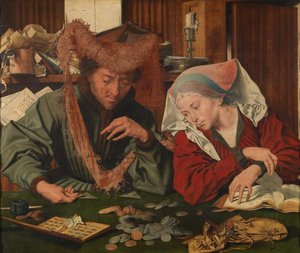
- A money changer and his wife, capturing the intersection of domestic life and commerce.
- The legal world, such as a lawyer in his office, reflecting the growing complexity of civic bureaucracy.
His masterpiece, Two Tax Gatherers, stands as a striking example of Northern Renaissance art. Through the use of oil on oak wood, he achieved a sense of depth and texture that brought his subjects to life. The painting serves as a vivid commentary on the corruption of tax officials, using the detailed depiction of clothing and surroundings to ground his satire in a recognizable reality. In these works, the heavy, old-fashioned garments of his characters add a layer of social critique, reminding the viewer of the era's shifting moral landscape.
Legacy and Artistic Influence
The stylistic development of Marinus van Reymerswaele shows the profound influence of the Antwerp painter Quentin Matsys. This connection helped shape his ability to blend elements of realism with a sharp, often caricatural sense of humor. His work is characterized by an attention to detail that allows the viewer to witness the minute textures of manuscripts, legal documents, and coins, all of which serve as symbols of the era's preoccupation with wealth and law.
While he worked extensively in Antwerp, his journey eventually led him back to the Northern Netherlands. After working in Antwerp until at least 1540, he moved to Goes, where his life reached its conclusion. Though many of his panels are known through attribution rather than signature, his impact on the genre scene remains undeniable. He left behind a visual legacy that continues to captivate, offering a profound glimpse into the mind of an artist grappling with faith, scholarship, and the ever-present shadows of human avarice.
Marinus Van Reymerswaele
1490 - 1546 , Netherlands
Quick Facts
- Artistic Movement Or Style: Northern Renaissance
- Artists Who Influenced This Artist: ['Quentin Matsys']
- Full Name: Marinus van Reymerswaele
- Nationality: Dutch
- Notable Artworks:
- Two Tax Gatherers
- The Tax Collectors
- St. Jerome in His Study
- Money-Changer and his Wife
- Place Of Birth: Reimerswaal, Netherlands
- Date Of Birth: 1490
- Date Of Death: 1546
Related Articles

Mastering Light and Shadow: The 25 Greatest Artworks by Rembrandt van Rijn
Explore Rembrandt's greatest Baroque masterpieces through light and shadow. Discover the full collection online at OriginalUniqueArt.com.
Northern Renaissance Masters: 10 Artworks That Shaped History |
Journey through the Northern Renaissance! Explore 10 iconic paintings by Jan van Eyck, Dürer & Bosch. Discover their stories, techniques & lasting impact. Find museum-quality art reproductions & elevate your home decor on .

The Northern Renaissance: A Flourishing of Realism, Religious Reform & Artistic Innovation
Explore the Northern Renaissance! Discover Jan van Eyck's innovations, religious shifts, & key artists of this influential period. Expert analysis and insights into Early Netherlandish painting at OriginalUniqueArt.

Early Netherlandish Masters: 10 Paintings That Revolutionized Art & Decor
Journey into the Early Netherlandish Renaissance! Explore 10 iconic paintings by Jan van Eyck, Rogier van der Weyden & more. Discover stunning detail, symbolism, and oil painting techniques. Find museum-quality art reproductions for your home at OriginalUniqueArt.com.

Early Netherlandish Masters: 10 Paintings That Revolutionized Art & Decor
Journey into the world of Early Netherlandish painting! Explore 10 masterpieces by Jan van Eyck, Rogier van der Weyden & more. Discover stunning detail, symbolism & Renaissance art for your home decor. Find museum-quality reproductions on OriginalUniqueArt.com