

 Preview
 Send
Send Share
Share
 Details
 Guide
Guide

 Download
 Similars
 X-Ray
X-Ray Diaporama
 Stats
StatsAlegoría de género (George Washington)


 Read More
The artwork displayed on this page is protected by copyright law, which means we cannot legally create or sell an identical reproduction. This protection is enforced under international agreements such as the Berne Convention and by national laws, including those outlined by the U.S. Copyright Law - Title 17.
This method fully complies with copyright regulations because it does not involve copying or duplicating the protected artwork. Instead, it is a creative reinterpretation - a new painting that is influenced by the original but not identical to it.
Giclée / Art Print
Museum-quality giclée or canvas print with fast production and flexible finish options. ( Buy Hand Made Painting Switch to Digital Image)




P118B $10

P118H $10

P118W $10

P438Z $10

P508JH $12

P508YH $12

P805H $10

P805Z $10

P919BZ $10

P919G $10

P919XJ $10

P959ZH $10

P968JZ $12

W106C $8

W218G $10

W218JH $8

W218Y $10

W307PJ $10

W316G $10

W316PJ $8

W316Y $10

W398PJ $8

W4111J $10

W500HY $15

W500JH $15

W692G $12

W849H $8

W940BG $15

W953PJ $8




Pick from our preset sizes that match the artwork's original proportions.

Type the width and the height you need, to fit your frame or your wall. A print can only be cut, never made bigger than the picture, so a size with a different shape loses a part of the image. We send you a digital mockup to approve before we print anything. The picture shown on this page does not show the real cut — only the mockup does.
Worldwide Delivery () in 2 weeks instead of standard 4/5 weeks. (23 October)

Free Worldwide Express Shipping

High-Quality Linen Canvas

Full Shipping Insurance

Customs Tax Refund Guarantee

True Color Matching Guarantee

100-Day Return Policy (Defects Only)

100% Money-Back Guarantee

Bulk Discount Offer
 Glass option is only available in size under 110 CM

Alegoría de género (George Washington)
Giclée / Art Print
Reproduction Size
-


Total Price
$ 81
A Haunting Reverie: Deconstructing American Iconography
This striking work by Marcel Duchamp moves beyond his famously provocative “readymades,” yet retains that same spirit of intellectual challenge and artistic innovation. Rather than a straightforward portrait, *Alegoría de género (George Washington)* presents a spectral, dissolving image – an abstract evocation of America’s first president emerging from a swirling darkness. Duchamp compels us to consider not simply *what* is depicted, but *how* it's perceived and what that perception reveals about our own understanding of history and identity.Style & Technique: A Fusion of Surrealism and Expressive Impasto
The artwork exists at the intersection of Surrealism and Expressionism. While Duchamp resisted rigid categorization, this piece embodies characteristics of both movements – a dreamlike atmosphere, an emphasis on subconscious imagery, and a prioritization of emotional resonance over precise representation. Duchamp’s masterful technique is immediately apparent in his use of impasto, building up thick layers of oil paint to create a palpable texture. This isn't merely paint applied to canvas; it’s a sculptural surface that speaks to the weight of history and the inevitable erosion of time. The visible brushstrokes are not concealed, but celebrated as integral to the artwork’s expressive power.Symbolism & Historical Context: A Provocative Allegory
The title itself, “Allegory of Gender (George Washington),” is deliberately provocative and multi-layered. Duchamp was deeply interested in gender roles and societal constructs, frequently subverting expectations within his art. Juxtaposing the iconic figure of Washington with "gender" suggests a critical deconstruction of American heroism – questioning not only *who* we choose to celebrate as national figures but also the very foundations upon which that celebration rests. The scattered, star-like shapes may represent the stars on the American flag, or perhaps allude to a more expansive cosmic or spiritual dimension. The somber background evokes mystery and melancholy, hinting at the inherent complexities and contradictions within the nation’s history. Created during a period of significant social and political upheaval, this work reflects Duchamp's skepticism towards established norms and authority.Emotional Impact & Interior Design Considerations
This artwork is not intended for passive viewing; it demands active engagement. The ambiguous form and muted color palette evoke feelings of introspection, questioning, and perhaps even a subtle unease. It’s a piece that sparks conversation and challenges viewers to confront their own preconceptions about history, identity, and the nature of representation itself.- In an interior design context, this artwork would serve as a powerful focal point in a study, library, or living space with a modern or eclectic aesthetic.
- Its subdued color scheme complements neutral palettes while adding depth and sophistication.
- The textural richness provides visual interest without overwhelming the surrounding décor.
- Strategic lighting will enhance the impasto’s effect, drawing attention to the artwork's dynamic surface.
- This piece is ideal for those who appreciate art that provokes thought and invites ongoing interpretation – a true statement piece that transcends mere decoration.
About the Artist: Marcel Duchamp (1887-1968)
Born in France, Marcel Duchamp was a pivotal figure in 20th-century art. He initially experimented with Post-Impressionism before becoming associated with Cubism, Dada, and Conceptual Art – though he resisted strict categorization. His most famous work, *Fountain* (1917), a signed urinal presented as sculpture, remains one of the most influential and controversial artworks ever created, fundamentally challenging traditional notions of art itself. Duchamp’s legacy lies in his relentless questioning of artistic conventions and his pioneering exploration of ideas over aesthetics.Questions & Answers
Does "Alegoría de género (George Washington)" have an augmented reality preview?
"Alegoría de género (George Washington)" by Marcel Duchamp can be previewed on your own wall with the artwork's AR Preview page, using augmented reality on a compatible device.
Which reproduction size is suggested for "Alegoría de género (George Washington)" by Marcel Duchamp?
The recommended print size for "Alegoría de género (George Washington)" by Marcel Duchamp is large.
How is "Alegoría de género (George Washington)" recommended to be printed - what size, what orientation?
For "Alegoría de género (George Washington)", the recommended print setup is a large size and a portrait orientation.
Artist Biography
A Revolutionary Spirit: The Life and Art of Marcel Duchamp
Marcel Duchamp, born Henri-Robert-Marcel Duchamp in 1887 in Blainville-Crevon, Normandy, was more than an artist; he was a philosophical provocateur who fundamentally altered the course of modern art. His early life, though seemingly conventional – nurtured within a family that appreciated artistic expression with both brothers pursuing successful careers as artists – hinted at the iconoclasm to come. Duchamp initially pursued formal training, mastering traditional techniques and experimenting with post-impressionist styles. However, this academic foundation served not as an end in itself, but as a springboard for questioning the very nature of art, its purpose, and its definition. He wasn’t content merely to depict the world; he sought to challenge how we perceive it, and what constitutes artistic value. This restless intellectual curiosity would become the defining characteristic of his prolific career.From Cubism to Dada: A Rejection of Convention
Duchamp's artistic journey was marked by a constant evolution, a deliberate shedding of established norms. His initial engagement with Cubism, evident in works like *Portrait of Chess Players* (1911), demonstrated an interest in fragmented forms and multiple perspectives – a departure from traditional representation. Yet, he quickly moved beyond purely aesthetic concerns, recognizing that simply rearranging visual elements wasn’t enough to address the deeper questions swirling within him. The horrors of World War I fueled this discontent, leading Duchamp to embrace Dadaism, a movement born out of disillusionment and a rejection of logic, reason, and traditional artistic values. It was within the Dadaist framework that Duchamp truly began to dismantle conventional notions of art. He wasn’t interested in creating beautiful objects; he wanted to provoke thought, challenge assumptions, and expose the arbitrariness of aesthetic judgment. This period saw the birth of his most radical innovation: the ‘readymade’.The Readymades and the Subversion of Art
The introduction of readymades – ordinary manufactured objects selected and presented as art – was Duchamp’s most significant contribution to the 20th century. These weren't simply found objects; they were deliberate acts of artistic subversion. By taking an everyday item, like a urinal (*Fountain*, 1917), signing it “R. Mutt,” and submitting it to an art exhibition, Duchamp challenged the very definition of artistic skill and authorship. Was it the artist’s hand that created the work, or was it the artist's *idea*? This question became central to his practice and laid the groundwork for Conceptual Art. Other notable readymades like *L.H.O.O.Q.* (1919), a postcard reproduction of the Mona Lisa defaced with a mustache and goatee, were playful yet pointed critiques of art history and established cultural icons. These works weren’t meant to be admired for their aesthetic qualities; they were intended to provoke debate and force viewers to reconsider their preconceived notions about what constitutes art. Duchamp believed that art should reside in the mind, not merely in the eye.Legacy and Enduring Influence
Marcel Duchamp's impact on subsequent generations of artists is immeasurable. He fundamentally altered our understanding of art, paving the way for movements like Conceptual Art, Minimalism, Pop Art, and countless others. His emphasis on the artist’s idea – the concept behind the work – over its aesthetic qualities continues to inspire artists today.- Cubism: Early exploration of fractured forms and spatial representation.
- Dadaism: Rejection of logic, reason, and traditional artistic values in response to World War I.
- Conceptual Art: Emphasis on the idea behind the artwork rather than its aesthetic qualities.
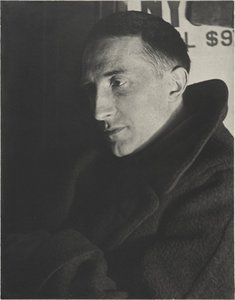
Marcel Duchamp
1887 - 1968 , France
Quick Facts
- Artistic Movement Or Style:
- Cubism
- Dadaism
- Conceptual Art
- Artists Or Movements Influenced By This Artist:
- Conceptual Art
- Minimalism
- Pop Art
- Artists Who Influenced This Artist:
- Cézanne
- Picasso
- Braque
- Full Name: Henri-Robert-Marcel Duchamp
- Nationality: French American
- Notable Artworks:
- Fountain
- Bicycle Wheel
- The Large Glass
- Place Of Birth: Blainville-sur-Mer, France
- Date Of Birth: 1887
- Date Of Death: 1968
Related Articles

Abstract Expressionism's 10 Defining Masterpieces |
Explore 10 defining Abstract Expressionism masterpieces by Pollock, Rothko & de Kooning. Discover the stories behind these iconic paintings and find museum-quality art reproductions to elevate your home decor on .

Kandinsky's Masterpieces: 25 Paintings That Define Abstract Art | OriginalUniqueArt
Journey through Wassily Kandinsky's 25 most iconic abstract paintings. Explore his revolutionary use of color, form & spiritual expressionism. Find museum-quality Kandinsky reproductions and elevate your home decor with OriginalUniqueArt.com. Discover all masterpieces on OriginalUniqueArt.com!

Oil on Canvas: A Historical & Technical Exploration of a Timeless Artistic Medium
Explore the rich history & enduring techniques of oil painting on canvas. Discover the science behind its longevity, conservation practices, and contemporary relevance. Expert insights for art enthusiasts.

The Enduring Legacy of Oil on Canvas: Technique, History & Contemporary Practice
Explore the rich history & enduring techniques of oil painting on canvas. Discover the science behind its longevity, conservation practices, and contemporary relevance. Expert insights for art enthusiasts.

The Enduring Legacy of Oil on Canvas: Technique, History & Aesthetic Impact
Explore the rich history & techniques of oil painting – from Renaissance masters to Impressionism. Discover pigments, layering methods, and why this timeless medium endures. Expert insights for artists & art enthusiasts.


