Preview
 Send
Send Share
Share
 Details

 Download
 Similars
 X-Ray
X-Ray Diaporama
Anápolis
 Drawing
- WallArt
- Contemporary Realism
 1965
1965- Modern
 20.0 x 24.0 cm
 Museu de Valores do Banco Central do Brasil
 Read More
Giclée / Art Print
Museum-quality giclée or canvas print with fast production and flexible finish options. ( Buy Hand Made Painting Buy Image)




P118B $10

P118H $10

P118W $10

P438Z $10

P508JH $12

P508YH $12

P805H $10

P805Z $10

P919BZ $10

P919G $10

P919XJ $10

P959ZH $10

P968JZ $12

W106C $8

W218G $10

W218JH $8

W218Y $10

W307PJ $10

W316G $10

W316PJ $8

W316Y $10

W398PJ $8

W4111J $10

W500HY $15

W500JH $15

W692G $12

W849H $8

W940BG $15

W953PJ $8




Pick from our preset sizes that match the artwork's original proportions.

You may enter your own dimensions to fit a specific frame or space. If your selected size does not match the original image's proportions, we will either crop the artwork or extend the image with a mirrored or solid-fill edge. A digital mockup will be sent for your approval before production begins.
Please note that the on-screen preview does not reflect the actual cropping or extension. Only the mockup will accurately show the final composition.
While custom sizes are available, we recommend selecting a dimension from the predefined list to preserve the original proportions.
Worldwide Delivery () in 2 weeks instead of standard 4/5 weeks. (28 August)

Free Worldwide Express Shipping

High-Quality Linen Canvas

Full Shipping Insurance

Customs Tax Refund Guarantee

True Color Matching Guarantee

60-Day Return Policy (Defects Only)

100% Money-Back Guarantee

Bulk Discount Offer
 Glass option is only available in size under 110 CM

Anápolis
Giclée / Art Print
Reproduction Size
-


Total Price
$ 81
A Window into the Psyche: The Intimate World of Anápolis
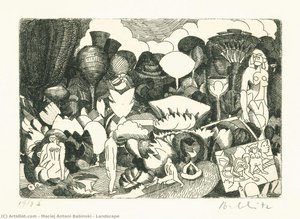
In the evocative black and white drawing Anápolis, created in 1965 by the Polish master Maciej Antoni Babinski, we are invited into a space where the boundaries between domestic reality and psychological depth dissolve. The composition centers on a woman standing before a window, her arms outstretched in a gesture that oscillates between profound longing and a desperate reach for connection. This singular movement serves as the emotional anchor of the piece, drawing the viewer's eye toward the threshold between the interior sanctuary and the unknown world outside. Through his meticulous use of line and shadow, Babinski transforms a seemingly mundane domestic scene into a stage for existential inquiry, making this work an irresistible centerpiece for those who appreciate art that speaks to the complexities of the human condition.
The setting is a dense, lived-in environment, where every object tells a story of shared existence and quiet accumulation. A dining table sits near the heart of the room, surrounded by chairs and a simple bowl, suggesting the rhythms of daily life and communal gathering. Yet, amidst this domesticity, there is an underlying tension characteristic of Babinski’s fascination with Freudian psychoanalysis. The presence of scattered books, bottles, and vases, alongside a bed tucked into the periphery, creates a layered narrative of a space that serves as both a refuge and a site of psychological struggle. For the collector or interior designer, this piece offers a sophisticated layer of storytelling, providing a focal point that encourages contemplation and invites guests to linger on its intricate details.
Technically, Anápolis showcases Babinski’s mastery of the graphic medium. The absence of color forces a reliance on contrast and texture, allowing the artist to sculpt form through light and dark. The interplay of shadows within the room creates a sense of depth and atmosphere, making the air itself feel heavy with unspoken thoughts. This stylistic choice aligns perfectly with the Polish Art Movement's emphasis on craftsmanship, yet it is infused with an experimental spirit that pushes toward abstraction and symbolism. The way the figures in the background interact—some seated, some engaged in quiet activity—creates a rhythmic complexity that mirrors the "ruffled" and intense themes found throughout Babinski’s oeuvre.
To possess a reproduction of Anápolis is to bring a piece of mid-century psychological exploration into a modern living space. It is an artwork that transcends mere decoration, acting instead as a window into the subconscious. Whether placed in a quiet study, a minimalist gallery wall, or a richly textured living room, the drawing provides a profound emotional resonance. It serves as a reminder of our shared human impulses: the desire to reach out, the need for sanctuary, and the beautiful, haunting complexity of the lives we lead within our own private worlds.
Artist Biography
A Journey Through the Psyche: The Life and Art of Maciej Antoni Babinski
The life of Maciej Antoni Babinski is a profound testament to the transformative power of displacement and the enduring resilience of the human spirit. Born in 1931 in Poznań, Poland, his early years were shaped by the turbulent winds of mid-century Europe. The onset of World War II forced his family into migration toward England, an experience that would later serve as a foundational layer in his artistic consciousness. This period of wandering and resettlement—moving from the United Kingdom to Montreal, Canada, and eventually to Brazil—did more than just alter his geography; it expanded the very boundaries of his creative vocabulary. Each new landscape and culture acted as a catalyst, infusing his work with a unique blend of European tradition and New World experimentation.
As Babinski settled into his artistic practice, he emerged not merely as a painter or engraver, but as a visual philosopher. His early training in Poland provided him with a rigorous command of classical techniques, yet it was his encounter with the diverse artistic currents of the mid-20th century that truly defined his voice. In Canada, he engaged with the abstract movements surrounding Paul-Émile Borduas, while his long residency in Brazil allowed him to commune with the graphic intensity of masters like Augusto Rodrigues and Oswaldo Goeldi. These varied influences coalesced into a style that remains strikingly singular: a fusion of surrealism and expressionism that seeks to map the uncharted territories of the human subconscious.
The Architecture of Emotion and Symbolism
To encounter a work by Babinski is to enter a space where the boundaries between reality and dream dissolve. His oeuvre is characterized by an intense preoccupation with psychological depth, often utilizing the stark contrasts of black and white to evoke a sense of existential tension. He masterfully employs line and form not just to represent subjects, but to communicate internal states of being. Whether through his hauntingly detailed etchings or his vibrant, abstract watercolors, there is a palpable sense of movement and unrest. His use of distortion is never arbitrary; rather, it serves as a deliberate tool to amplify the emotional weight of his compositions, inviting the viewer to confront the complexities of fear, longing, and identity.
The symbolism within his work often draws from archetypal imagery, creating a bridge between personal experience and universal truth. His pieces frequently feature:
- Psychological Tension: The use of crowded or claustrophobic spaces to mirror the internal struggles of the human mind.
- Natural Metaphors: Landscapes and botanical elements that serve as vessels for deeper, often unsettling, symbolic meanings.
- The Human Figure: Portraits and figures that are often "ruffled" or distorted, capturing the raw, unvarnished essence of emotion.
Legacy and Historical Significance
Babinski’s career is marked by both immense creative achievement and the profound impact of political upheaval. His time teaching at the Central Institute of Arts in Brasília was tragically interrupted by political persecution, forcing him to relocate once again within Brazil. Despite these disruptions, his commitment to the pedagogical and artistic community remained steadfast, as seen in his influential tenure at the Federal University of Uberlândia. This period of academic service ensured that his mastery of engraving, illustration, and painting would be passed down to subsequent generations of artists.
Today, the historical significance of Maciej Antoni Babinski lies in his ability to synthesize a globalized perspective into a deeply personal artistic language. His works are not merely artifacts of Polish or Brazilian art history; they are universal explorations of the psyche. From the prestigious collections of the Musée des Valeurs du Banque Central du Brésil to the halls of the Blanton Museum of Art, his legacy continues to resonate. He remains a vital figure for anyone seeking to understand how the movement of a life across continents can result in an art that speaks to the permanent, unmoving truths of the human condition.

maciej antoni babinski
1931 - , Poland
Quick Facts
- Artistic Movement Or Style: Psychological Drawings
- Date Of Birth: 1931
- Full Name: Maciej Antoni Babinski
- Nationality: Polish
- Notable Artworks:
- Eden
- Figures and Animals
- No Title
- Place Of Birth: Poznań, Poland
Related Articles

White on Canvas: 10 Masterpieces & Timeless Elegance for Your Home Decor
Explore 10 iconic white paintings by Monet, Whistler & Rothko! Discover the stories behind these serene masterpieces and their impact on art history. Find museum-quality reproductions for your home decor at .

Dark Masterpieces: 10 Iconic Paintings Dominated by Black Tones |
Explore 10 iconic paintings dominated by black tones, from Rembrandt’s chiaroscuro to Goya's dark expressions. Discover the stories behind these masterpieces & find museum-quality art reproductions for your home at .

Monochrome Visions: Exploring the Aesthetic & Historical Significance of Black & White Photography
Explore the rich history & artistic power of black and white photography. From early techniques to iconic masters like Ansel Adams, discover why monochrome continues to captivate art lovers today. Expert insights for collectors.
Shadow & Soul: Why Black & White Photography Remains the Ultimate Power Move in Modern Art
Discover why black & white photography remains a powerful force in contemporary art. Explore the impact of light, shadow, and texture through a visual journey of monochrome mastery and learn how to elevate your space with timeless grayscale aesthetics.
Mars Black Masterpieces: 10 Iconic Paintings & Timeless Art Decor Ideas
Delve into the power of 'Mars Black' with 10 iconic paintings by masters like Rembrandt & Caravaggio. Explore dramatic chiaroscuro, gothic art, and timeless beauty. Find museum-quality reproductions & elevate your home decor on .