Preview
 Send
Send Share
Share
 Details

 Download
 Similars
 X-Ray
X-Ray Diaporama
 Stats
StatsDawn
 Read More
Giclée / Art Print
Museum-quality giclée or canvas print with fast production and flexible finish options. ( Buy Hand Made Painting Switch to Digital Image)




































Pick from our preset sizes that match the artwork's original proportions.

You may enter your own dimensions to fit a specific frame or space. If your selected size does not match the original image's proportions, we will either crop the artwork or extend the image with a mirrored or solid-fill edge. A digital mockup will be sent for your approval before production begins.
Please note that the on-screen preview does not reflect the actual cropping or extension. Only the mockup will accurately show the final composition.
While custom sizes are available, we recommend selecting a dimension from the predefined list to preserve the original proportions.
Worldwide Delivery () in 2 weeks instead of standard 4/5 weeks. (13 September)

Free Worldwide Express Shipping

High-Quality Linen Canvas

Full Shipping Insurance

Customs Tax Refund Guarantee

True Color Matching Guarantee

100-Day Return Policy (Defects Only)

100% Money-Back Guarantee

Bulk Discount Offer
 Glass option is only available in size under 110 CM

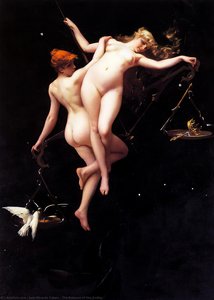
Dawn
Giclée / Art Print
Reproduction Size
-


Total Price
$ 81
Artist Biography
A Life Painted in Dreams: The Enigmatic World of Luis Ricardo Falero
Luis Ricardo Falero, a name perhaps less familiar than those of his contemporaries, nevertheless occupies a fascinating and unique space within the landscape of 19th-century art. Born in Granada, Spain, in 1851, Falero’s life was one of unexpected turns, intellectual curiosity, and a captivating artistic vision that blended academic skill with a distinctly romantic sensibility. His journey began not amidst easels and palettes, but on the deck of a Spanish naval vessel. This early foray into maritime life proved unfulfilling, a stark contrast to the burgeoning passion for art that simmered within him. Defying his parents’ expectations, he embarked on a remarkable pilgrimage – walking from Spain to Paris, a testament to his unwavering dedication and artistic ambition. It was in Paris that Falero truly began to forge his path, immersing himself in formal studies while simultaneously pursuing interests in the burgeoning fields of chemistry and mechanical engineering. This unusual combination of disciplines would profoundly shape his artistic output, imbuing it with both technical precision and a sense of otherworldly wonder.The Intersection of Science and Sensibility
Falero’s scientific pursuits weren't merely diversions; they were integral to his creative process. The practical experiments demanded by chemistry and engineering proved hazardous, ultimately leading him to prioritize painting as his sole vocation. However, the analytical mindset cultivated through these studies remained, influencing how he approached composition, light, and form. He studied under Gabriel Ferrier in Paris before continuing his education in London, which would become his adopted home. It was here that Falero’s artistic style truly blossomed, reflecting a synthesis of academic training and scientific fascination – particularly with astronomy. This celestial obsession permeated his work, manifesting as constellations woven into the fabric of his compositions, most notably in pieces like “The Marriage of a Comet” and “Twin Stars.” He wasn't simply depicting stars; he was exploring their symbolic weight, their connection to mythology, and their place within the grand cosmic order. His engagement with astronomy extended beyond personal inspiration, leading to collaborations illustrating the writings of Camille Flammarion, a prominent French astronomer, further solidifying the unique intersection of art and science that defined his oeuvre.Mythology, Fantasy, and the Allure of the Exotic
Falero’s paintings are characterized by an ethereal quality, often depicting female figures within lush, dreamlike landscapes steeped in mythology and exoticism. He possessed a remarkable ability to capture both the physical beauty and the inner life of his subjects, imbuing them with a sense of mystery and allure. Works like “Lily Fairy” (1888) exemplify this talent – a captivating depiction of a fairy amidst vibrant flora, radiating an enchanting energy. "Moon Nymph" (1883) showcases his skill in portraying graceful, otherworldly figures, while “The Enchantress” (1878) reveals a more mystical and seductive side to his artistic vision. Even pieces like “Muse of the Night,” also known as “The Witches Sabbath”, demonstrate a darker, more dramatic range, proving Falero’s versatility and willingness to explore complex themes. He wasn't merely illustrating stories; he was creating immersive worlds that invited viewers to lose themselves in realms of fantasy and imagination. His use of color, light, and shadow contributed to this effect, creating an atmosphere of both sensuality and spiritual depth.A Complex Legacy
Falero’s personal life, however, was not without its shadows. In 1896, he found himself embroiled in a paternity suit brought by Maud Harvey, who alleged seduction as a minor and subsequent abandonment upon discovering her pregnancy. The case garnered public attention, revealing a more complicated side to the artist's character. Tragically, Falero died at University College Hospital in London later that same year, at the young age of 45, leaving behind an estate valued at £1,139. His widow, Maria Cristina Spinelli, served as his executrix. Despite the controversies surrounding his final years, Luis Ricardo Falero’s artistic legacy endures. Though not a household name today, he occupies a significant niche within 19th-century art history. He represents a compelling fusion of artistic skill, scientific curiosity, and orientalist fantasy – a glimpse into a world where mythology, astronomy, and sensuality converge. His paintings continue to captivate viewers with their beauty, mystery, and intellectual depth, offering a unique window into the Victorian era’s fascination with both the tangible and the intangible. While his works are primarily held within private collections, pieces like the watercolour of ‘Twin Stars’ at the Metropolitan Museum of Art serve as enduring reminders of this remarkable artist's vision.
luis falero
1851 - 1896 , Spain
Quick Facts
- Artistic Movement Or Style: Orientalism, Symbolism
- Artists Who Influenced This Artist:
- Gabriel Ferrier
- Camille Flammarion
- Date Of Birth: 1851
- Date Of Death: 1896
- Full Name: Luis Ricardo Falero
- Nationality: Spanish
- Notable Artworks:
- Lily Fairy
- Moon Nymph
- The Enchantress
- Muse of the Night
- Place Of Birth: Granada, Spain