Text size
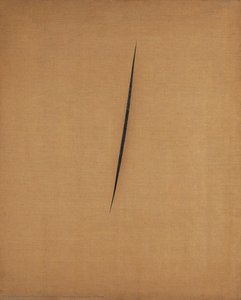
Spatial Concept by Lucio Fontana, oil on linen painted by hand

() ·

A painting made for you, by hand

Spatial Concept (Lucio Fontana, 1957) An oil painting, painted by hand for you alone

Oil painting, hand-painted for you

Hand-painted oil on canvas in your size and frame, made to order by our artists. ( Oil Edition )

Painted by hand in oil for you from $200 at 37 x 27 cm

Spatial Concept by Lucio Fontana, and what makes this piece singular

A large brown circle with scattered dots and thick impasto texture, creating a sense of infinite depth against a dark grey background.

Lucio Fontana: biography

Argentine-born Italian Spatialist known for slashed canvases and punctured portals into the void that bridge two-dimensional art and real space.

from $200 ·

Chapter 1

How large should it be?

Slide to change the size; the picture on the left shows the frame at its real width. The proportions of the original are kept.

Pick from our preset sizes that match the artwork's original proportions.

width
height

Type the width and the height you need, to fit your frame or your wall. This is hand-painted, so for a size with a different shape the artist can paint a bit more around the picture, or cut a bit — you choose. We send you a digital mockup to approve before the painting starts. The picture shown on this page does not show the real result — only the mockup does.

Standard
custom
CM
INCH

Chapter 2

How should it arrive?

Choose the edges of the stretched canvas

Choose your frame

Corner sample of the WhiteWrap canvas edge finish, stretched on solid wood bars
White $1
Corner sample of the BlurSideWrap canvas edge finish, stretched on solid wood bars
Blurside $1
Corner sample of the ExtendedWrap canvas edge finish, stretched on solid wood bars
Extended $1
Corner sample of the P118B picture frame: moulded polystyrene, 5 cm wide and 3 cm thick
P118B $10
Corner sample of the P118H picture frame: moulded polystyrene, 5 cm wide and 3 cm thick
P118H $10
Corner sample of the P118W picture frame: moulded polystyrene, 5 cm wide and 3 cm thick
P118W $10
Corner sample of the P438Z picture frame: moulded polystyrene, 5.5 cm wide and 3.5 cm thick
P438Z $10
Corner sample of the P508JH picture frame: moulded polystyrene, 7 cm wide and 3.5 cm thick
P508JH $12
Corner sample of the P508YH picture frame: moulded polystyrene, 7 cm wide and 3.5 cm thick
P508YH $12
Corner sample of the P805H picture frame: moulded polystyrene, 5 cm wide and 3.5 cm thick
P805H $10
Corner sample of the P805Z picture frame: moulded polystyrene, 5 cm wide and 3.5 cm thick
P805Z $10
Corner sample of the P919BZ picture frame: moulded polystyrene, 7 cm wide and 3.5 cm thick
P919BZ $10
Corner sample of the P919G picture frame: moulded polystyrene, 7 cm wide and 3.5 cm thick
P919G $10
Corner sample of the P919XJ picture frame: moulded polystyrene, 7 cm wide and 3.5 cm thick
P919XJ $10
Corner sample of the P959ZH picture frame: moulded polystyrene, 5 cm wide and 3 cm thick
P959ZH $10
Corner sample of the P968JZ picture frame: moulded polystyrene, 6 cm wide and 4 cm thick
P968JZ $12
Corner sample of the W106C picture frame: solid wood, 5 cm wide and 3 cm thick
W106C $8
Corner sample of the W218G picture frame: solid wood, 5 cm wide and 3 cm thick
W218G $10
Corner sample of the W218JH picture frame: solid wood, 5 cm wide and 3 cm thick
W218JH $8
Corner sample of the W218Y picture frame: solid wood, 5 cm wide and 3 cm thick
W218Y $10
Corner sample of the W307PJ picture frame: solid wood, 6 cm wide and 3 cm thick
W307PJ $10
Corner sample of the W316G picture frame: solid wood, 6 cm wide and 3 cm thick
W316G $10
Corner sample of the W316PJ picture frame: solid wood, 6 cm wide and 3 cm thick
W316PJ $8
Corner sample of the W316Y picture frame: solid wood, 6 cm wide and 3 cm thick
W316Y $10
Corner sample of the W398PJ picture frame: solid wood, 5 cm wide and 3 cm thick
W398PJ $8
Corner sample of the W4111J picture frame: solid wood, 6.5 cm wide and 3.5 cm thick
W4111J $10
Corner sample of the W500HY picture frame: solid wood, 7 cm wide and 5 cm thick
W500HY $15
Corner sample of the W500JH picture frame: solid wood, 7 cm wide and 5 cm thick
W500JH $15
Corner sample of the W692G picture frame: solid wood, 8 cm wide and 4 cm thick
W692G $12
Corner sample of the W849H picture frame: solid wood, 5 cm wide and 3 cm thick
W849H $8
Corner sample of the W940BG picture frame: solid wood, 7.5 cm wide and 4.5 cm thick
W940BG $15
Corner sample of the W953PJ picture frame: solid wood, 6 cm wide and 3.5 cm thick
W953PJ $8
Corner sample of the H24-GOLD picture frame: carved wood with gesso, 10 cm wide and 6 cm thick
H24-GOLD $30
Corner sample of the H24-SILVER picture frame: carved wood with gesso, 10 cm wide and 6 cm thick
H24-SILVER $30
Corner sample of the H36-GOLD picture frame: carved wood with gesso, 15 cm wide and 6.5 cm thick
H36-GOLD $45
Corner sample of the H36-SILVER picture frame: carved wood with gesso, 15 cm wide and 6.5 cm thick
H36-SILVER $45
Frame preview
Framed

Moulding: . Overall size with the frame: .

Chapter 3

Who paints it, and should anything change?

Examples of what can be changed: Replace face with customer photo; Add pet (e.g., replace cat with dog); Include hidden message in background; Change background landscape or elements.
After order, OriginalUniqueArt.com team will email client for instructions and provide a mockup preview

Chapter 4

Worldwide Delivery () in 3/4 weeks instead of standard 4/5 weeks. (5 December). No compromise on quality.

The finishing touches

A nameplate, as in a museum?

Engraved Bronze Plaque Details

This elegant plaque features the artist's name and the title of the artwork, finely engraved for a timeless presentation.

It is made from bronze with a refined, elegant finish. The text is precisely laser-engraved for a sharp and permanent result. Measuring 9x2 cm, the plaque is compact yet easy to read. It's built to be durable and scratch-resistant, offering a professional, museum-quality look. Mounting is simple thanks to the included adhesive backing.

Transparent Acrylic Plaque Details

The plaque includes essential engraved details such as the artist's name, the title of the artwork, the date it was created, the type of media used-like oil on canvas or watercolor-a brief description of the piece, and a QR code that links to the complete artwork information.

It is crafted from clear acrylic, offering a sleek, modern appearance. The text is UV-engraved in black to ensure strong visual contrast. With a size of 10x15 cm, it ensures optimal readability. It comes equipped with two metal hooks for secure wall mounting. The plaque is designed to be weather-resistant, making it suitable for various environments, and it includes interactive features that work seamlessly with smartphone scanning.

Black Acrylic Plaque Details

This elegant plaque includes engraved information such as the artist's name, the title of the artwork, the date it was created, the type of media used (like oil on canvas or watercolor), a short description of the artwork, and a QR code for quick access to more information.

The plaque itself is made from refined black acrylic with a premium finish. The text is laser-engraved in white for high contrast and readability. Its size is 10x15 cm, designed to be easy to read. It comes with two metal hooks for professional mounting. The design is sleek and fits any interior style. It is also weather-resistant and durable, with built-in digital integration for mobile compatibility.

A protective varnish?

When do you need it?

Chapter 5

Your painting, as you ordered it

Spatial Concept

Reproduction Medium

Reproduction Size

-

Elite Senior Artist

More detail, finesse, and extra production time

-

Reproduction Frame

-

-

For artworks or reproductions larger than 105 cm (approximately 41 inches) on any side, the frame will be shipped as a kit, disassembled. This method ensures safe delivery and prevents damage during transport.

Professional assembly required - this is not a DIY product.
The kit must be assembled and the canvas stretched by an experienced professional framer, using wood glue (not supplied), a canvas stretching plier and clamps to hold the bars square while the glue dries. Incorrect assembly or uneven canvas tension can permanently damage the artwork and is not covered by our warranty.

  • All solid wood bars are included, precisely cut to size.

  • Assembled with the screws provided, plus wood glue for the corner joints, which is not supplied and must be sourced by your framer.

  • Professional tools are required and not included: a canvas stretching plier (tensioner) and clamps to hold the bars square while the glue dries.

Important:
The corner joints require wood glue, the bars must be held with clamps until the glue is fully dry, and tightening the canvas on the assembled frame requires a canvas stretching plier. None of these are included in the kit. Please arrange an experienced professional framer before ordering this size.

Nameplate

-

-

Protective Varnish

Glossy Varnish (enhances colors, protects against light/moisture)

-

Customize My Artwork

Examples of what can be changed: Replace face with customer photo; Add pet (e.g., replace cat with dog); Include hidden message in background; Change background landscape or elements.

-

Urgent

Worldwide Delivery () in 3/4 weeks instead of standard 4/5 weeks. (5 December). No compromise on quality.

-

Express Shipping

Worldwide Delivery () in 4/5 weeks. (12 December).

Included

Total Price

$ 300

Total Price $ 300

Glass option is only available in size under 110 CM

Included with every order

  • Free Worldwide Express Shipping
  • High-Quality Linen Canvas
  • Full Shipping Insurance
  • Customs Tax Refund Guarantee
  • True Color Matching Guarantee
  • 100-day returns, money back
  • 100% Money-Back Guarantee
  • Bulk Discount Offer

The Creation of Spatial Concept

In 1957, Lucio Fontana brings a radical new dimension to the canvas with Spatial Concept. The artist, an Argentine-born Italian sculptor, painter, and theorist, works with a profound understanding of physical matter. Born in Rosario, Argentina, in 1899, Fontana carries a sculptor's sensibility into this moment of creation. He approaches the surface not as a window to a scene, but as a site for direct action. The air around the work feels heavy with the intent to break through the traditional boundaries of the two-dimensional plane.

The act of making Spatial Concept involves a deliberate confrontation with the material. Lucio Fontana moves beyond the simple application of pigment to engage with the very essence of space. Every gesture is a response to the tension between the solid surface and the void that lies beneath. This work emerges from a life spent navigating the intersection of different worlds, from the technical discipline of sculpture to the theoretical reaches of Spatialism. The canvas becomes a threshold, a place where the artist's hand meets the infinite.

Composition and Visual Elements

A large, roughly circular form dominates the visual field, commanding attention through its sheer presence. This shape sits slightly above the vertical center, creating a sense of weight and balance that pulls the eye toward its core. The edges of the circle are not perfectly geometric; instead, they appear organic and slightly irregular, suggesting a hand-wrought quality that defies machine-made precision. This central form emerges from a uniform background of dark grey and black, a void that pushes the circle forward into the viewer's immediate space.

The color palette remains strictly monochromatic, relying on subtle tonal shifts rather than a variety of hues. Shades of brown and grey interact across the surface of the circle, creating a quiet, atmospheric depth. Scattered across this circular expanse are numerous small dots. These points of light disrupt the continuity of the form, appearing like distant stars or punctures in a solid surface. The interplay between the dark, receding background and the textured, light-catching dots creates a rhythmic tension, making the entire composition feel as though it is suspended in a silent, cosmic expanse.

Technique and Material Application

The physical presence of the work emerges from a deliberate layering of mixed media on canvas. Using wood as a support, the artist builds a surface that feels deeply tangible. Thick applications of paint create a heavy impasto, resulting in visible ridges that catch the light and shadow. This tactile quality transforms the canvas from a flat plane into a rugged, sculptural landscape. Every stroke carries a sense of weight and intention.

Precision meets raw energy in the way the paint is applied. The artist layers the material with a controlled hand, yet the resulting textures remain visceral. Small dots are scattered across the circular form, disrupting the tonal gradations of the brown and grey hues. These marks interrupt the surface, adding a rhythmic complexity to the impasto. The interplay between the smooth transitions of color and the raised, physical ridges invites a close, sensory examination of the material itself.

The Artistic Vision of Spatialism

The air shifts as we confront the core of Spatialism, a movement Fontana established in 1947 to break the silence of the canvas. He no longer seeks to mimic the world through the old illusions of perspective. Instead, he reaches for something far more elusive. The movement strives to weave real space and time directly into the fabric of the work, moving beyond the flat, static surface to embrace the actual dimensions of the cosmos. It is a radical departure from traditional representation, where the goal is no longer to depict a scene, but to engage with the universe that exists beyond our immediate perception.

In this vision, the canvas becomes a threshold. By puncturing the boundary between the seen and the infinite, the artist invites a confrontation with the void. There is a sense that the work is not merely a surface to be looked at, but a portal to be entered. This pursuit of the unknown mirrors the scientific shifts of a changing era, seeking to capture the very essence of space itself. The artist's hand moves with a purpose that transcends mere decoration, aiming instead to touch the intangible reality of the vacuum.

Related Works by Lucio Fontana

The artist’s restless exploration of the void continues through various iterations of his spatial investigations. In the Boschi Di Stefano House Museum in Milan, one finds two earlier versions of this concept, one from about 1955 and another from 1956. These works exist as part of a vast output that includes over 200 pieces from the Buchi and Tagli series, produced between 1949 and 1968. Each piece acts as a physical rupture, a moment where the canvas ceases to be a mere surface and becomes a threshold.

The evolution of his technique leads into the Olii series, which the artist worked on between 1957 and 1968. Here, the interaction between thick, pigmented oil paint and deliberate incisions creates a sense of depth that feels almost liquid. In other moments, the geometry of the work shifts, as seen in the Concetto spaziale, La Fine di Dio (1963–64), where the canvas takes on an egg shape, further challenging the traditional rectangular boundaries of the medium.

Where to See This Artwork

The presence of Spatial Concept remains anchored in the heart of Milan, Italy. It resides within the walls of the Boschi Di Stefano House Museum, a space that has curated its collections since 2003. Visitors find themselves in a setting where the physical weight of history meets the quietude of modern thought. The museum holds approximately 300 works, creating an environment where one might encounter the echoes of various artistic movements through the decades.

Walking through this Milanese institution, the atmosphere invites a slow encounter with the objects on display. The museum provides a specific context for this work, placing it among a gathered assembly of art that reflects the evolving language of form and space. It is a place where the stillness of the gallery allows the viewer to confront the direct, physical reality of the canvas and the voids it contains.

Questions & Answers

Is this Spatial Concept painted by hand or printed?

Painted by hand: a trained painter copies Spatial Concept in oil on linen canvas.

What size should I choose for Spatial Concept?

The original measures 180 x 97 cm. Sizes run from 36.6 x 27.3 cm ($200) to 243.6 x 182.0 cm ($1640); the table on this page lists the main steps and their prices.

How long does delivery take?

Delivery takes 4 to 5 weeks, with free worldwide express shipping; an urgent production option is offered on this page. You can return it within 100 days for a full refund, with no condition.

Where is the original Spatial Concept?

The original is in the collection of the Boschi Di Stefano House Museum, Milan.

What medium did Lucio Fontana use for Spatial Concept?

Mixed Media.

More about this painting

Preview AR preview Oil Edition Send
Details Fact sheet Add to favorites Download Similars X-Ray Diaporama Q&A Presentation Stats

In numbers

  • 1957the year it was painted
  • 29frames to choose from
  • standard sizes, in its own proportions
  • 5weeks to paint and deliver it

About the original

Dimensions
180.0 x 97.0 cm
Lucio Fontana

Lucio Fontana

1899 - 1968, Argentina

Quick facts about Lucio Fontana

  • Artistic Movement Or Style: Spatialism
  • Artists Or Movements Influenced By This Artist:
    • Minimalism
    • Arte Povera
    • Zero
    • Nouveau Réalisme
  • Artists Who Influenced This Artist:
    • Vincent van Gogh
    • Pieter Bruegel the Elder
    • Jan Grzegorz Stanisławski
  • Full Name: Lucio Fontana
  • Nationality: Argentine-born Italian
  • Notable Artworks:
    • Busto femminile
    • Uomini a cavallo
    • Signorina seduta
    • Il fiocinatore
    • Spatial Concept

    • Concetto spaziale (La notte)
    • Soffitto spaziale
    • View of
    • I quanta
    • Teatrino
    • Space Concept, Waiting
  • Place Of Birth: Rosario, Argentina
  • Date Of Birth: 1899
  • Date Of Death: 1968

Quick Facts

  • Date: 1957
  • Medium: Mixed Media
  • Dimensions: 180 x 97 cm
  • Year: 1957
  • Influences: Futurism
  • Artist: Lucio Fontana
  • Notable elements or techniques: Holes; Vertical perforations
  • Location: Private collection, Milan
  • Title: Spatial Concept

Quiz

There is only one correct answer for each question.

Question 1:
In which year was the artwork "Spatial Concept" created?
Question 2:
Where was the artist Lucio Fontana born?
Question 3:
What is the primary technique used in the central circle of the painting?
Question 4:
Which movement did Lucio Fontana found?
Question 5:
What is the size of the artwork "Spatial Concept"?