

 Preview
 Send
Send Share
Share
 Details

 Download
 Similars
 X-Ray
X-Ray Diaporama
Courtyard


 Read More
Giclée / Art Print
Museum-quality giclée or canvas print with fast production and flexible finish options. ( Switch to hand made Painting Switch to Image)




































Pick from our preset sizes that match the artwork's original proportions.

You may enter your own dimensions to fit a specific frame or space. If your selected size does not match the original image's proportions, we will either crop the artwork or extend the image with a mirrored or solid-fill edge. A digital mockup will be sent for your approval before production begins.
Please note that the on-screen preview does not reflect the actual cropping or extension. Only the mockup will accurately show the final composition.
While custom sizes are available, we recommend selecting a dimension from the predefined list to preserve the original proportions.
Worldwide Delivery () in 2 weeks instead of standard 4/5 weeks. (11 August)

Free Worldwide Express Shipping

High-Quality Linen Canvas

Full Shipping Insurance

Customs Tax Refund Guarantee

True Color Matching Guarantee

60-Day Return Policy (Defects Only)

100% Money-Back Guarantee

Bulk Discount Offer
 Glass option is only available in size under 110 CM

Courtyard
Giclée / Art Print
Reproduction Size
-


Total Price
$ 81
Artist Biography
Jean Fouquet: A Pioneer of Portraiture and Renaissance Innovation
Jean Fouquet, a figure shrouded in intriguing mystery, stands as one of the most pivotal artists of early 15th-century France. Born around 1420 in Tours and dying in 1481, he wasn’t merely a painter; he was a revolutionary who fundamentally altered the course of European art by pioneering portraiture and introducing Italian Renaissance techniques to a French audience. While much about his life remains elusive – his early training is debated, with theories suggesting influences from both the Van Eycks in Bruges and the Master of Flémalle in Ghent – Fouquet’s impact on subsequent generations of artists is undeniable.
Fouquet's career unfolded against a backdrop of intense political and social change. The Hundred Years’ War was still raging, and France was grappling with establishing its own distinct identity amidst the influence of England. This context profoundly shaped his work, particularly his commissions for the French court under kings Charles VII and Louis XI. He wasn’t simply producing devotional images; he was actively participating in a deliberate effort to solidify national pride through art, as evidenced by his iconic portrait of Charles VII, a rare depiction of a reigning monarch during that era.
Fouquet's artistic style is characterized by a remarkable synthesis of Northern European and Italian Renaissance elements. He inherited the meticulous detail and rich colors of the Flemish masters, particularly in his panel paintings, but he also embraced the innovations of the burgeoning Italian Renaissance – linear perspective, atmospheric modeling, and a heightened sense of realism. His works are distinguished by their elegant compositions, refined drapery, and subtle use of light and shadow, creating an illusionistic depth rarely seen in contemporary French art. He was a master of capturing fleeting expressions and conveying psychological nuance, particularly evident in his portraits.
The Development of Portraiture
Perhaps Fouquet’s most significant contribution to the history of art lies in his development of portraiture as a distinct genre. Before him, depictions of individuals were largely confined to religious or allegorical contexts. Fouquet, however, began creating intimate and individualized portraits that captured the likenesses of prominent figures – courtiers, diplomats, and even members of the royal family. These weren’t simply formal representations; they possessed a remarkable degree of psychological insight, revealing the personalities and character of their subjects.
His most famous portrait, the depiction of Charles VII, exemplifies this innovation. The painting is not merely a likeness but a carefully constructed image designed to project an aura of authority and legitimacy. Fouquet skillfully employed techniques such as sfumato – a subtle blurring of outlines – to create a sense of depth and volume, while his use of color and composition contributes to the overall impression of regal dignity. This portrait marked a crucial shift in artistic practice, paving the way for future generations of portraitists.
Techniques and Influences
Fouquet’s technical skill was exceptional, reflecting a deep understanding of both Flemish and Italian painting traditions. He mastered the use of oil paint, which allowed him to achieve greater luminosity and subtlety than tempera, a medium commonly used at the time. His meticulous attention to detail is evident in his rendering of fabrics, jewelry, and facial features – all rendered with astonishing precision.
His artistic journey was profoundly shaped by his travels to Italy. During this period, he encountered the works of masters such as Fra Angelico and Filarete, absorbing their innovative techniques and stylistic approaches. He skillfully integrated these influences into his own work, creating a unique synthesis that distinguished him from his contemporaries. The influence of Italian perspective is particularly noticeable in his later paintings, where he employed linear perspective to create a more realistic sense of space.
Legacy and Historical Significance
Despite the challenges of reconstructing his life and career, Jean Fouquet’s legacy as one of the most important artists of the early 15th century is firmly established. He was a pioneer in portraiture, introducing a new level of psychological realism to European art. His innovative use of perspective and his synthesis of Northern and Italian artistic traditions profoundly influenced subsequent generations of painters, including those who would later contribute to the development of the Renaissance.
Fouquet’s work stands as a testament to the dynamism and creativity of early 15th-century France. He was not merely a painter; he was an artist who helped shape the cultural landscape of his time, leaving behind a body of work that continues to fascinate and inspire art historians today. His contributions are often overlooked in favor of more prominent figures of the Renaissance, but his influence on the development of portraiture and European painting is undeniable.
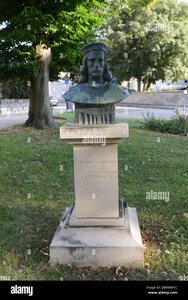
luciano laurana
1420 - 1479 , Italy
Quick Facts
- Artistic Movement Or Style: Early Renaissance
- Artists Or Movements Influenced By This Artist:
- Fra Angelico
- Masaccio
- Artists Who Influenced This Artist:
- Van Eycks
- Lorenzo Monaco
- Date Of Birth: c. 1420
- Date Of Death: 1481
- Full Name: Jean Fouquet
- Nationality: French
- Notable Artworks:
- Portrait of a Young Man
- Haft Paykar copy
- Episodes from Lives
- Place Of Birth: Tours, France



