Preview
 Send
Send Share
Share
 Details
 Guide
Guide

 Download
 Similars
 X-Ray
X-Ray Diaporama
 Stats
StatsEcce Homo
 Engraving
- WallArt
- Northern Renaissance Engraving
 1510
1510- Early Modern
 287.0 x 452.0 cm
 Rijksmuseum
 Read More
Hand Made Oil Reproduction
Hand-painted oil on canvas in your size and frame, made to order by our artists. ( Switch to Print Switch to Digital Image)




P118B $10

P118H $10

P118W $10

P438Z $10

P508JH $12

P508YH $12

P805H $10

P805Z $10

P919BZ $10

P919G $10

P919XJ $10

P959ZH $10

P968JZ $12

W106C $8

W218G $10

W218JH $8

W218Y $10

W307PJ $10

W316G $10

W316PJ $8

W316Y $10

W398PJ $8

W4111J $10

W500HY $15

W500JH $15

W692G $12

W849H $8

W940BG $15

W953PJ $8




Pick from our preset sizes that match the artwork's original proportions.

Type the width and the height you need, to fit your frame or your wall. This is hand-painted, so for a size with a different shape the artist can paint a bit more around the picture, or cut a bit — you choose. We send you a digital mockup to approve before the painting starts. The picture shown on this page does not show the real result — only the mockup does.
After order, OriginalUniqueArt.com team will email client for instructions and provide a mockup preview
Worldwide Delivery () in 3/4 weeks instead of standard 5 weeks. (23 October). No compromise on quality.

Free Worldwide Express Shipping

High-Quality Linen Canvas

Full Shipping Insurance

Customs Tax Refund Guarantee

True Color Matching Guarantee

100-Day Return Policy (Defects Only)

100% Money-Back Guarantee

Bulk Discount Offer
 Glass option is only available in size under 110 CM

Ecce Homo
Reproduction Medium
Reproduction Size
-


Total Price
$ 625
The Drama Etched in Shadow: An Encounter with "Ecce Homo"
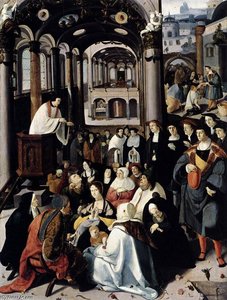
To stand before an engraving like Lucas van Leyden's "Ecce Homo" is to step directly into the charged atmosphere of history, rendered not in vibrant oils, but in the exquisite discipline of line. This monumental black and white depiction captures a moment of profound public spectacle—the presentation of Christ, or the Man, before a throng of onlookers. The sheer density of the crowd, clustered around an imposing architectural facade crowned by a detailed clock tower, creates an immediate sense of overwhelming human drama. It is a scene teeming with unspoken narratives; every gesture, every shadowed corner, whispers tales of judgment and spectacle.
Mastery in Monochrome: Technique and Texture
What elevates this piece beyond mere documentation is the breathtaking technical virtuosity displayed by Van Leyden. The artist has achieved an astonishing depth and richness using only ink scratched into metal. This was not a casual sketch; it was the meticulous work of the engraver, employing tools that allowed him to build form through countless fine lines. Observe how the texture of rough-hewn stone contrasts with the soft folds of drapery, all differentiated solely by the density of hatching and cross-hatching. The monochromatic palette forces the viewer's eye to focus entirely on composition, line quality, and tonal variation. It is a testament to the power inherent in restraint—a visual symphony played out across shades of gray.
Historical Echoes and Symbolic Weight
Dating from 1510, this work places us firmly within the Northern Renaissance, an era where religious fervor mingled with burgeoning humanism. The subject matter itself, "Ecce Homo," carries immense symbolic weight—the moment of public scrutiny before ultimate sacrifice. The architecture surrounding the central figures does more than simply set the scene; it acts as a monumental stage for fate. The crowd, so richly detailed, represents humanity in its totality: curiosity, judgment, awe, and indifference, all converging on one pivotal figure. For the modern collector or designer, this piece offers an unparalleled depth of contemplation—a reminder that even the grandest moments are built upon countless individual gazes.
Bringing the Drama Home: Reproduction for Your Space
Owning a reproduction of "Ecce Homo" is to invite a piece of historical gravitas into your contemporary living space. The original scale, suggested by its impressive dimensions, speaks to its monumental impact, making it a breathtaking focal point for an entryway hall or a grand study. While the subject matter is deeply religious, its aesthetic power—the dramatic contrast, the intricate pattern work, and the masterful use of negative space—allows it to function as high art decor. It provides intellectual depth without sacrificing visual drama, ensuring that your walls become not just surfaces, but curated narratives.
Questions & Answers
In which movement and which era is "Ecce Homo" by Lucas van Leyden placed?
"Ecce Homo" by Lucas van Leyden is placed in the Northern Renaissance Engraving movement, within the Renaissance era of its creator.
What orientation does "Ecce Homo" by Lucas van Leyden have?
The format of "Ecce Homo" is landscape. This is useful when planning where a reproduction will be placed.
What technique and style characterize "Ecce Homo" by Lucas van Leyden?
In "Ecce Homo", the engraving technique meets the Northern Renaissance Engraving movement.
Artist Biography
early life and training
lucas van leyden, a dutch painter and printmaker, was born in 1494 in leiden, netherlands. he was the son of huygh jacobsz, a painter, and began his artistic training under his father's guidance. later, he joined the workshop of cornelis engelbrechtsz in 1508, where he refined his skills.artistic development
lucas van leyden was among the first dutch exponents of genre painting and a highly accomplished engraver. his early work, characterized by half-length figures (c. 1506-1512), showcases his precocious originality. as he matured, his landscapes developed, and he became skilled in engraving at a remarkably young age. the earliest known print by him, mohammed and the murdered monk (1508), demonstrates his mastery of the medium.notable works and style
seventeen paintings surely attributed to lucas van leyden survive, including:- the healing of the blind man of jericho, a masterpiece showcasing multiple figures against wooded landscapes.
- saint paul, attr. leyden, exemplifying his engraving prowess.
- the milkmaid (engraving, 1510), highlighting his early skill in the medium.
museum collections and online presence
lucas van leyden's works can be found in various museums, including the van gogh museum (netherlands), which houses an extensive collection of his engravings and paintings. online platforms like OriginalUniqueArt.com offer a comprehensive selection of his works, allowing art enthusiasts to explore his oeuvre in detail.legacy
lucas van leyden's contributions to dutch genre painting and engraving are undeniable. his innovative style and technical skill have made him a celebrated figure in the art world. as a pioneer of dutch art, his legacy continues to inspire artists and art lovers alike.- view lucas van leyden's artworks on OriginalUniqueArt.com
- explore the van gogh museum (netherlands) collection online
- discover more about dutch art and its pioneers on OriginalUniqueArt.com's blog

Lucas van Leyden
1494 - 1533 , Netherlands
Quick Facts
- Full Name: Lucas Hugensz van Leyden
- Nationality: Dutch
- Date Of Birth: 1494
- Date Of Death: 1533
- Place Of Birth: Leiden, Netherlands
- Notable Artworks:
- The Healing of the Blind Man of Jericho
- Saint Paul
- The Milkmaid
- Artistic Movement Or Style: Early Netherlandish Renaissance
- Artists Who Influenced This Artist: ['Albrecht Dürer']
- Artists Or Movements Influenced By This Artist: ['German Renaissance']
Related Articles
Engraving's Golden Age: 10 Masterpieces That Redefined Art | OriginalUniqueArt
Journey through art history with our Top 10 Legendary Engravings! Explore masterpieces by Dürer, Rembrandt & Goya. Discover the stories behind these iconic prints and find museum-quality reproductions for your home at OriginalUniqueArt.com.

Early Netherlandish Masters: 10 Paintings That Revolutionized Art & Decor
Journey into the world of Early Netherlandish painting! Explore 10 masterpieces by Jan van Eyck, Rogier van der Weyden & more. Discover stunning detail, symbolism & Renaissance art for your home decor. Find museum-quality reproductions on OriginalUniqueArt.com

Lucas van Leyden: Innovation & Intimacy in Early Netherlandish Printmaking
Explore the groundbreaking prints of Lucas van Leyden, a Dutch master bridging Gothic detail & Renaissance innovation. Discover his rare works, investment potential, and legacy for discerning collectors.

Engraving: A Historical Survey of Technique, Artistic Expression & Enduring Legacy
Explore the rich history of engraving with OriginalUniqueArt. Discover techniques, iconic artists like Dürer & Callot, collecting tips, and expert guidance for preserving your art investment. Learn about intaglio printing & more!

Rembrandt's Masterpieces: Explore 25 Iconic Paintings & Prints | OriginalUniqueArt
Journey through Rembrandt van Rijn's 25 most iconic paintings & etchings. Explore Dutch Golden Age masterpieces, dramatic chiaroscuro, and timeless portraits. Find museum-quality art reproductions to elevate your home decor on OriginalUniqueArt.com.