
 Send
Send Share
Share
 Details
 Guide
Guide

 Download
 Similars
 Diaporama
 Stats
StatsVisitation
 Ceramics
- Early Renaissance Sculpture
 1445
1445- Renaissance
 184.0 x 153.0 cm
 San Giovanni Fuorcivitas
 Read More
Purchase a high-resolution, enhanced digital image, far superior to the online preview.
Each file is meticulously prepared by our in-house specialists using advanced tools and expert manual retouching. We ensure every image has exceptional clarity, precise color accuracy, and fine detail.
The final file is delivered via email within 72 hours, optimized for immediate use in professional, editorial, and print environments. This is the same quality trusted by top-tier design studios, publishers, and galleries.
Digital Image
Download a high-resolution file for personal display, printing, and creative projects. ( Switch to Print Buy Hand Made Painting)
Included in Every Digital Image Order
Expert Digital Delivery, Guaranteed
When you choose OriginalUniqueArt.com, you're not just getting an image - you're receiving a professionally enhanced digital artwork, crafted with precision and backed by a satisfaction guarantee. Here's everything that comes with your order, automatically:

Fast Email Delivery
Your high-resolution digital image file will be emailed to you within 72 hours of ordering - ready for immediate use.

AI-Enhanced Digital File
Your artwork is professionally optimized using advanced AI tools and manual editing, ensuring maximum detail, clarity, and color accuracy.

Free Lifetime Re-Delivery
Accidentally deleted or lost your file? No worries - we'll resend it to you anytime, free of charge.

No Import Fees - Ever
Enjoy your artwork instantly with zero customs, duties, or delivery fees - digital downloads are always tax-free.

Color Accuracy Guarantee
We ensure your digital image reflects the original colors as closely as possible using professional tools and color management.

100-Day Satisfaction Guarantee
If you're not satisfied with your digital image, we'll revise it or refund 100% within 100 days - no questions asked.

100% Money-Back Guarantee
Not satisfied? Get a full refund within 100 days of receiving your digital file - no questions asked.

Bulk Order Discounts
Buy 3 images, save 10% - Buy 5, save 15% - Buy 10+, save 20%. Great for creative projects, galleries, and agencies.
Luca della Robbia’s ‘Visitation’: A Testament to Florentine Grace
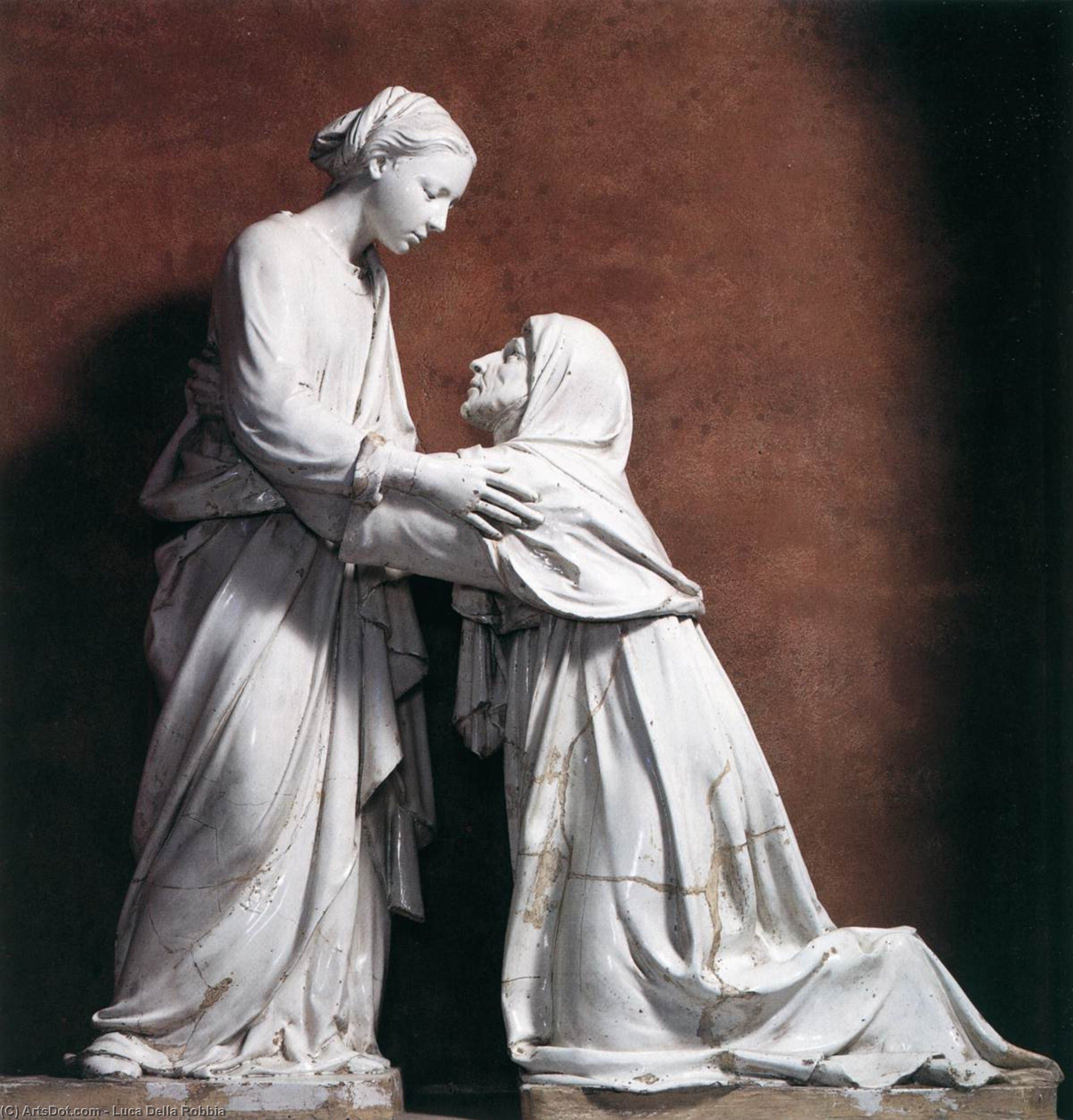
“Visitation,” dating back to 1445 and attributed to the masterful Luca della Robbia, offers a profound glimpse into the heart of Renaissance devotional art. This exquisite terracotta sculpture, measuring 184 x 153 cm, transcends mere representation; it embodies a moment of serene intimacy, capturing the essence of Mary’s visit to Elizabeth with an unparalleled sensitivity and technical brilliance. The scene unfolds with two figures – one kneeling in quiet contemplation, the other gently supporting her head – creating a tableau that speaks volumes about compassion, faith, and the profound connection between mother and child.
The Art of Terracotta: Della Robbia’s Innovation
Luca della Robbia's genius lay in his pioneering use of glazed terracotta. This technique, perfected over decades, involved meticulously molding clay into intricate forms, firing them within a kiln to achieve a durable structure, and then applying a vibrant glaze – typically in shades of white and cream – that created surfaces of remarkable smoothness and luminosity. The resulting effect is both tactile and visually arresting; the subtle variations in tone across the sculpture’s surface suggest depth and form, while the glazed finish imparts an ethereal quality, reminiscent of marble but with a uniquely warm character. Della Robbia's mastery was not merely technical; it was deeply rooted in humanist ideals, reflecting a desire to capture human emotion and beauty through a refined and accessible medium.
A Renaissance Narrative: Symbolism and Emotion
The composition of “Visitation” is laden with symbolic meaning. The gesture of support – the standing figure gently holding the kneeling woman’s head – represents divine grace, maternal compassion, and the unwavering loyalty between Mary and Elizabeth. The shallow perspective draws the viewer into the immediate interaction, emphasizing the tenderness and empathy that permeate the scene. Della Robbia's skill lies in his ability to translate complex religious narratives into emotionally resonant forms. The muted reddish-brown background further enhances the figures’ luminosity, directing our attention to their expressions of quiet reverence and profound connection. This work is a powerful testament to the Renaissance fascination with human emotion and its representation within sacred contexts.
Historical Context and Artistic Influence
Created in 1445, “Visitation” reflects the artistic climate of Florence during the early Renaissance. Luca della Robbia’s work builds upon the legacy of masters like Donatello and Ghiberti, yet he forged his own distinctive style – characterized by its refined elegance, graceful poses, and a profound understanding of human anatomy. His influence extended far beyond Florence, shaping terracotta sculpture traditions throughout Italy. This piece stands as a crucial example of della Robbia’s contribution to the development of Renaissance art, demonstrating his ability to synthesize classical ideals with humanist concerns and create works of enduring beauty and spiritual significance.
Questions & Answers
Can I see an X-ray view of "Visitation" by Luca della Robbia?
The X-Ray page of "Visitation" by Luca della Robbia is an interactive viewer that lets you slide through eleven optical layers of the artwork's image, including an X-ray style view.
What does "Visitation" by Luca della Robbia bring to an interior?
With its romantic mood, "Visitation" is suggested for a living room.
Which print setup is suggested for "Visitation" by Luca della Robbia?
For "Visitation", the recommended print setup is a large size and a square orientation.
Artist Biography
The Master of Glazed Earth: The Life and Legacy of Luca della Robbia
In the heart of the Florentine Renaissance, a period defined by the rebirth of classical ideals and the pursuit of anatomical perfection, Luca della Robbia emerged as a visionary who transformed the very medium of sculpture. While his contemporaries often sought glory in the heavy permanence of marble or the shimmering prestige of bronze, Luca found a profound, luminous beauty in the humble earth. His life, spanning from 1399 to 1482, was dedicated to the perfection of tin-glazed terracotta, a technique that would not only define his personal legacy but also provide a vibrant, colorful voice to the religious and civic landscapes of Italy.
Born into a lineage of skilled craftsmen in Florence, Luca’s early years were steeped in the rigorous traditions of the Florentine workshop. Though much of his formative period remains veiled by the mists of history, his artistic DNA was undeniably shaped by the giants of his era. He moved within the same intellectual and creative circles as Donatello and Ghiberti, absorbing the burgeoning humanist spirit that sought to marry Christian devotion with the grace of classical antiquity. His early associations, particularly his work on the monumental projects of the Florence Baptistry, allowed him to witness firsthand the evolution of naturalism—a movement toward capturing the subtle nuances of human emotion and the delicate textures of life.
Innovation in Color and Clay
The true genius of Luca della Robbia lay in his ability to innovate within a medium that was previously considered secondary to stone. By developing a specialized tin-glaze, he achieved a brilliant, weather-resistant finish that allowed for a striking palette of whites and blues. This technique, often referred to as della Robbia ware, brought an unprecedented luminosity to sculptural reliefs. Unlike the monochromatic austerity of marble, Luca’s works possessed a celestial glow, making them ideal for the altars and cloisters of churches where light played a crucial role in spiritual contemplation.
His technical mastery allowed him to bridge the gap between fine art and decorative excellence. The process required an intimate knowledge of chemistry and kiln temperatures to ensure that the glaze adhered perfectly to the clay without cracking or losing its brilliance. This innovation had a profound impact on the accessibility of art; while marble was reserved for the most elite commissions, Luca’s glazed terracotta could be produced with a certain level of repeatable excellence, allowing his aesthetic to permeate both grand cathedrals and smaller, more intimate devotional spaces.
A Devotional Vision: Themes and Achievements
The subject matter of Luca’s oeuvre was deeply rooted in the religious fervor of the Quattrocento. His sculptures served as visual sermons, designed to evoke tenderness, piety, and awe. Through his hands, the most sacred figures of the Christian tradition were rendered with a humanizing warmth that resonated deeply with the faithful.
Notable highlights of his career include:
- The Nativity: A masterpiece completed around 1460, which showcases his ability to blend the monumental scale of Renaissance composition with an intimate, tender portrayal of the Holy Family.
- Madonna and Child: His various iterations of this theme demonstrate a mastery of the "sweet" style, where the divine is made approachable through soft facial features and graceful, flowing drapery.
- Relief Paneling: His ability to utilize the flat surface of terracotta to create depth and narrative movement, often framed by intricate garlands of fruit and foliage that became a hallmark of his studio's style.
Beyond his individual technical triumphs, Luca della Robbia’s historical significance lies in the establishment of a lasting artistic dynasty. His workshop became a beacon of Florentine craftsmanship, influencing generations of sculptors and decorators across Europe. By elevating terracotta from a utilitarian medium to a high art form, he expanded the vocabulary of the Renaissance, ensuring that the brilliance of his glazed earth would continue to shine long after the era of the masters had passed.

Luca della Robbia
1399 - 1482 , Italy
Quick Facts
- Full Name: Luca della Robbia
- Nationality: Italian
- Date Of Birth: 1399
- Date Of Death: 1482
- Place Of Birth: Florence, Italy
- Notable Artworks:
- Nativity
- Madonna and Child
- Artistic Movement Or Style: Renaissance Sculpture
- Artists Who Influenced This Artist:
- Donatello
- Ghiberti
- Artists Or Movements Influenced By This Artist:
- Andrea della Robbia
- Giovanni della Robbia