Send
Send Share
Share
 Details
 Guide
Guide

 Download
 Similars
 Diaporama
 Stats
StatsLability
 Mixed Materials
- Sculpture
- Assemblage Art
 1974
1974 150.0 x 80.0 cm
 Research Institute of Communication in Art
 Read More
The artwork displayed on this page is protected by copyright law, which means we cannot legally create or sell an identical reproduction. This protection is enforced under international agreements such as the Berne Convention and by national laws, including those outlined by the U.S. Copyright Law - Title 17.
This method fully complies with copyright regulations because it does not involve copying or duplicating the protected artwork. Instead, it is a creative reinterpretation - a new painting that is influenced by the original but not identical to it.
Giclée / Art Print
Museum-quality giclée or canvas print with fast production and flexible finish options. ( Buy Hand Made Painting Switch to Digital Image)




































Pick from our preset sizes that match the artwork's original proportions.

Type the width and the height you need, to fit your frame or your wall. A print can only be cut, never made bigger than the picture, so a size with a different shape loses a part of the image. We send you a digital mockup to approve before we print anything. The picture shown on this page does not show the real cut — only the mockup does.
Worldwide Delivery () in 2 weeks instead of standard 4/5 weeks. (25 October)

Free Worldwide Express Shipping

High-Quality Linen Canvas

Full Shipping Insurance

Customs Tax Refund Guarantee

True Color Matching Guarantee

100-Day Return Policy (Defects Only)

100% Money-Back Guarantee

Bulk Discount Offer
 Glass option is only available in size under 110 CM

Lability
Giclée / Art Print
Reproduction Size
-


Total Price
$ 81
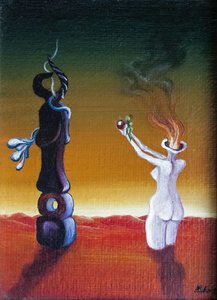
The Ephemeral Balance: Exploring Lubo Kristek's Lability
To stand before Lubo Kristek’s Lability is not merely to observe an object; it is to engage in a delicate, almost precarious dialogue with entropy itself. This striking assemblage, dating from 1974, captures the very essence of modern existence—a state of perpetual, beautiful instability. The piece centers around a wooden structure crowned by a metal ball fashioned into a face, immediately drawing the viewer into its mechanical poetry. Kristek masterfully constructs an environment where balance is not a fixed state but a momentary triumph over gravity. It invites participation, compelling the observer to test the limits of equilibrium, mirroring the constant negotiation we undertake with the unpredictable currents of contemporary life.
Symbolism of Uncertainty and the Self
The title itself, Lability, speaks volumes about the artist’s preoccupation with flux. The artwork functions as a sophisticated toy—a tumbler whose inherent design dictates that any deviation from its center will inevitably lead to a return, suggesting a cyclical nature to human experience. Yet, this return is never guaranteed; it is always earned through effort. Kristek layers profound philosophical weight onto this seemingly playful mechanism. He speaks of the "architectonic of the soul," hinting at an inner structure—a labyrinth hidden within the wood itself—that requires specialized tools and deep excavation to even perceive. This suggests that the self, much like the sculpture, is a complex system, beautiful in its potential but constantly under the pressure of external forces.
Materiality and the Echoes of Time
What elevates Lability beyond mere assemblage is Kristek’s profound reverence for used objects. He possesses an almost archaeological sensibility, seeking out components that have already lived lives. For him, the history embedded within these disparate materials—the frequency of their previous states—is as vital to the artwork as the artist's hand. The face itself, rendered from a collage of wood, metal, and perhaps stone, embodies this principle; it is an accumulation of histories. Furthermore, the inclusion of surrounding elements in the photograph—the watchful horses, the ticking clocks, the silent chairs—suggests that Lability exists within a larger narrative space, where time itself is both measured and fluid.
A Touch of the Mime and the Modern Condition
The face’s specific depiction, resembling the mime artist Ladislav Fialka, adds a layer of poignant commentary. The mime, by profession, masters the art of conveying emotion through constraint and illusion. Here, Kristek seems to place this artistic archetype within the context of the "whipping boy"—a figure perpetually at the mercy of others' narratives. This juxtaposition forces us to question agency: are we the performers in our own lives, or merely objects manipulated by unseen hands? For collectors and designers seeking art that sparks intellectual conversation, Lability offers a potent meditation on freedom versus constraint, making it a centerpiece that demands contemplation.
Bringing the Experience Home
To reproduce the spirit of Lability in your own space is to invite a dynamic tension into your décor. While the original possesses its unique patina of time and struggle, acquiring a high-quality reproduction allows you to curate this conversation piece. It serves not just as decoration, but as a philosophical anchor—a beautiful reminder that life’s most profound moments are found in the delicate act of maintaining balance against the inevitable pull toward chaos.
Questions & Answers
What mood and emotion does "Lability" by Lubo Kristek express?
The recorded mood of "Lability" by Lubo Kristek is mystical, and its emotional tone is reflective.
How intense are the colors in "Lability" by Lubo Kristek?
The color intensity of "Lability" is vivid. Intensity describes how strong the colors appear.
Which period of Lubo Kristek's career does "Lability" belong to?
"Lability" belongs to the Mid-career period of Lubo Kristek's career. This classification relates the work to the artist's development.
Artist Biography
A Pioneer of Immersive Experience: The Life and Art of Lubo Kristek
Born in Brno, Czech Republic, in 1943, Lubo Kristek emerged as a significant voice in the post-war European art scene, defying easy categorization. His artistic journey began during the turbulent 1960s, a period ripe with experimentation and a questioning of established norms. From the outset, Kristek demonstrated a restless spirit, refusing to be confined by traditional mediums or approaches. He wasn’t simply interested in creating objects; he sought to orchestrate experiences, blurring the boundaries between art, life, and audience participation. This early inclination towards challenging conventions would become a defining characteristic of his prolific career. The political climate of Czechoslovakia at the time undoubtedly fueled this desire for artistic freedom, pushing him toward explorations that were both conceptually daring and subtly subversive.From Assemblage to ‘Holographic Perception’
Kristek's work is fundamentally rooted in assemblage – a technique of creating three-dimensional artworks from disparate found objects. However, he quickly transcended the purely formal aspects of this practice, imbuing his assemblages with layers of meaning and social commentary. His sculptures weren’t merely collections of materials; they were critical examinations of human vulnerability, medical ethics, and our complex relationship with the natural world. A pivotal moment in Kristek's artistic development came with his relocation to West Germany in 1968, following the Prague Spring. This move exposed him to new ideas and influences, solidifying his commitment to conceptual art, surrealism, and performance art. It was during this period that he began formulating his groundbreaking theory of “holographic perception.” Kristek believed that true artistic impact wasn’t achieved through a single, linear experience but rather through the simultaneous stimulation of multiple senses and emotions. He envisioned artworks as multifaceted environments designed to create a holistic, immersive experience for the viewer – akin to how a hologram contains all perspectives within its structure.Happenings, Nocturnal Vernissages, and Public Interventions
The practical application of Kristek’s “holographic perception” theory manifested most powerfully in his *happenings* and *nocturnal vernissages*. These weren't conventional art openings; they were carefully orchestrated events designed to disrupt expectations and engage the audience on a visceral level. Often taking place at night, these gatherings blurred the lines between artist, artwork, and spectator. Kristek’s interventions extended beyond gallery walls, frequently spilling into public spaces. Works like *Kristek House* in Brno – a building transformed into a surreal architectural assemblage – demonstrate his commitment to making art accessible and challenging established notions of urban landscape. Another striking example is *Promenade with a Neurotic Fox*, a performance piece that confronted societal taboos surrounding death and mortality, inviting viewers to grapple with uncomfortable truths. His work *Requiem for Mobile Telephones* served as a poignant critique of our increasing dependence on technology, prompting reflection on the human cost of constant connectivity.Legacy and Lasting Influence
Lubo Kristek’s contributions to contemporary art are profound and far-reaching. He didn't simply create artworks; he pioneered a new way of thinking about artistic experience. His emphasis on immersion, participation, and the integration of multiple media has influenced generations of artists working in performance art, installation art, and conceptual sculpture. While his work often tackles complex social and ethical issues, it never feels didactic or preachy. Instead, Kristek invites viewers to engage with these themes on their own terms, fostering critical thinking and emotional resonance. His legacy is preserved not only through the numerous museums and collections that house his works – including the Museum Kunstsalon Franke Schenk in Germany and the Cathedral Prague in the Czech Republic – but also through the continued exploration of his ideas by artists and scholars around the world. Discovering Kristek’s work, whether through reproductions or experiencing it firsthand, is an invitation to step outside conventional boundaries and embrace a more holistic, immersive understanding of art's power. His vision continues to inspire those who seek to create experiences that truly resonate with the human spirit.
Lubo Kristek
1943 - , Czech Republic
Quick Facts
- Full Name: Lubo Kristek
- Nationality: Czech
- Date Of Birth: 1943
- Place Of Birth: Brno, Czech Republic
- Notable Artworks:
- Kristek House
- Temptation of St Anthony
- In the Prematurely Cloned Age…
- Artistic Movement Or Style:
- Conceptual art
- Surrealism
- Performance art
Related Articles

Bronze Age to Modern Masters: 10 Sculptures That Redefined Art | OriginalUniqueArt
Journey through art history with 10 legendary bronze sculptures – from Michelangelo's David to Rodin’s Thinker. Explore the stories, techniques & timeless beauty of these masterpieces. Find museum-quality reproductions & elevate your home decor on OriginalUniqueArt.com.

Bronze Sculptures That Defined Art History | OriginalUniqueArt
Journey through art history with our Top 10 bronze sculptures! Explore masterpieces by Rodin, Michelangelo & more. Discover stories behind iconic statues and find museum-quality reproductions for your home decor at OriginalUniqueArt.com.
The Enduring Legacy of Bronze Sculpture: History, Techniques & Contemporary Interpretations
Explore the rich history & enduring appeal of bronze sculpture. Learn about casting techniques, iconic artists, collecting tips, & contemporary interpretations. Expert insights for discerning art collectors.

The Enduring Form: Sculpture Across History, Technique & Emotional Resonance
Explore the rich history of sculpture with OriginalUniqueArt. Discover key techniques, influential artists & investment potential for discerning collectors. Expert insights into valuing and collecting timeless masterpieces.

The Enduring Form: Exploring Themes & Techniques in Sculpture Across Historical Periods
Explore the rich history of sculpture from ancient masterpieces to contemporary innovations. Discover key techniques, influential artists & investment potential for discerning art collectors.