 Preview
 Send
Send Share
Share
 Details
 Guide
Guide

 Download
 Similars
 X-Ray
X-Ray Diaporama
 Stats
StatsCity
 Ink On Paper
- Abstract Architectural Expression
 2003
2003- Modern
 100.0 x 100.0 cm
 Buenos Aires Museum of Modern Art
 Read More
The artwork displayed on this page is protected by copyright law, which means we cannot legally create or sell an identical reproduction. This protection is enforced under international agreements such as the Berne Convention and by national laws, including those outlined by the U.S. Copyright Law - Title 17.
This method fully complies with copyright regulations because it does not involve copying or duplicating the protected artwork. Instead, it is a creative reinterpretation - a new painting that is influenced by the original but not identical to it.
Giclée / Art Print
Museum-quality giclée or canvas print with fast production and flexible finish options. ( Buy Hand Made Painting Switch to Digital Image)




P118B $10

P118H $10

P118W $10

P438Z $10

P508JH $12

P508YH $12

P805H $10

P805Z $10

P919BZ $10

P919G $10

P919XJ $10

P959ZH $10

P968JZ $12

W106C $8

W218G $10

W218JH $8

W218Y $10

W307PJ $10

W316G $10

W316PJ $8

W316Y $10

W398PJ $8

W4111J $10

W500HY $15

W500JH $15

W692G $12

W849H $8

W940BG $15

W953PJ $8




Pick from our preset sizes that match the artwork's original proportions.

Type the width and the height you need, to fit your frame or your wall. A print can only be cut, never made bigger than the picture, so a size with a different shape loses a part of the image. We send you a digital mockup to approve before we print anything. The picture shown on this page does not show the real cut — only the mockup does.
Worldwide Delivery () in 2 weeks instead of standard 4/5 weeks. (28 October)

Free Worldwide Express Shipping

High-Quality Linen Canvas

Full Shipping Insurance

Customs Tax Refund Guarantee

True Color Matching Guarantee

100-Day Return Policy (Defects Only)

100% Money-Back Guarantee

Bulk Discount Offer
 Glass option is only available in size under 110 CM

City
Giclée / Art Print
Reproduction Size
-


Total Price
$ 81
León David Ferrari’s “City”: A Labyrinth of Protest and Urban Anxiety
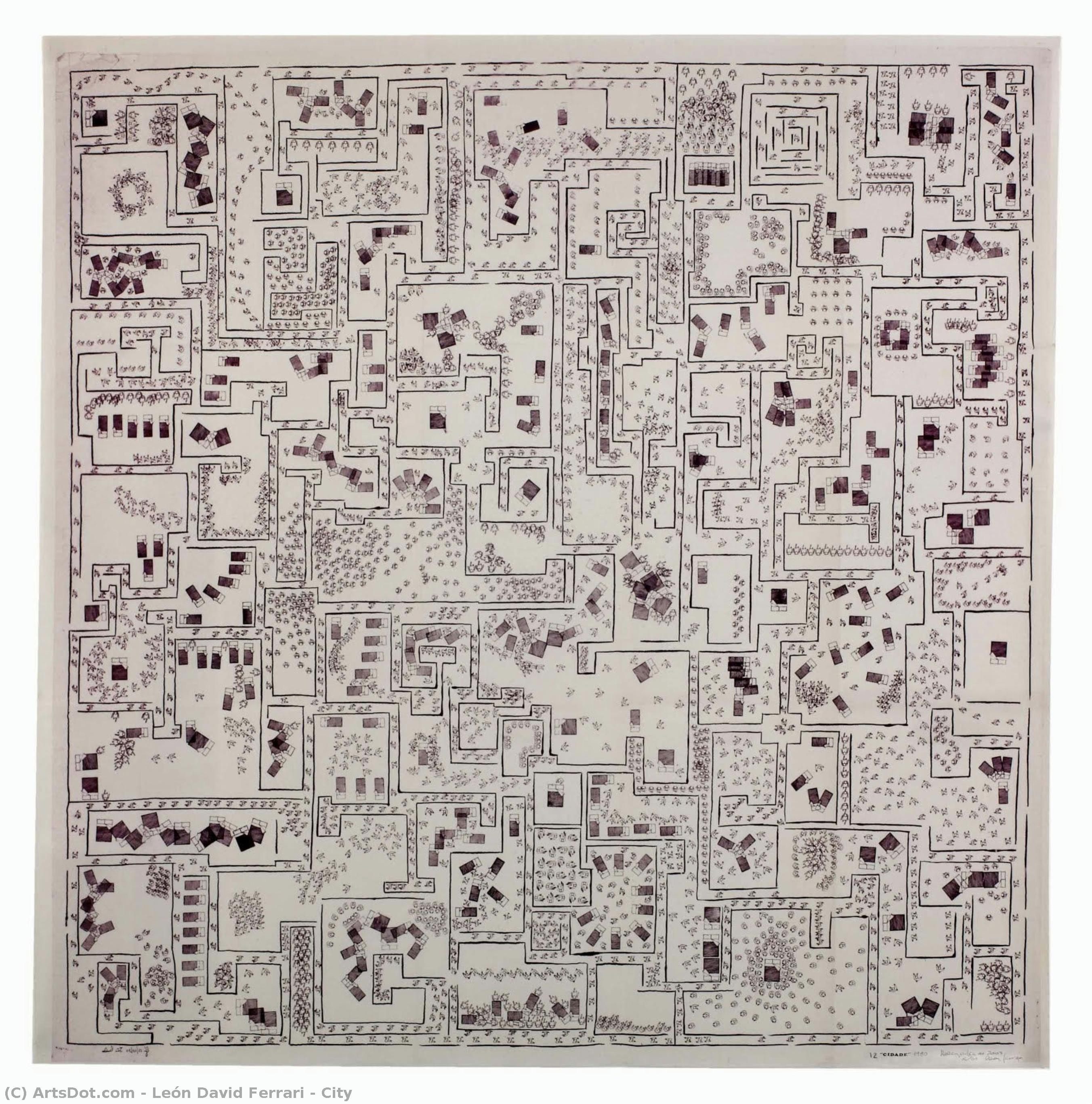
León David Ferrari's "City," completed in 2003, is more than just a depiction of an urban landscape; it’s a potent visual statement born from a lifetime dedicated to challenging societal norms. Executed on paper – likely through meticulous graphite or charcoal work – this intricate black and white drawing embodies the artist’s deeply held convictions about power structures, religious hypocrisy, and the disorienting nature of modern life. Ferrari, a prominent figure in Argentine conceptual art, spent his career provoking dialogue with his often controversial works, and “City” stands as a testament to that enduring spirit. The sheer density of the composition, a maze-like arrangement of buildings and streets rendered with precise lines, immediately draws the viewer into a space of unsettling complexity – mirroring, perhaps, the anxieties inherent in navigating an increasingly impersonal urban environment.
A Technical Masterpiece: Line, Texture, and Monochromatic Drama
- Line Work: The artwork’s foundation lies in Ferrari's extraordinary control of line. Varying thicknesses create a dynamic visual texture, suggesting both the rigid order of urban planning and the chaotic sprawl of a city. These lines aren’t merely descriptive; they are actively employed to build tension and guide the viewer’s eye through the intricate composition.
- Monochromatic Palette: Ferrari's masterful use of black, white, and subtle grey amplifies the drawing’s emotional impact. The absence of color intensifies the sense of alienation and detachment, echoing themes prevalent in his earlier work. A carefully placed reddish-brown accentuates architectural details, adding a touch of dramatic emphasis without disrupting the overall monochrome mood.
- Texture & Technique: The smooth appearance belies the labor involved – layering and cross-hatching create subtle tonal variations, suggesting a dry medium like pen or pencil. This meticulous technique contributes to the artwork’s tactile quality, inviting close inspection and rewarding attentive viewing.
Symbolism Within the Structure: A Critique of Civilization
"City" operates on multiple symbolic levels. The overwhelmingly geometric composition – rectangles dominating the scene – can be interpreted as a critique of rigid societal structures and the dehumanizing effects of industrialization. The labyrinthine quality evokes feelings of disorientation, mirroring the experience of anonymity within a vast urban system. Ferrari’s earlier work frequently targeted religious institutions and political power, and “City” subtly continues this thread. The lack of a clear focal point forces the viewer to confront the overwhelming nature of the cityscape, prompting questions about individual agency and the impact of systems on human lives. The drawing's resemblance to an architectural diagram or even a complex machine further reinforces this sense of mechanical control.
Historical Context and Artistic Influence
Created in 2003, “City” represents the culmination of Ferrari’s lifelong artistic struggle against injustice and oppression. His earlier works, such as "Western and Christian Civilization," a shocking depiction of Christ crucified on an American fighter jet, established him as a provocative voice challenging dominant ideologies. This piece builds upon that legacy, employing a more restrained yet equally powerful visual language to convey his concerns about the direction of modern society. Ferrari’s influence extends beyond Argentina; he is recognized as a key figure in the development of conceptual art and its exploration of social and political themes through unconventional media.
Questions & Answers
How does "City" fit into León David Ferrari's themes and style?
"City" shares with León David Ferrari's other works its Abstract Architectural Expression style and the recorded themes: dissent, protest, urban critique, religious satire, imperialism, architectural complexity, systemic, ferrari’s provocative statements.
Where and for what purpose is "City" recommended?
Use (accent) and space (living room) are the two recommendations recorded for "City" by León David Ferrari.
How is the mood of "City" by León David Ferrari described?
"City" has a serene atmosphere.
Artist Biography
a life marked by protest and artistic expression
león david ferrari, an argentine contemporary conceptual artist, left an indelible mark on the art world with his provocative works that challenged the status quo. born in buenos aires, argentina on september 3, 1920, ferrari's life was a testament to the power of artistic expression as a form of dissent.early life and career
ferrari's artistic journey began in the early 1950s, with his works often reflecting his disdain for the argentine government, imperialism, and the church. this is exemplified in his piece western and christian civilization, which depicted a near life-size christ hanging crucified on an american fighter jet, sparking controversy upon its creation in 1965.notable works and exhibitions
* untitled (23 x 16 cm), part of the buenos aires museum of modern art (buenos aires, argentina), showcases ferrari's mastery of oil painting on paper. * untitled, banheiros series, another piece from the same museum, further demonstrates his versatility in using paper as a medium.- view ferrari's works at OriginalUniqueArt
- understand the context of suicidal tendencies in historical figures
- explore colección andrés blaisten (mexico), a mexican art collection featuring diverse latin american artworks, on OriginalUniqueArt.com.
legacy and impact
ferrari's extended career, spanning from 1954 to his passing in 2013, was marked by protests against his work, including from pope francis when he was still cardinal jorge bergoglio. despite the controversy, ferrari's art remains a powerful commentary on the societal issues of his time. his legacy continues to inspire and provoke, serving as a testament to the enduring power of artistic expression.- delve into the colección andrés blaisten (mexico) at OriginalUniqueArt.com to explore more latin american artworks.
- discover the museo nacional de bellas artes (argentina), a renowned art museum in buenos aires, featuring an extensive collection of argentine and international artworks.
conclusion
león david ferrari's life was a complex interplay of artistic expression and societal dissent. through his works, available on OriginalUniqueArt.com, we are reminded of the profound impact one individual can have on our collective cultural consciousness.- explore león david ferrari's artworks
- learn more about casimiro castro, a mexican painter and lithographer, known for his graphic and landscape art in nineteenth-century mexico.
León David Ferrari
1920 - 2013 , Argentina
Quick Facts
- Full Name: León David Ferrari
- Nationality: Argentine
- Date Of Birth: 1920
- Date Of Death: 2013
- Place Of Birth: Buenos Aires, Argentina
- Notable Artworks:
- São Paulo Association Award
- Untitled (Paper)
- Western and Christian Civilization
- Artistic Movement Or Style: Conceptual Art
- Artists Who Influenced This Artist:
- Marcel Duchamp
- Yves Klein
- Artists Or Movements Influenced By This Artist:
- Minimalism
- Neo-Expressionism
Related Articles

Abstract Expressionism's 10 Defining Masterpieces |
Explore 10 defining Abstract Expressionism masterpieces by Pollock, Rothko & de Kooning. Discover the stories behind these iconic paintings and find museum-quality art reproductions to elevate your home decor on .

White on Canvas: 10 Masterpieces & Timeless Elegance for Your Home Decor
Explore 10 iconic white paintings by Monet, Whistler & Rothko! Discover the stories behind these serene masterpieces and their impact on art history. Find museum-quality reproductions for your home decor at .

Dark Masterpieces: 10 Iconic Paintings Dominated by Black Tones |
Explore 10 iconic paintings dominated by black tones, from Rembrandt’s chiaroscuro to Goya's dark expressions. Discover the stories behind these masterpieces & find museum-quality art reproductions for your home at .

Kandinsky's Masterpieces: 25 Paintings That Define Abstract Art | OriginalUniqueArt
Journey through Wassily Kandinsky's 25 most iconic abstract paintings. Explore his revolutionary use of color, form & spiritual expressionism. Find museum-quality Kandinsky reproductions and elevate your home decor with OriginalUniqueArt.com. Discover all masterpieces on OriginalUniqueArt.com!
Kazimir Malevich: 25 Masterpieces of Suprematism & Abstract Art | OriginalUniqueArt
Explore 25 iconic artworks by Kazimir Malevich, pioneer of Suprematism & abstract art. Discover the stories behind 'Black Square' and more! Find museum-quality prints & elevate your home decor with OriginalUniqueArt.com.