Send
Send Share
Share
 Details
 Guide
Guide

 Download
 Similars
 Diaporama
 Stats
StatsDe l
 Metal
Metal- Sculpture
- Surrealism
 1933
1933- Modern
 55.0 x 35.0 cm
 Museu d'Art Jaume Morera
 Read More
The artwork displayed on this page is protected by copyright law, which means we cannot legally create or sell an identical reproduction. This protection is enforced under international agreements such as the Berne Convention and by national laws, including those outlined by the U.S. Copyright Law - Title 17.
As a respectful and legal alternative, we offer custom, hand-painted artworks inspired by the original. Our skilled and professional artists carefully study the original's style, mood, and artistic essence to create a new, unique piece that evokes the same feeling - while remaining an original creation in its own right.
This method fully complies with copyright regulations because it does not involve copying or duplicating the protected artwork. Instead, it is a creative reinterpretation - a new painting that is influenced by the original but not identical to it.
Hand Made Oil Reproduction
Hand-painted oil on canvas in your size and frame, made to order by our artists. ( Switch to Print Switch to Digital Image)




































Pick from our preset sizes that match the artwork's original proportions.

Type the width and the height you need, to fit your frame or your wall. This is hand-painted, so for a size with a different shape the artist can paint a bit more around the picture, or cut a bit — you choose. We send you a digital mockup to approve before the painting starts. The picture shown on this page does not show the real result — only the mockup does.
After order, OriginalUniqueArt.com team will email client for instructions and provide a mockup preview
Worldwide Delivery () in 3/4 weeks instead of standard 5 weeks. (28 October). No compromise on quality.

Free Worldwide Express Shipping

High-Quality Linen Canvas

Full Shipping Insurance

Customs Tax Refund Guarantee

True Color Matching Guarantee

100-Day Return Policy (Defects Only)

100% Money-Back Guarantee

Bulk Discount Offer
 Glass option is only available in size under 110 CM

De l
Reproduction Medium
Reproduction Size
-


Total Price
$ 300
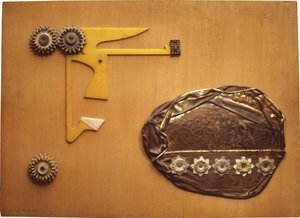
A Dance of Metal and Mystery
In the quiet, contemplative halls of modern sculpture, few pieces command attention with such enigmatic grace as "De l" by the Catalan master Leandre Cristòfol i Peralba. Created in 1933, this striking work serves as a profound testament to the dawn of surrealism in Catalonia. At first glance, the eye is immediately ensnared by a central, sweeping metal ring, its surface etched with a mesmerizing spiral design that seems to pulse with an internal rhythm. This primary form acts as a celestial orbit, around which smaller, delicate rings revolve like miniature moons. The composition is anchored by a singular, small circle at the base, providing a grounded counterpoint to the ethereal, swirling energy above. It is a piece that does not merely sit in space; it inhabits it, creating a visual dialogue between weight and weightlessness.
The sculpture embodies the radical spirit of Cristòfol i Peralba, an artist who famously rejected the rigid constraints of traditional sculpture to forge his own idiosyncratic universe. As a pioneer of the surrealist movement in his region, Peralba utilized metal not as a heavy, industrial medium, but as a fluid language capable of expressing the subconscious. The technique displayed here—a masterful manipulation of metallic forms to create a sense of organic motion—reflects his self-taught brilliance. Through the interplay of light and shadow upon the spiral grooves, the artist invites the viewer to lose themselves in a labyrinthine journey, where the boundaries between the physical object and the dreamscape begin to blur.
Symbolism and the Surrealist Soul
Beyond its structural elegance, "De l" is steeped in the symbolic language of the early 20th-century avant-garde. The spiral, an ancient symbol of growth, evolution, and the infinite, serves as the heartbeat of the work. In the context of Peralba’s fascination with non-figurative themes and the exploration of religious and dreamlike states, this spiral represents the cyclical nature of existence and the unfolding of the human psyche. The interconnected rings suggest a cosmic harmony, a delicate balance of forces that mirrors the artist's attempt to construct a personal mythology through abstract geometry.
For the discerning collector or interior designer, this piece offers more than mere decoration; it offers an intellectual and emotional anchor. Its monochromatic essence—captured so powerfully in historical black and white photography—allows it to integrate seamlessly into sophisticated, contemporary environments. Whether placed in a minimalist gallery setting or as a focal point in a curated residential collection, the sculpture evokes a sense of profound stillness and curiosity. To possess a reproduction of such a significant work is to bring a fragment of Catalan surrealist history into one's personal space, inviting a continuous meditation on form, motion, and the mysteries of the unseen.
Questions & Answers
What size is "De l" by Leandre Cristòfol I Peralba in real life?
The original "De l" by Leandre Cristòfol I Peralba measures 55 x 35 cm.
How many people view "De l"?
The Stats page of "De l" by Leandre Cristòfol I Peralba presents public visit statistics: monthly visits of this artwork, a comparison with the artist's most viewed works, and where its visitors come from.
How much light do the colors of "De l" appear to reflect?
"De l" by Leandre Cristòfol I Peralba has a gentle luminance luminance. Luminance describes how much light the colors appear to reflect.
Artist Biography
The Visionary of Catalan Surrealism
In the quiet landscapes of Olesa de Balaguer, Spain, a profound artistic journey began in 1908, marking the birth of one of Catalonia's most distinctive creative spirits: Leandre Cristòfol i Peralba. A self-taught master, Cristòfol did not merely observe the world; he sought to dismantle its traditional structures to reveal the subconscious truths lying beneath. His life, spanning nearly a century until his passing in 1998, was defined by a relentless pursuit of an aesthetic universe that transcended the boundaries of classical form. As a pioneer of surrealist sculpture in Catalonia, he carved out a legacy that bridged the gap between the tangible and the dreamlike, establishing himself as a vital figure in the evolution of 20th-century Spanish modernism.
Cristòfol’s artistic development was characterized by a courageous rejection of academic rigidity. Rather than adhering to the established methods of his era, he embraced an intuitive approach that allowed for the exploration of non-figurative shapes and complex textures. His work often functioned as a dialogue between the physical and the spiritual, frequently weaving religious themes into abstract compositions. This unique intersection of the sacred and the surreal gave his pieces a haunting, meditative quality, inviting viewers to contemplate the mysteries of faith through the lens of modern abstraction.
A Mastery of Form and Material
The breadth of Cristòfol’s talent is most evident in the diverse mediums he commanded. While many remember him as a sculptor who manipulated metal and iron to create intricate, balanced assemblages, his hand was equally expressive in drawing and painting. His early works, such as his 1934 drawings, showcased a captivating Impressionistic sensibility, using soft tones and fluid lines to capture the rhythmic movement of daily life. As his style matured, however, it drifted toward the more enigmatic territories of surrealism, where the weight of iron and the starkness of metal could better represent the gravity of human dreams.
In his sculptural masterpieces, such as the 1963 work Trajecte orbital, one can witness his profound ability to balance heavy, industrial materials like iron on wooden bases to create a sense of celestial motion. These works were not merely objects but explorations of equilibrium and tension. His technical prowess allowed him to transform cold, hard elements into poetic expressions of:
- The delicate interplay between light and shadow in non-figurative compositions.
- The structural complexity of metalwork that mirrors the chaotic yet ordered nature of the subconscious.
- The use of assemblage to evoke religious and spiritual symbolism through abstract geometry.
Legacy and Historical Significance
Leandre Cristòfol i Peralba remains a cornerstone in the study of Catalan surrealism. His influence extends far beyond his physical works, reaching into the pedagogical foundations of art in the region; notably, he served as an instructor for future generations of artists, including figures like Albert Bayona i Fernández. By challenging the traditional sculptural methods of his time, he paved the way for a more experimental and liberated approach to Catalan art, ensuring that the movement would continue to evolve through abstraction and innovation.
Today, the echoes of his creativity can be felt in the halls of significant institutions that celebrate the diverse heritage of Catalonia. While his works reside in precious collections such as the Museu d'Art Jaume Morera, his true impact is found in the way he redefined the sculptor's role—not as a mere imitator of nature, but as an architect of the unseen. His life stands as a testament to the power of the self-taught artist to reshape the cultural landscape, leaving behind a body of work that continues to inspire awe and introspection in all who encounter its surrealist beauty.
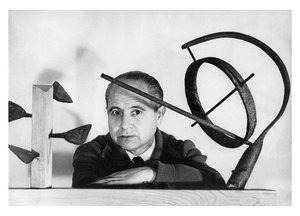
Leandre Cristòfol I Peralba
1908 - 1998 , Spain
Quick Facts
- Artistic Movement Or Style: Surrealism, Non-figurative
- Artists Or Movements Influenced By This Artist: ['Catalan Surrealist sculpture']
- Date Of Birth: 1908
- Date Of Death: 1998
- Full Name: Leandre Cristòfol i Peralba
- Nationality: Catalan
- Notable Artworks:
- Sculpture
- Drawing
- Moonlit Night
- Trajecte orbital
- Place Of Birth: Olesa de Balaguer, Spain
Related Articles

Bronze Sculptures That Defined Art History | OriginalUniqueArt
Journey through art history with our Top 10 bronze sculptures! Explore masterpieces by Rodin, Michelangelo & more. Discover stories behind iconic statues and find museum-quality reproductions for your home decor at OriginalUniqueArt.com.

The Enduring Form: Sculpture Across History, Technique & Emotional Resonance
Explore the rich history of sculpture with OriginalUniqueArt. Discover key techniques, influential artists & investment potential for discerning collectors. Expert insights into valuing and collecting timeless masterpieces.
Forged in Fire: The Timeless Strength and Ethereal Beauty of Metal Art
Discover the enduring allure of metal art. Explore how masterfully forged sculptures blend industrial strength with organic elegance to create timeless investment pieces for sophisticated collectors and luxury interiors.

Bronze Age to Modern Masters: 10 Sculptures That Redefined Art | OriginalUniqueArt
Journey through art history with 10 legendary bronze sculptures – from Michelangelo's David to Rodin’s Thinker. Explore the stories, techniques & timeless beauty of these masterpieces. Find museum-quality reproductions & elevate your home decor on OriginalUniqueArt.com.

The Enduring Form: Exploring Themes & Techniques in Sculpture Across Historical Periods
Explore the rich history of sculpture from ancient masterpieces to contemporary innovations. Discover key techniques, influential artists & investment potential for discerning art collectors.