Menu

() ·

A painting made for you, by hand

Hand Made Oil Reproduction

Hand-painted oil on canvas in your size and frame, made to order by our artists. ( Switch to Print Switch to Digital Image)

Collectible Description

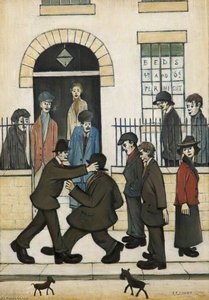
Explore Laurence Stephen Lowry's 'The Cripples,' a poignant depiction of urban life and its marginalized figures. A stark, evocative painting reflecting social commentary & human experience.

Artist Biography

Discover L.S. Lowry (1887-1976), the iconic British artist famed for his poignant depictions of Northern industrial life, 'matchstick men', and haunting landscapes. Explore his unique style & legacy.

from ·

Chapter 1

How large should it be?

Slide to change the size; the wall on the left shows it at its real scale. The proportions of the original are kept.

Standard
custom
CM
INCH

Pick from our preset sizes that match the artwork's original proportions.

width
height

Type the width and the height you need, to fit your frame or your wall. This is hand-painted, so for a size with a different shape the artist can paint a bit more around the picture, or cut a bit — you choose. We send you a digital mockup to approve before the painting starts. The picture shown on this page does not show the real result — only the mockup does.

Chapter 2

How should it arrive?

Choose the edges of the stretched canvas

Choose your frame

Corner sample of the WhiteWrap canvas edge finish, stretched on solid wood bars
White $1
Corner sample of the BlurSideWrap canvas edge finish, stretched on solid wood bars
Blurside $1
Corner sample of the ExtendedWrap canvas edge finish, stretched on solid wood bars
Extended $1
Corner sample of the P118B picture frame: moulded polystyrene, 5 cm wide and 3 cm thick
P118B $10
Corner sample of the P118H picture frame: moulded polystyrene, 5 cm wide and 3 cm thick
P118H $10
Corner sample of the P118W picture frame: moulded polystyrene, 5 cm wide and 3 cm thick
P118W $10
Corner sample of the P438Z picture frame: moulded polystyrene, 5.5 cm wide and 3.5 cm thick
P438Z $10
Corner sample of the P508JH picture frame: moulded polystyrene, 7 cm wide and 3.5 cm thick
P508JH $12
Corner sample of the P508YH picture frame: moulded polystyrene, 7 cm wide and 3.5 cm thick
P508YH $12
Corner sample of the P805H picture frame: moulded polystyrene, 5 cm wide and 3.5 cm thick
P805H $10
Corner sample of the P805Z picture frame: moulded polystyrene, 5 cm wide and 3.5 cm thick
P805Z $10
Corner sample of the P919BZ picture frame: moulded polystyrene, 7 cm wide and 3.5 cm thick
P919BZ $10
Corner sample of the P919G picture frame: moulded polystyrene, 7 cm wide and 3.5 cm thick
P919G $10
Corner sample of the P919XJ picture frame: moulded polystyrene, 7 cm wide and 3.5 cm thick
P919XJ $10
Corner sample of the P959ZH picture frame: moulded polystyrene, 5 cm wide and 3 cm thick
P959ZH $10
Corner sample of the P968JZ picture frame: moulded polystyrene, 6 cm wide and 4 cm thick
P968JZ $12
Corner sample of the W106C picture frame: solid wood, 5 cm wide and 3 cm thick
W106C $8
Corner sample of the W218G picture frame: solid wood, 5 cm wide and 3 cm thick
W218G $10
Corner sample of the W218JH picture frame: solid wood, 5 cm wide and 3 cm thick
W218JH $8
Corner sample of the W218Y picture frame: solid wood, 5 cm wide and 3 cm thick
W218Y $10
Corner sample of the W307PJ picture frame: solid wood, 6 cm wide and 3 cm thick
W307PJ $10
Corner sample of the W316G picture frame: solid wood, 6 cm wide and 3 cm thick
W316G $10
Corner sample of the W316PJ picture frame: solid wood, 6 cm wide and 3 cm thick
W316PJ $8
Corner sample of the W316Y picture frame: solid wood, 6 cm wide and 3 cm thick
W316Y $10
Corner sample of the W398PJ picture frame: solid wood, 5 cm wide and 3 cm thick
W398PJ $8
Corner sample of the W4111J picture frame: solid wood, 6.5 cm wide and 3.5 cm thick
W4111J $10
Corner sample of the W500HY picture frame: solid wood, 7 cm wide and 5 cm thick
W500HY $15
Corner sample of the W500JH picture frame: solid wood, 7 cm wide and 5 cm thick
W500JH $15
Corner sample of the W692G picture frame: solid wood, 8 cm wide and 4 cm thick
W692G $12
Corner sample of the W849H picture frame: solid wood, 5 cm wide and 3 cm thick
W849H $8
Corner sample of the W940BG picture frame: solid wood, 7.5 cm wide and 4.5 cm thick
W940BG $15
Corner sample of the W953PJ picture frame: solid wood, 6 cm wide and 3.5 cm thick
W953PJ $8
Corner sample of the H24-GOLD picture frame: carved wood with gesso, 10 cm wide and 6 cm thick
H24-GOLD $30
Corner sample of the H24-SILVER picture frame: carved wood with gesso, 10 cm wide and 6 cm thick
H24-SILVER $30
Corner sample of the H36-GOLD picture frame: carved wood with gesso, 15 cm wide and 6.5 cm thick
H36-GOLD $45
Corner sample of the H36-SILVER picture frame: carved wood with gesso, 15 cm wide and 6.5 cm thick
H36-SILVER $45
Frame preview
Framed

Moulding: . Overall size with the frame: .

Chapter 3

Who paints it, and should anything change?

Examples of what can be changed: Replace face with customer photo; Add pet (e.g., replace cat with dog); Include hidden message in background; Change background landscape or elements.
After order, OriginalUniqueArt.com team will email client for instructions and provide a mockup preview

Worldwide Delivery () in 3/4 weeks instead of standard 5 weeks. (29 October). No compromise on quality.

Chapter 4

The finishing touches

A nameplate, as in a museum?

Engraved Bronze Plaque Details

This elegant plaque features the artist's name and the title of the artwork, finely engraved for a timeless presentation.

It is made from bronze with a refined, elegant finish. The text is precisely laser-engraved for a sharp and permanent result. Measuring 9x2 cm, the plaque is compact yet easy to read. It's built to be durable and scratch-resistant, offering a professional, museum-quality look. Mounting is simple thanks to the included adhesive backing.

Transparent Acrylic Plaque Details

The plaque includes essential engraved details such as the artist's name, the title of the artwork, the date it was created, the type of media used-like oil on canvas or watercolor-a brief description of the piece, and a QR code that links to the complete artwork information.

It is crafted from clear acrylic, offering a sleek, modern appearance. The text is UV-engraved in black to ensure strong visual contrast. With a size of 10x15 cm, it ensures optimal readability. It comes equipped with two metal hooks for secure wall mounting. The plaque is designed to be weather-resistant, making it suitable for various environments, and it includes interactive features that work seamlessly with smartphone scanning.

Black Acrylic Plaque Details

This elegant plaque includes engraved information such as the artist's name, the title of the artwork, the date it was created, the type of media used (like oil on canvas or watercolor), a short description of the artwork, and a QR code for quick access to more information.

The plaque itself is made from refined black acrylic with a premium finish. The text is laser-engraved in white for high contrast and readability. Its size is 10x15 cm, designed to be easy to read. It comes with two metal hooks for professional mounting. The design is sleek and fits any interior style. It is also weather-resistant and durable, with built-in digital integration for mobile compatibility.

A protective varnish?

When do you need it?

Chapter 5

Your painting, as you ordered it

The Cripples

Reproduction Medium

Reproduction Size

-

Elite Senior Artist

More detail, finesse, and extra production time

-

Reproduction Frame

-

-

For artworks or reproductions larger than 105 cm (approximately 41 inches) on any side, the frame will be shipped as a kit, disassembled. This method ensures safe delivery and prevents damage during transport.

Professional assembly required - this is not a DIY product.
The kit must be assembled and the canvas stretched by an experienced professional framer, using wood glue (not supplied), a canvas stretching plier and clamps to hold the bars square while the glue dries. Incorrect assembly or uneven canvas tension can permanently damage the artwork and is not covered by our warranty.

  • All solid wood bars are included, precisely cut to size.

  • Assembled with the screws provided, plus wood glue for the corner joints, which is not supplied and must be sourced by your framer.

  • Professional tools are required and not included: a canvas stretching plier (tensioner) and clamps to hold the bars square while the glue dries.

Important:
The corner joints require wood glue, the bars must be held with clamps until the glue is fully dry, and tightening the canvas on the assembled frame requires a canvas stretching plier. None of these are included in the kit. Please arrange an experienced professional framer before ordering this size.

Nameplate

-

-

Protective Varnish

Glossy Varnish (enhances colors, protects against light/moisture)

-

Customize My Artwork

Examples of what can be changed: Replace face with customer photo; Add pet (e.g., replace cat with dog); Include hidden message in background; Change background landscape or elements.

-

Urgent

Worldwide Delivery () in 3/4 weeks instead of standard 5 weeks. (29 October). No compromise on quality.

-

Express Shipping

Worldwide Delivery () in 5 weeks. (5 November).

Included

Total Price

$ 900

Total Price $ 900

Glass option is only available in size under 110 CM

Included with every order

  • Free Worldwide Express Shipping
  • High-Quality Linen Canvas
  • Full Shipping Insurance
  • Customs Tax Refund Guarantee
  • True Color Matching Guarantee
  • 100-Day Return Policy (Defects Only)
  • 100% Money-Back Guarantee
  • Bulk Discount Offer

Laurence Stephen Lowry’s “The Cripples”: A Study in Urban Isolation

Laurence Stephen Lowry's "The Cripples," painted in 1949, isn’t merely a depiction of Manchester street life; it’s a poignant and unsettling meditation on anonymity, social exclusion, and the quiet dignity of those often overlooked. This iconic work, now housed within the collection of The Lowry in Salford, offers a rare glimpse into the artist's unique perspective – one that eschewed sentimentality for a starkly observed reality, revealing a profound sensitivity to the human condition amidst the relentless march of industrial progress. Lowry’s decision to avoid explicit emotional expression is key to understanding the painting’s enduring power; instead, he invites viewers to contemplate the lives and experiences of his subjects through their very absence of overt feeling.

The scene unfolds within a densely populated urban square, rendered in Lowry's signature monochrome palette – a deliberate choice that strips away any potential distraction, forcing the viewer to confront the figures with unflinching honesty. A multitude of pedestrians, predominantly men, populate the frame, their faces largely obscured and their movements seemingly aimless. They are not individuals engaged in conversation or activity; rather, they exist as anonymous components within a larger, impersonal landscape. The composition itself is deliberately chaotic, mirroring the perceived disorder of urban life – figures overlap, merge into one another, and recede into the distance, creating a sense of overwhelming density and isolation. The buildings lining the street are simplified architectural forms, serving primarily to establish a spatial context rather than offering any detailed representation.

A Study in Form and Technique

Lowry’s technique is instantly recognizable: a direct, almost childlike approach characterized by loose brushstrokes and a deliberate avoidance of meticulous detail. The figures are rendered with simplified geometric shapes – cylinders for limbs, rectangles for bodies – creating an effect that is both immediate and slightly unsettling. The lines delineating the forms are often imprecise, contributing to their anonymity and reinforcing the painting’s overall sense of detachment. Notably, Lowry employed a medium likely consisting of graphite or charcoal on paper, lending the work a subtle textural quality—a delicate balance between precision and spontaneity. The lack of blending or layering suggests an immediate, intuitive approach, as if Lowry were capturing fleeting impressions rather than constructing a carefully planned composition.

Symbolism and Historical Context

The title itself, “The Cripples,” immediately introduces a layer of complexity. While the painting depicts individuals with physical disabilities – a woman leaning heavily on a cane, a man with a limp – it’s crucial to understand that Lowry wasn't simply portraying charity cases or victims of misfortune. He was drawing inspiration from his own observations of Manchester’s streets and its inhabitants, many of whom were struggling with poverty, illness, and the social consequences of rapid industrialization. The figures are not presented as objects of pity; rather, they are integrated into the fabric of everyday life, existing alongside their able-bodied counterparts without receiving any particular attention or consideration. The presence of carnival headgear – a cardboard crown, a paper shako, a beret – adds another layer of symbolic meaning, suggesting that these individuals represent various social classes and roles within the community.

A Legacy of Observation

Further research reveals intriguing connections to Lowry’s own life and artistic sensibilities. The debate surrounding his potential Asperger's syndrome offers a compelling lens through which to interpret "The Cripples." His meticulous observation of detail, coupled with a seeming indifference to conventional notions of beauty or emotional expression, aligns remarkably well with the characteristics associated with this neurodevelopmental condition. Moreover, Lowry’s work reflects a broader trend in British art during the mid-20th century – a shift away from idealized representations and towards a more realistic, often unflinching portrayal of social realities. "The Cripples" stands as a testament to Lowry's unique vision, inviting viewers to contemplate the complexities of urban life and the enduring power of observation.

Questions & Answers

Where is the landscape format of "The Cripples" recommended to be displayed?

Format (landscape) and recommended space (living room) are the two placement facts recorded for "The Cripples" by Laurence Stephen Lowry.

How is the color composition of "The Cripples" by Laurence Stephen Lowry built?

In "The Cripples", a statement contrast is paired with a softly mixed palette harmony.

Where can I buy a digital image of "The Cripples" by Laurence Stephen Lowry?

To get a digital file of "The Cripples" by Laurence Stephen Lowry, order a high-resolution digital image download on its Digital Image page.

In numbers

  • 29frames to choose from
  • standard sizes, in its own proportions
  • 5weeks to paint and deliver it

About the original

Laurence Stephen Lowry

Laurence Stephen Lowry

1887 - 1976, United Kingdom

Quick Facts

  • Full Name: Laurence Stephen Lowry
  • Nationality: British
  • Date Of Birth: 1887
  • Date Of Death: 1976
  • Place Of Birth: Stretford, United Kingdom
  • Notable Artworks:
    • An Old Street
    • Swinton Moss
    • Untitled (447)
  • Artistic Movement Or Style: Industrial Painting
  • Artists Who Influenced This Artist: ['Impressionism']
  • Artists Or Movements Influenced By This Artist: ['Northern England Art']

Artist Biography

The Quiet Observer of Industrial England

Laurence Stephen Lowry, born in the heart of Stretford, Cheshire, in 1887, remains one of Britain’s most beloved and distinctive voices in twentieth-century art. While his name is now synonymous with the gritty, evocative landscapes of Northern England, his journey to international acclaim was a slow, poignant ascent. For much of his life, Lowry lived as a quiet observer, working as a rent collector by day while honing his craft in the evenings. This dual existence allowed him to witness the rhythmic, often harsh, pulse of industrial life with a unique intimacy. His work does not merely represent the smoke-filled horizons of Salford and Pendlebury; it captures a profound sensitivity to the human condition, finding a quiet dignity within the stark realities of the industrial age.

Lowry’s artistic development was deeply rooted in his surroundings, yet his technical foundations were built upon a careful study of form and light. Initially influenced by the principles of Impressionism and Post-Impressionism, he sought to capture the essence of a scene rather than its mere surface. His early training at the Manchester Art School provided him with the tools to translate the sprawling factories and crowded streets into something much more symbolic. As his style matured, he moved away from grand narratives, choosing instead to focus on subtle nuances of observation. He often worked within a highly restricted palette—utilizing colors such as flake white, ivory black, vermilion, Prussian blue, and yellow ochre—to create compositions that felt both grounded in reality and elevated by a dreamlike, almost surrealist quality.

The Magic of the Matchstick Men

Perhaps the most enduring legacy of Lowry is his creation of the so-called "matchstick men." These stylized, simplified human figures, often depicted without shadows or distinct facial features, populate his urban landscapes with a sense of collective movement and shared destiny. Through these figures, Lowry transformed bustling street scenes into poetic meditations on community and solitude. Whether they are walking toward a football match, congregating near a mill, or wandering through a park, these characters embody the resilience of the working class. There is a haunting beauty in how he places these small, fragile forms against the backdrop of massive, brooding industrial structures, creating a tension between the monumental scale of industry and the delicate nature of human life.

Beyond his famous urban scenes, Lowry’s repertoire was surprisingly diverse, revealing an artist of great depth and curiosity. While the industrial landscape is his most celebrated subject, he also explored:

  • Mysterious Unpopulated Landscapes: Brooding, atmospheric scenes that evoke a sense of solitude and the passage of time.
  • Seascapes: Pure, elemental depictions of sea and sky that emerged from his fascination with the coast in the 1940s.
  • Portraits: Intimate, often somber studies of individuals that showcase his ability to capture character through minimal detail.
  • The "Marionette" Works: A collection of unpublished, surrealist-leaning pieces discovered only after his death, revealing a more experimental side of his imagination.

A Lasting Legacy in British Art

Though he achieved significant national fame following his first solo exhibition in London in 1939, Lowry’s true impact is felt in the way he redefined the English landscape. He did not seek to glorify progress or paint heroic vistas; instead, he found beauty in the mundane and the melancholic. His ability to find poignant beauty in the soot-stained streets of the North West has made his work a cornerstone of British cultural identity. Today, institutions such as The Lowry in Salford Quays serve as vital guardians of his immense legacy, housing one of the largest public collections of his work.

Lowry’s significance lies in his refusal to look away from the difficult realities of his era. By documenting the lives of ordinary people with such empathy and stylistic innovation, he ensured that the spirit of industrial England would be preserved not just as history, but as art. He remains a master of atmosphere, an artist who proved that even in the most crowded, industrial settings, there is a profound, quiet magic to be found.

Quick Facts

  • Dimensions: 101 x 76 cm
  • Location: The Lowry, Salford
  • Artistic style: Naive realism
  • Year: 1949
  • Influences: Social realism

Art Quiz

There is only one correct answer for each question.

Question 1:
According to Lowry, what was a primary intention behind his painting ‘The Cripples’?
Question 2:
What medium did Lowry primarily use to create ‘The Cripples’?
Question 3:
What is the overall mood conveyed by the composition of ‘The Cripples’?
Question 4:
What is the significance of the ‘foxtails’ worn by some of the figures in ‘The Cripples’?
Question 5:
In what year was ‘The Cripples’ painted?

More about this painting

Preview AR preview Switch to Print Switch to Digital Image Send
Details Guide Add to favorites Download Similars X-Ray Diaporama Q&A Stats