
 Preview
 Send
Send Share
Share
 Details
 Guide
Guide

 Download
 Similars
 X-Ray
X-Ray Diaporama
 Stats
StatsFire-eye
 Read More
Hand Made Oil Reproduction
Hand-painted oil on canvas in your size and frame, made to order by our artists. ( Switch to Print Switch to Digital Image)




































Pick from our preset sizes that match the artwork's original proportions.

You may enter your own dimensions to fit a specific frame or space. If your selected size does not match the original image's proportions, we will either crop the artwork or extend the painting with additional hand-painted elements. A digital mockup will be sent for your approval before production begins.
Please note that the on-screen preview does not reflect the actual cropping or extension. Only the mockup will accurately show the final composition.
While custom sizes are available, we recommend selecting a dimension from the predefined list to preserve the original proportions.
After order, OriginalUniqueArt.com team will email client for instructions and provide a mockup preview
Worldwide Delivery () in 3/4 weeks instead of standard 5 weeks. (26 September). No compromise on quality.

Free Worldwide Express Shipping

High-Quality Linen Canvas

Full Shipping Insurance

Customs Tax Refund Guarantee

True Color Matching Guarantee

100-Day Return Policy (Defects Only)

100% Money-Back Guarantee

Bulk Discount Offer
 Glass option is only available in size under 110 CM

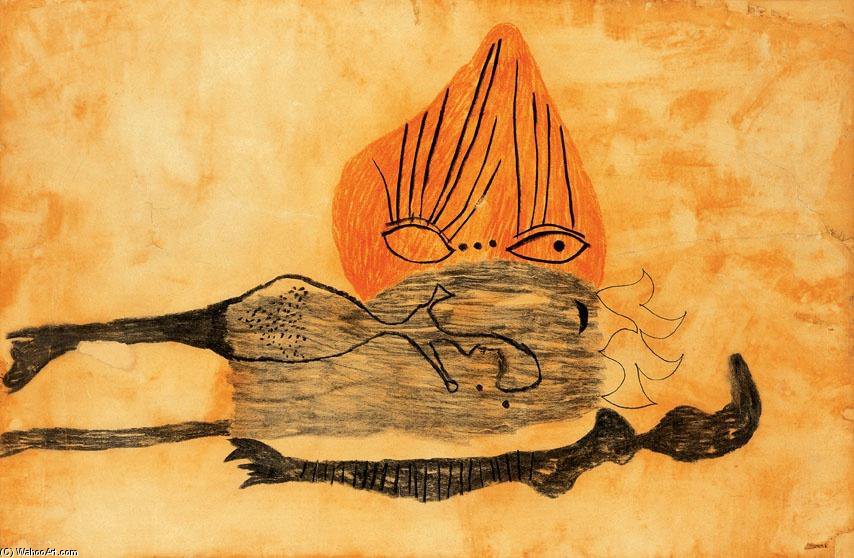
Fire-eye
Reproduction Medium
Reproduction Size
-


Total Price
$ 300
Artist Biography
Lajos Vajda: A Visionary Echo of the Hungarian Avant-garde
Lajos Vajda stands as one of Hungary’s most distinctive and haunting figures in the realm of avant-garde art, a painter whose singular style and deeply symbolic imagery continue to resonate with profound intensity. Born in 1908 in Zalaegerszeg, Hungary, into a humble Jewish family, Vajda’s early life was marked by both movement and the shadows of hardship. His artistic journey began under the rigorous tutelage of István Csók at the Hungarian Academy of Fine Arts in Budapest, a period that established his foundational mastery of composition. However, it was his time in Paris between 1930 and 1934, studying within the atelier of Fernand Léger alongside Dezső Korniss, that truly ignited his creative spirit. In the vibrant intellectual atmosphere of France, Vajda encountered the revolutionary currents of Cubism and Surrealism, forces that would irrevocably shape his visual language into a unique synthesis of geometric abstraction and dreamlike, often unsettling, imagery.
The essence of Vajda’s work lies in its extraordinary ability to bridge disparate worlds. Upon returning to Hungary, he became a dedicated collector and chronicler of folk art motifs, particularly from the regions of Szentendre and Szigetmonostor. He did not merely observe these traditions; he absorbed them, meticulously documenting symbols and patterns to serve as the bedrock of his creative process. His canvases became complex tableaux where religious iconography—drawing from Orthodox Christian, Roman Catholic, and Jewish traditions—was seamlessly woven with architectural elements and folkloric textures. This layering of meaning created a spiritual depth that felt both ancient and startlingly modern, allowing him to explore themes of identity, heritage, and the human condition through a lens of constructed reality.
The Synthesis of Symbolism and Modernity
Vajda’s technical evolution was characterized by an incredible versatility, moving between the structured discipline of Constructivism and the fluid, emotive depths of Surrealism. His work often functioned as a visual dialogue between the tangible and the metaphysical. In his more graphic works, one can observe a rhythmic tension inspired by the musical structures of Béla Bartók and Zoltán Kodály, where line and shape dance with a mathematical yet soulful precision. Conversely, his later drawings and sketches possess a raw, visceral quality, often utilizing charcoal and watercolor to evoke the swirling, unpredictable forces of nature and the encroaching darkness of history.
Beyond the purely aesthetic, Vajda’s art was deeply intertwined with the turbulent political landscape of the early 20th century. His fascination with the dramatic power of film and photo-montage led him to create works that addressed the great cataclysms of mankind. Through his lens, the horrors of war, hunger, and systemic violence were not merely documented but transformed into symbolic allegories. His final abstract surrealistic works are particularly poignant, as they seem to foreshadow the unimaginable atrocities of World War II, capturing a sense of dread and fragmentation that mirrored the fracturing of European civilization itself.
Legacy and Historical Significance
Though his life was tragically cut short by tuberculosis in 1941 at the age of only thirty-three, Lajos Vajda left behind an impressive and influential oeuvre that redefined the boundaries of Hungarian modernism. His greatness lies in his refusal to adhere to the rigid dogmas of the movements he inhabited; instead, he achieved a profound independence by integrating local historical materials with international avant-garde trends. He transformed the "local" into something universal, proving that folk motifs and religious symbols could speak to the global anxieties of the modern age.
Today, Vajda is remembered not just as a painter, but as a visionary who captured the soul of a disappearing world while simultaneously peering into the chaos of the future. His contributions continue to be studied for their:
- Innovative Synthesis: The seamless blending of Cubist structure with Surrealist dreamscapes and folk tradition.
- Cultural Preservation: His vital role in documenting and elevating Hungarian and Jewish cultural motifs within high art.
- Emotional Depth: An ability to translate the political and social anxieties of his era into enduring, symbolic masterpieces.

Lajos Vajda
1908 - 1941 , Hungary
Quick Facts
- Artistic Movement Or Style: Cubism & Surrealism
- Artists Or Movements Influenced By This Artist: ['European School Art Group']
- Artists Who Influenced This Artist:
- Béla Bartók
- Zoltán Kodály
- Fernand Léger
- Date Of Birth: 1908
- Full Name: Lajos Vajda
- Nationality: Hungarian
- Notable Artworks:
- Moulding Powers On The Horizon
- Self-portrait With Hat
- Madonna Above The Gate
- Place Of Birth: Zalaegerszeg, Hungary


