 Preview
 Send
Send Share
Share
 Details
 Guide
Guide

 Download
 Similars
 X-Ray
X-Ray Diaporama
 Stats
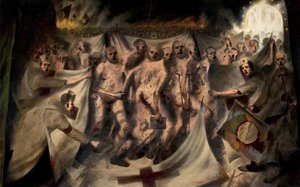
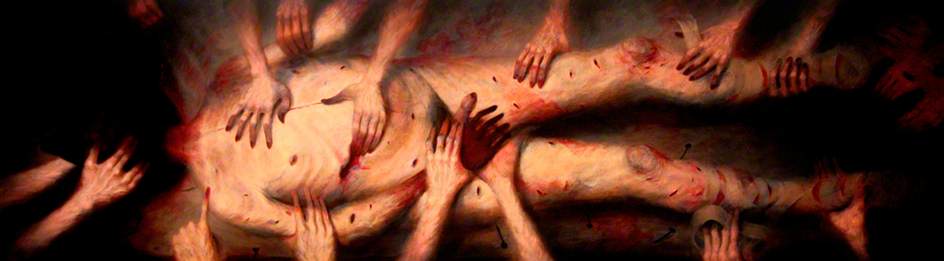
StatsThe Idealist (polyptych, predella panel)
 60.0 x 208.0 cm
 Middlesbrough Institute of Modern Art
 Read More
The artwork displayed on this page is protected by copyright law, which means we cannot legally create or sell an identical reproduction. This protection is enforced under international agreements such as the Berne Convention and by national laws, including those outlined by the U.S. Copyright Law - Title 17.
As a respectful and legal alternative, we offer custom, hand-painted artworks inspired by the original. Our skilled and professional artists carefully study the original's style, mood, and artistic essence to create a new, unique piece that evokes the same feeling - while remaining an original creation in its own right.
This method fully complies with copyright regulations because it does not involve copying or duplicating the protected artwork. Instead, it is a creative reinterpretation - a new painting that is influenced by the original but not identical to it.
Hand Made Oil Reproduction
Hand-painted oil on canvas in your size and frame, made to order by our artists. ( Switch to Print Switch to Digital Image)




































Pick from our preset sizes that match the artwork's original proportions.

Type the width and the height you need, to fit your frame or your wall. This is hand-painted, so for a size with a different shape the artist can paint a bit more around the picture, or cut a bit — you choose. We send you a digital mockup to approve before the painting starts. The picture shown on this page does not show the real result — only the mockup does.
After order, OriginalUniqueArt.com team will email client for instructions and provide a mockup preview
Worldwide Delivery () in 3/4 weeks instead of standard 5 weeks. (23 October). No compromise on quality.

Free Worldwide Express Shipping

High-Quality Linen Canvas

Full Shipping Insurance

Customs Tax Refund Guarantee

True Color Matching Guarantee

100-Day Return Policy (Defects Only)

100% Money-Back Guarantee

Bulk Discount Offer
 Glass option is only available in size under 110 CM

The Idealist (polyptych, predella panel)
Reproduction Medium
Reproduction Size
-


Total Price
$ 300
Artist Biography
The Crucible of Change: An Exploration of the Art of the 1960s
The decade of the 1960s wasn’t merely a period marked by social upheaval and political protest; it was, fundamentally, an artistic crucible. A confluence of factors – burgeoning consumerism, the rise of mass media, the anxieties of the Cold War, and a growing disillusionment with traditional art forms – fueled a radical transformation in aesthetics and artistic practice. Artists, grappling with these seismic shifts, rejected established conventions and sought new ways to engage with the world around them, ultimately laying the groundwork for much of contemporary art. The era witnessed an explosion of diverse movements, each challenging existing paradigms and pushing the boundaries of what constituted “art.” From the vibrant, ironic commentary of Pop Art to the stark minimalism of sculpture, and the conceptual explorations that questioned the very nature of artistic creation, the 1960s redefined modern aesthetics and left an indelible mark on the art world.The Seeds of Rebellion: Key Movements and Their Origins
Several distinct movements emerged during this period, each with its own unique philosophy and approach. Pop Art, arguably the most recognizable movement of the decade, arose as a direct response to Abstract Expressionism’s perceived elitism and emotional intensity. Artists like Andy Warhol, Roy Lichtenstein, and Robert Rauschenberg embraced imagery from popular culture – advertising, comic books, celebrity photographs – elevating these everyday objects and figures to the status of art. This wasn't simply imitation; it was a deliberate critique of consumer society and the blurring lines between high and low culture. Simultaneously, Minimalism emerged as a counterpoint, stripping art down to its essential components: geometric forms, industrial materials, and a focus on process rather than product. Artists like Donald Judd, Sol LeWitt, and Carl Andre sought to eliminate any trace of personal expression or stylistic flourishes, creating works that were intellectually rigorous and devoid of emotional content. Conceptual Art further expanded this challenge, prioritizing the idea behind the artwork over its physical manifestation. Artists like Joseph Kosuth questioned the definition of art itself, using language, photography, and everyday objects as their medium.Iconic Figures and Their Defining Works
The 1960s produced a constellation of artists whose work continues to resonate today. Andy Warhol’s silkscreen prints of Marilyn Monroe and Campbell's Soup cans remain instantly recognizable symbols of Pop Art, capturing the spirit of consumer culture with their bold colors and repetitive imagery. Roy Lichtenstein’s comic-inspired paintings, characterized by Ben-Day dots and a deliberately naive style, offered a satirical commentary on American popular culture. Sol LeWitt’s minimalist sculptures – often constructed using identical components according to precise instructions – exemplified the principles of Minimalism, emphasizing geometric forms and systematic processes. Robert Rauschenberg's "Combines," which fused painting and sculpture, blurred the boundaries between traditional art forms and introduced a playful element of chance and improvisation. Furthermore, artists like Jasper Johns explored themes of symbolism and representation through his iconic flag paintings and target drawings, while Claes Oldenburg created monumental sculptures of everyday objects, transforming familiar items into surprising and often humorous works of art.Beyond the Canvas: Expanding Artistic Boundaries
The 1960s wasn’t confined to painting and sculpture; it witnessed a significant expansion of artistic practices beyond traditional mediums. Happenings, organized events that combined performance, visual art, and audience participation, challenged the established conventions of gallery exhibitions and embraced spontaneity and improvisation. Fluxus artists, such as George Maciunas, created “events” – often ephemeral and low-budget – that questioned the very definition of art and its role in society. Nam June Paik’s pioneering work with video art explored the possibilities of electronic media, anticipating the rise of digital art in the decades to come. The decade also saw a resurgence of interest in performance art, with artists like Carolee Schneemann pushing the boundaries of the body as a medium and challenging traditional notions of gender and sexuality.A Lasting Legacy: Influence and Significance
The artistic innovations of the 1960s profoundly shaped the course of contemporary art. The rejection of traditional aesthetics, the embrace of popular culture, and the emphasis on conceptual ideas paved the way for subsequent movements such as Conceptual Art, Minimalism, and Postmodernism. Artists who emerged during this period continue to influence artists today, demonstrating a lasting legacy that extends far beyond its initial context. The decade’s questioning of artistic conventions, its engagement with social and political issues, and its exploration of new media established a precedent for experimentation and innovation that remains central to the art world. The spirit of rebellion and critical inquiry embodied by the artists of the 1960s continues to inspire artists to challenge assumptions, push boundaries, and engage with the complexities of the modern world.
Ken Currie
1960 - , United Kingdom
Quick Facts
- Full Name: WahooArt
- Date Of Birth: 1960
- Place Of Birth: North Shields, United Kingdom
- Notable Artworks: ['Various famous artworks']
- Artistic Movement Or Style: Hand-painted reproductions