Preview
 Send
Send Share
Share
 Details
 Guide
Guide

 Download
 Similars
 X-Ray
X-Ray Diaporama
 Stats
StatsAnatomy Lesson (polyptych, right panel)
 Oil On Panel
- Contemporary Art
 1990
1990- Contemporary
 133.0 x 103.0 cm
 Middlesbrough Institute of Modern Art
 Read More
The artwork displayed on this page is protected by copyright law, which means we cannot legally create or sell an identical reproduction. This protection is enforced under international agreements such as the Berne Convention and by national laws, including those outlined by the U.S. Copyright Law - Title 17.
This method fully complies with copyright regulations because it does not involve copying or duplicating the protected artwork. Instead, it is a creative reinterpretation - a new painting that is influenced by the original but not identical to it.
Giclée / Art Print
Museum-quality giclée or canvas print with fast production and flexible finish options. ( Buy Hand Made Painting Switch to Digital Image)




P118B $10

P118H $10

P118W $10

P438Z $10

P508JH $12

P508YH $12

P805H $10

P805Z $10

P919BZ $10

P919G $10

P919XJ $10

P959ZH $10

P968JZ $12

W106C $8

W218G $10

W218JH $8

W218Y $10

W307PJ $10

W316G $10

W316PJ $8

W316Y $10

W398PJ $8

W4111J $10

W500HY $15

W500JH $15

W692G $12

W849H $8

W940BG $15

W953PJ $8




Pick from our preset sizes that match the artwork's original proportions.

You may enter your own dimensions to fit a specific frame or space. If your selected size does not match the original image's proportions, we will either crop the artwork or extend the image with a mirrored or solid-fill edge. A digital mockup will be sent for your approval before production begins.
Please note that the on-screen preview does not reflect the actual cropping or extension. Only the mockup will accurately show the final composition.
While custom sizes are available, we recommend selecting a dimension from the predefined list to preserve the original proportions.
Worldwide Delivery () in 2 weeks instead of standard 4/5 weeks. (11 October)

Free Worldwide Express Shipping

High-Quality Linen Canvas

Full Shipping Insurance

Customs Tax Refund Guarantee

True Color Matching Guarantee

100-Day Return Policy (Defects Only)

100% Money-Back Guarantee

Bulk Discount Offer
 Glass option is only available in size under 110 CM

Anatomy Lesson (polyptych, right panel)
Giclée / Art Print
Reproduction Size
-


Total Price
$ 81
A Visceral Encounter with Ken Currie’s Anatomy Lesson
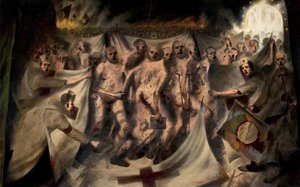
In the hauntingly evocative Anatomy Lesson (polyptych, right panel), the contemporary master Ken Currie invites viewers into a space where the boundaries between medical inquiry and profound human vulnerability dissolve. Painted in 1990, this striking oil on panel serves as a powerful fragment of a larger narrative, capturing a moment of intense scrutiny and raw exposure. At the heart of the composition lies a woman, her form presented with an unflinching honesty that commands the viewer's gaze. She is not merely a subject of study but the epicenter of a complex psychological drama, surrounded by figures whose presence oscillates between scientific curiosity and something far more unsettling. The painting possesses a magnetic, almost theatrical quality, drawing the observer into a scene where the flesh is both a biological specimen and a vessel for deep-seated human emotion.
The technique employed by Currie is nothing short of masterful, utilizing the rich, layered possibilities of oil paint to create a sense of depth and tactile reality. The artist employs a palette that feels grounded yet surreal, allowing the textures of skin, fabric, and shadow to interact in a way that heightens the painting's visceral impact. There is a deliberate tension in the brushwork; while certain areas possess a smooth, classical finish reminiscent of historical anatomical studies, other passages lean into a more expressive, modern urgency. This duality reflects the artist's ability to bridge the gap between the traditions of the past and the anxieties of the contemporary era, making it an exceptional piece for collectors who appreciate art that challenges the eye while soothing the soul through its sheer technical prowess.
Symbolism and the Weight of the Gaze
Beyond its immediate visual impact, Anatomy Lesson is a profound meditation on the nature of observation and the loss of autonomy. The figures surrounding the central woman—some adorned with masks, others bearing distorted or intense facial expressions—act as proxies for the collective gaze of society. Their pointing gestures and focused stares transform the act of looking into an act of intrusion. This creates a palpable sense of voyeurism and vulnerability, suggesting that to be "studied" is often to be stripped of one's humanity. The masks worn by certain onlookers introduce an element of the uncanny, blurring the line between the real and the performative, and hinting at the hidden identities and collective prejudices that shape our perception of the "other."
For the discerning interior designer or art enthusiast, this work offers a sophisticated layer of intellectual depth to any curated space. It is a piece that demands conversation, acting as a focal point that stimulates thought long after one has left its presence. Whether placed in a contemporary gallery setting or integrated into a luxurious, classically inspired room, the painting’s ability to evoke both discomfort and awe makes it a timeless acquisition. It is more than a reproduction of a scene; it is an invitation to contemplate the complexities of the human condition, making it a profound addition to any collection dedicated to the exploration of identity, science, and the enduring power of the human spirit.
Questions & Answers
Where in Ken Currie's career does "Anatomy Lesson (polyptych, right panel)" fall, given its date?
Given its 1990 date, "Anatomy Lesson (polyptych, right panel)" falls in Ken Currie's Mature Period.
How old was Ken Currie when creating "Anatomy Lesson (polyptych, right panel)" in 1990?
When "Anatomy Lesson (polyptych, right panel)" was created in 1990, Ken Currie - born in 1960 - was 30 years old.
What space matches the colors of "Anatomy Lesson (polyptych, right panel)" by Ken Currie?
With its earthy palette, "Anatomy Lesson (polyptych, right panel)" by Ken Currie is recommended for a living room. The colors are part of the reason for this suggestion.
Do the colors of "Anatomy Lesson (polyptych, right panel)" appear strong or soft?
"Anatomy Lesson (polyptych, right panel)" by Ken Currie shows a balanced color intensity.
When was "Anatomy Lesson (polyptych, right panel)" made?
"Anatomy Lesson (polyptych, right panel)" dates from 1990. The date places the work within Ken Currie's career and its era.
Who created "Anatomy Lesson (polyptych, right panel)"?
The artist behind "Anatomy Lesson (polyptych, right panel)" is Ken Currie. The work is catalogued under Ken Currie's name.
Is "Anatomy Lesson (polyptych, right panel)" available as a fine art print?
A print of "Anatomy Lesson (polyptych, right panel)" by Ken Currie can be ordered directly on this page: a fine art print on cotton canvas or archival canvas paper.
Artist Biography
The Crucible of Change: An Exploration of the Art of the 1960s
The decade of the 1960s wasn’t merely a period marked by social upheaval and political protest; it was, fundamentally, an artistic crucible. A confluence of factors – burgeoning consumerism, the rise of mass media, the anxieties of the Cold War, and a growing disillusionment with traditional art forms – fueled a radical transformation in aesthetics and artistic practice. Artists, grappling with these seismic shifts, rejected established conventions and sought new ways to engage with the world around them, ultimately laying the groundwork for much of contemporary art. The era witnessed an explosion of diverse movements, each challenging existing paradigms and pushing the boundaries of what constituted “art.” From the vibrant, ironic commentary of Pop Art to the stark minimalism of sculpture, and the conceptual explorations that questioned the very nature of artistic creation, the 1960s redefined modern aesthetics and left an indelible mark on the art world.The Seeds of Rebellion: Key Movements and Their Origins
Several distinct movements emerged during this period, each with its own unique philosophy and approach. Pop Art, arguably the most recognizable movement of the decade, arose as a direct response to Abstract Expressionism’s perceived elitism and emotional intensity. Artists like Andy Warhol, Roy Lichtenstein, and Robert Rauschenberg embraced imagery from popular culture – advertising, comic books, celebrity photographs – elevating these everyday objects and figures to the status of art. This wasn't simply imitation; it was a deliberate critique of consumer society and the blurring lines between high and low culture. Simultaneously, Minimalism emerged as a counterpoint, stripping art down to its essential components: geometric forms, industrial materials, and a focus on process rather than product. Artists like Donald Judd, Sol LeWitt, and Carl Andre sought to eliminate any trace of personal expression or stylistic flourishes, creating works that were intellectually rigorous and devoid of emotional content. Conceptual Art further expanded this challenge, prioritizing the idea behind the artwork over its physical manifestation. Artists like Joseph Kosuth questioned the definition of art itself, using language, photography, and everyday objects as their medium.Iconic Figures and Their Defining Works
The 1960s produced a constellation of artists whose work continues to resonate today. Andy Warhol’s silkscreen prints of Marilyn Monroe and Campbell's Soup cans remain instantly recognizable symbols of Pop Art, capturing the spirit of consumer culture with their bold colors and repetitive imagery. Roy Lichtenstein’s comic-inspired paintings, characterized by Ben-Day dots and a deliberately naive style, offered a satirical commentary on American popular culture. Sol LeWitt’s minimalist sculptures – often constructed using identical components according to precise instructions – exemplified the principles of Minimalism, emphasizing geometric forms and systematic processes. Robert Rauschenberg's "Combines," which fused painting and sculpture, blurred the boundaries between traditional art forms and introduced a playful element of chance and improvisation. Furthermore, artists like Jasper Johns explored themes of symbolism and representation through his iconic flag paintings and target drawings, while Claes Oldenburg created monumental sculptures of everyday objects, transforming familiar items into surprising and often humorous works of art.Beyond the Canvas: Expanding Artistic Boundaries
The 1960s wasn’t confined to painting and sculpture; it witnessed a significant expansion of artistic practices beyond traditional mediums. Happenings, organized events that combined performance, visual art, and audience participation, challenged the established conventions of gallery exhibitions and embraced spontaneity and improvisation. Fluxus artists, such as George Maciunas, created “events” – often ephemeral and low-budget – that questioned the very definition of art and its role in society. Nam June Paik’s pioneering work with video art explored the possibilities of electronic media, anticipating the rise of digital art in the decades to come. The decade also saw a resurgence of interest in performance art, with artists like Carolee Schneemann pushing the boundaries of the body as a medium and challenging traditional notions of gender and sexuality.A Lasting Legacy: Influence and Significance
The artistic innovations of the 1960s profoundly shaped the course of contemporary art. The rejection of traditional aesthetics, the embrace of popular culture, and the emphasis on conceptual ideas paved the way for subsequent movements such as Conceptual Art, Minimalism, and Postmodernism. Artists who emerged during this period continue to influence artists today, demonstrating a lasting legacy that extends far beyond its initial context. The decade’s questioning of artistic conventions, its engagement with social and political issues, and its exploration of new media established a precedent for experimentation and innovation that remains central to the art world. The spirit of rebellion and critical inquiry embodied by the artists of the 1960s continues to inspire artists to challenge assumptions, push boundaries, and engage with the complexities of the modern world.
Ken Currie
1960 - , United Kingdom
Quick Facts
- Full Name: WahooArt
- Date Of Birth: 1960
- Place Of Birth: North Shields, United Kingdom
- Notable Artworks: ['Various famous artworks']
- Artistic Movement Or Style: Hand-painted reproductions
Related Articles

Unveiling the Mystery: A Journey Through the World's Most Iconic Mask Artworks
Embark on a profound journey through the world's most iconic mask artworks. Explore the spiritual depth, intricate craftsmanship, and rich cultural heritage of global traditions, from Chhau to Gomira, in this expert-led exploration of ancestral artistry and symbolic beauty.

Oil on Panel: A Historical Survey of Technique, Support & Aesthetic Evolution
Explore the rich history of oil on panel painting! Discover Renaissance techniques, support structures & aesthetic evolution. Expert insights for art collectors and enthusiasts.

Oil on Panel Masters: 10 Paintings That Revolutionized Art |
Journey through 10 legendary 'Oil on Panel' masterpieces by Van Eyck, Bosch & Bruegel. Explore the stories behind these iconic Renaissance & Baroque paintings and find museum-quality art reproductions to elevate your home decor. Discover all masterpieces on !
Mastering the Surface: A Historical and Technical Guide to the Art of Oil on Panel Painting
Explore the profound history and technical brilliance of oil on panel painting. From Renaissance masters to modern techniques, discover why this rigid support offers unparalleled precision and permanence for fine art lovers and collectors.

Mastering the Surface: The Timeless Elegance and Technical Brilliance of Oil on Panel Painting
Discover the enduring allure of oil on panel painting. Explore the technical mastery, historical significance, and luminous depth that define this prestigious medium, from Renaissance masters to modern fine art reproductions for discerning collectors.