Preview
 Send
Send Share
Share
 Details
 Guide
Guide

 Download
 Similars
 X-Ray
X-Ray Diaporama
 Stats
StatsLaundress


 Read More
Giclée / Art Print
Museum-quality giclée or canvas print with fast production and flexible finish options. ( Buy Hand Made Painting Switch to Digital Image)




P118B $10

P118H $10

P118W $10

P438Z $10

P508JH $12

P508YH $12

P805H $10

P805Z $10

P919BZ $10

P919G $10

P919XJ $10

P959ZH $10

P968JZ $12

W106C $8

W218G $10

W218JH $8

W218Y $10

W307PJ $10

W316G $10

W316PJ $8

W316Y $10

W398PJ $8

W4111J $10

W500HY $15

W500JH $15

W692G $12

W849H $8

W940BG $15

W953PJ $8




Pick from our preset sizes that match the artwork's original proportions.

Type the width and the height you need, to fit your frame or your wall. A print can only be cut, never made bigger than the picture, so a size with a different shape loses a part of the image. We send you a digital mockup to approve before we print anything. The picture shown on this page does not show the real cut — only the mockup does.
Worldwide Delivery () in 2 weeks instead of standard 4/5 weeks. (25 October)

Free Worldwide Express Shipping

High-Quality Linen Canvas

Full Shipping Insurance

Customs Tax Refund Guarantee

True Color Matching Guarantee

100-Day Return Policy (Defects Only)

100% Money-Back Guarantee

Bulk Discount Offer
 Glass option is only available in size under 110 CM

Laundress
Giclée / Art Print
Reproduction Size
-


Total Price
$ 81
Kazimir Malevich’s “Laundress”: A Study in Simplicity and Human Essence
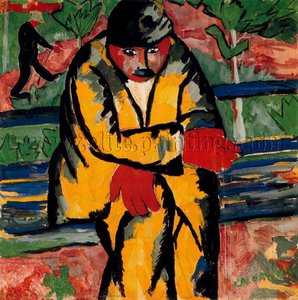
Kazimir Malevich's "Laundress," painted circa 1927, isn’t merely a depiction of domestic labor; it’s a profound distillation of form, color, and the quiet dignity of everyday life. Emerging from the fertile ground of Suprematism – Malevich’s revolutionary movement dedicated to pure abstraction – this work represents a pivotal moment in his artistic journey, bridging the gap between geometric experimentation and a renewed focus on human subject matter. The painting captures a woman engaged in her daily task at a washbasin, rendered with an almost austere beauty that belies its emotional depth.
The composition is strikingly simple yet remarkably dynamic. A central diagonal line, formed by the woman’s bent posture and the curve of the washbasin, immediately draws the viewer's eye through the scene. The arrangement feels deliberately balanced, with the bucket on her right providing a grounding element against the verticality of her form. Malevich masterfully employs geometric shapes – circles for the basin, cylinders for the bucket – not as decorative elements but as fundamental building blocks of his visual language. These forms are rendered in bold, confident lines, creating a sense of solidity and presence within the otherwise reductive space.
A Palette of Restraint and Texture
The painting’s color palette is deliberately restrained, dominated by shades of yellow, white, and muted browns. This monochromatic approach isn't about lack of vibrancy; rather, it serves to heighten the impact of form and texture. Malevich utilizes a technique of hatching – layering short, parallel lines – to suggest volume and shadow, creating an illusion of depth without resorting to traditional perspective. The varying density of these lines imbues the surfaces with a tactile quality, inviting the viewer to almost feel the roughness of the linen clothing and the coolness of the water.
The yellow headscarf worn by the laundress is particularly striking, acting as a focal point against the predominantly neutral background. It’s a small detail that injects warmth and humanity into the composition, hinting at the woman's identity and adding a subtle note of resilience. The careful rendering of her hands, visible as she reaches for the bucket, speaks volumes about the physicality of her labor – a testament to the quiet strength inherent in routine tasks.
Roots in Expressionism and Constructivism
"Laundress" reflects Malevich’s evolving artistic influences. Initially trained in Impressionism and Symbolism, he was deeply impacted by Cubism's fragmentation of form and Futurism’s celebration of dynamism. However, it was his encounter with the Russian avant-garde – particularly artists like Vladimir Tatlin and Piet Mondrian – that ultimately shaped his Suprematist vision. The painting’s simplified forms and expressive lines bear a clear resemblance to Expressionist techniques, while its emphasis on geometric abstraction aligns with Constructivist principles.
The historical context is crucial to understanding the work's significance. Created in the aftermath of the Russian Revolution, "Laundress" can be interpreted as a commentary on the changing social landscape and the role of labor within a new society. Malevich sought to strip away all superfluous elements – representing emotion, narrative, or individual identity – leaving only the essential forms and colors that conveyed pure feeling. This pursuit of “pure feeling” is powerfully embodied in this image of a woman performing her daily task with quiet determination.
Symbolism and Emotional Resonance
Beyond its formal qualities, "Laundress" resonates with profound symbolism. The act of washing represents purification, renewal, and the cyclical nature of life. The laundress herself embodies resilience, dignity, and a connection to the earth – her labor rooted in the rhythms of domesticity. Despite the painting’s stark simplicity, it evokes a sense of empathy and respect for this often-overlooked figure of everyday life.
Reproductions of “Laundress” offer a captivating glimpse into Malevich's artistic genius. Whether displayed as a statement piece in a modern interior or as a thoughtful addition to a collection of 20th-century art, this painting continues to inspire and provoke contemplation on the beauty found within simplicity and the enduring power of human experience.
Questions & Answers
What does "Laundress" share with the rest of Kazimir Malevich's output?
"Laundress" belongs to Kazimir Malevich's Expressionism work, whose recorded themes include expressionism, russian folk art, rural life, domestic routine, labor, hardship, diligence, malevich’s early experimentation”,.
From which country does the Expressionism work "Laundress" come?
"Laundress" was created by Kazimir Malevich, born in Ukraine, within the Expressionism movement. The artist's origin links the work to Expressionism as practiced by artists from Ukraine.
Is "Laundress" by Kazimir Malevich in the public domain, and why?
The copyright status of "Laundress" - in the public domain - its copyright has expired - follows from the artist's death in 1935.
Artist Biography
Kazimir Malevich: A Pioneer of Abstract Art
Early Life and Influences
- Born in Kyiv Oblast, Ukraine in 1878 to a Polish family, Kazimir Severinovich Malevich’s early life was shaped by the rural Ukrainian landscape and its rich folk culture.
- His upbringing instilled in him an appreciation for traditional artistic expressions that would later subtly influence his work.
- Formal training began in Kyiv, but Malevich quickly sought broader artistic horizons, moving towards Moscow and eventually engaging with the burgeoning avant-garde movements of Europe.
- Key Influences: Early exposure to folk art, combined with a desire for modern expression, formed the foundation of his unique style.
Artistic Development & Key Movements
- Initially, Malevich explored various styles including Impressionism, Symbolism, Fauvism, and Cubism. A pivotal trip to Paris in 1912 exposed him to the latest developments in European art.
- He gradually moved away from representational forms, seeking a purely artistic language based on geometric shapes and color.
- This led to the development of Suprematism around 1915 – an abstract movement focused on “the supremacy of pure feeling” in art.
- Suprematism rejected any attempt to depict objects from the visible world, instead prioritizing basic geometric forms like squares, circles, and rectangles.
Major Achievements & Notable Works
- Black Square (1915): Arguably his most famous work, it represents a radical departure from traditional art and is considered a foundational piece of abstract painting.
- White on White (1918): A series exploring the purity of form and color, featuring white geometric shapes against a white background – pushing abstraction to its limits.
- Stroyuschiysya dom [House under Construction] (1916): An early example of Suprematism showcasing his unique perspective on Ukrainian culture through abstract forms.
- He also wrote extensively on art theory, articulating the philosophical principles behind Suprematism and advocating for a new artistic consciousness.
Historical Significance & Legacy
- Malevich’s work profoundly impacted the development of 20th-century abstract art, influencing movements like Minimalism and Constructivism.
- He challenged conventional notions of representation and paved the way for non-objective art.
- His ideas about pure feeling and geometric abstraction continue to resonate with artists today.
- Despite facing political persecution under Stalin – initially supported, then suppressed – Malevich persevered in his practice and teaching.
- Influence on Later Artists: He directly influenced artists like El Lissitzky and indirectly shaped countless others through the enduring legacy of Suprematism.
Later Life & Death
- In his later years, Malevich revisited figurative painting, attempting to synthesize his abstract principles with representational forms.
- He continued to teach and write about art until his death in Leningrad (now St. Petersburg) in 1935.
- His work remained relatively obscure for decades after his death but experienced a resurgence of interest in the latter half of the 20th century, solidifying his place as one of the most important figures in modern art history.

Kazimir Malevich
1878 - 1935 , Ukraine
Related Articles
Beyond Representation: Exploring the Radical Geometry of Suprematism & Its Spiritual Foundations
Explore the revolutionary world of Suprematism with our expert guide. Discover Kazimir Malevich's groundbreaking art, its spiritual foundations & lasting influence on modern design. Learn about collecting this iconic movement.

Suprematism Explained: The Radical Geometry and Pure Feeling of Kazimir Malevich
Explore the radical world of Suprematism. Discover how Kazimir Malevich revolutionized modern art through pure geometric abstraction, non-objective form, and the supremacy of feeling. An essential guide for art students and collectors seeking deep historical context.
Kazimir Malevich: 25 Masterpieces of Suprematism & Abstract Art | OriginalUniqueArt
Explore 25 iconic artworks by Kazimir Malevich, pioneer of Suprematism & abstract art. Discover the stories behind 'Black Square' and more! Find museum-quality prints & elevate your home decor with OriginalUniqueArt.com.
Kazimir Malevich: Pioneering Suprematism & the Quest for Non-Objective Art
Explore the revolutionary art of Kazimir Malevich & his groundbreaking Suprematism movement. Discover the origins, core principles, and lasting impact of this pivotal force in modern abstract painting.
Cubist Expressionism's 10 Defining Masterpieces | Art for Your Home
Explore 10 defining Cubist Expressionism masterpieces by Picasso, Braque & more. Discover the stories behind these bold, geometric paintings and bring museum-quality art to your home with OriginalUniqueArt.com. Explore the full collection online.


![Black circle [1913] State Russian Museum,](/media/artworks/images-thumb/62/67/6267e452b0c8476772a6511e19ce1616.jpg)