Text size

() ·

A painting made for you, by hand

Making Umbrellas

Hand Made Oil Reproduction

Hand-painted oil on canvas in your size and frame, made to order by our artists. ( Switch to Print Switch to Digital Image)

Collectible Description

Discover 'Making Umbrellas' by Katsushika Hokusai! This monochrome woodblock print showcases Edo-period artistry & daily life. Explore Ukiyo-e’s beauty.

Artist Biography

Discover Katsushika Hokusai (1760-1849), Japan's ukiyo-e master! Explore 'The Great Wave,' landscapes, manga & woodblock prints. Influenced Impressionism & more!

from ·

Chapter 1

How large should it be?

Slide to change the size; the picture on the left shows the frame at its real width. The proportions of the original are kept.

Standard
custom
CM
INCH

Pick from our preset sizes that match the artwork's original proportions.

width
height

Type the width and the height you need, to fit your frame or your wall. This is hand-painted, so for a size with a different shape the artist can paint a bit more around the picture, or cut a bit — you choose. We send you a digital mockup to approve before the painting starts. The picture shown on this page does not show the real result — only the mockup does.

Chapter 2

How should it arrive?

Choose the edges of the stretched canvas

Choose your frame

Corner sample of the WhiteWrap canvas edge finish, stretched on solid wood bars
White $1
Corner sample of the BlurSideWrap canvas edge finish, stretched on solid wood bars
Blurside $1
Corner sample of the ExtendedWrap canvas edge finish, stretched on solid wood bars
Extended $1
Corner sample of the P118B picture frame: moulded polystyrene, 5 cm wide and 3 cm thick
P118B $10
Corner sample of the P118H picture frame: moulded polystyrene, 5 cm wide and 3 cm thick
P118H $10
Corner sample of the P118W picture frame: moulded polystyrene, 5 cm wide and 3 cm thick
P118W $10
Corner sample of the P438Z picture frame: moulded polystyrene, 5.5 cm wide and 3.5 cm thick
P438Z $10
Corner sample of the P508JH picture frame: moulded polystyrene, 7 cm wide and 3.5 cm thick
P508JH $12
Corner sample of the P508YH picture frame: moulded polystyrene, 7 cm wide and 3.5 cm thick
P508YH $12
Corner sample of the P805H picture frame: moulded polystyrene, 5 cm wide and 3.5 cm thick
P805H $10
Corner sample of the P805Z picture frame: moulded polystyrene, 5 cm wide and 3.5 cm thick
P805Z $10
Corner sample of the P919BZ picture frame: moulded polystyrene, 7 cm wide and 3.5 cm thick
P919BZ $10
Corner sample of the P919G picture frame: moulded polystyrene, 7 cm wide and 3.5 cm thick
P919G $10
Corner sample of the P919XJ picture frame: moulded polystyrene, 7 cm wide and 3.5 cm thick
P919XJ $10
Corner sample of the P959ZH picture frame: moulded polystyrene, 5 cm wide and 3 cm thick
P959ZH $10
Corner sample of the P968JZ picture frame: moulded polystyrene, 6 cm wide and 4 cm thick
P968JZ $12
Corner sample of the W106C picture frame: solid wood, 5 cm wide and 3 cm thick
W106C $8
Corner sample of the W218G picture frame: solid wood, 5 cm wide and 3 cm thick
W218G $10
Corner sample of the W218JH picture frame: solid wood, 5 cm wide and 3 cm thick
W218JH $8
Corner sample of the W218Y picture frame: solid wood, 5 cm wide and 3 cm thick
W218Y $10
Corner sample of the W307PJ picture frame: solid wood, 6 cm wide and 3 cm thick
W307PJ $10
Corner sample of the W316G picture frame: solid wood, 6 cm wide and 3 cm thick
W316G $10
Corner sample of the W316PJ picture frame: solid wood, 6 cm wide and 3 cm thick
W316PJ $8
Corner sample of the W316Y picture frame: solid wood, 6 cm wide and 3 cm thick
W316Y $10
Corner sample of the W398PJ picture frame: solid wood, 5 cm wide and 3 cm thick
W398PJ $8
Corner sample of the W4111J picture frame: solid wood, 6.5 cm wide and 3.5 cm thick
W4111J $10
Corner sample of the W500HY picture frame: solid wood, 7 cm wide and 5 cm thick
W500HY $15
Corner sample of the W500JH picture frame: solid wood, 7 cm wide and 5 cm thick
W500JH $15
Corner sample of the W692G picture frame: solid wood, 8 cm wide and 4 cm thick
W692G $12
Corner sample of the W849H picture frame: solid wood, 5 cm wide and 3 cm thick
W849H $8
Corner sample of the W940BG picture frame: solid wood, 7.5 cm wide and 4.5 cm thick
W940BG $15
Corner sample of the W953PJ picture frame: solid wood, 6 cm wide and 3.5 cm thick
W953PJ $8
Corner sample of the H24-GOLD picture frame: carved wood with gesso, 10 cm wide and 6 cm thick
H24-GOLD $30
Corner sample of the H24-SILVER picture frame: carved wood with gesso, 10 cm wide and 6 cm thick
H24-SILVER $30
Corner sample of the H36-GOLD picture frame: carved wood with gesso, 15 cm wide and 6.5 cm thick
H36-GOLD $45
Corner sample of the H36-SILVER picture frame: carved wood with gesso, 15 cm wide and 6.5 cm thick
H36-SILVER $45
Frame preview
Framed

Moulding: . Overall size with the frame: .

Chapter 3

Who paints it, and should anything change?

Examples of what can be changed: Replace face with customer photo; Add pet (e.g., replace cat with dog); Include hidden message in background; Change background landscape or elements.
After order, OriginalUniqueArt.com team will email client for instructions and provide a mockup preview

Worldwide Delivery () in 3/4 weeks instead of standard 5 weeks. (2 November). No compromise on quality.

Chapter 4

The finishing touches

A nameplate, as in a museum?

Engraved Bronze Plaque Details

This elegant plaque features the artist's name and the title of the artwork, finely engraved for a timeless presentation.

It is made from bronze with a refined, elegant finish. The text is precisely laser-engraved for a sharp and permanent result. Measuring 9x2 cm, the plaque is compact yet easy to read. It's built to be durable and scratch-resistant, offering a professional, museum-quality look. Mounting is simple thanks to the included adhesive backing.

Transparent Acrylic Plaque Details

The plaque includes essential engraved details such as the artist's name, the title of the artwork, the date it was created, the type of media used-like oil on canvas or watercolor-a brief description of the piece, and a QR code that links to the complete artwork information.

It is crafted from clear acrylic, offering a sleek, modern appearance. The text is UV-engraved in black to ensure strong visual contrast. With a size of 10x15 cm, it ensures optimal readability. It comes equipped with two metal hooks for secure wall mounting. The plaque is designed to be weather-resistant, making it suitable for various environments, and it includes interactive features that work seamlessly with smartphone scanning.

Black Acrylic Plaque Details

This elegant plaque includes engraved information such as the artist's name, the title of the artwork, the date it was created, the type of media used (like oil on canvas or watercolor), a short description of the artwork, and a QR code for quick access to more information.

The plaque itself is made from refined black acrylic with a premium finish. The text is laser-engraved in white for high contrast and readability. Its size is 10x15 cm, designed to be easy to read. It comes with two metal hooks for professional mounting. The design is sleek and fits any interior style. It is also weather-resistant and durable, with built-in digital integration for mobile compatibility.

A protective varnish?

When do you need it?

Chapter 5

Your painting, as you ordered it

Making Umbrellas

Reproduction Medium

Reproduction Size

-

Elite Senior Artist

More detail, finesse, and extra production time

-

Reproduction Frame

-

-

For artworks or reproductions larger than 105 cm (approximately 41 inches) on any side, the frame will be shipped as a kit, disassembled. This method ensures safe delivery and prevents damage during transport.

Professional assembly required - this is not a DIY product.
The kit must be assembled and the canvas stretched by an experienced professional framer, using wood glue (not supplied), a canvas stretching plier and clamps to hold the bars square while the glue dries. Incorrect assembly or uneven canvas tension can permanently damage the artwork and is not covered by our warranty.

  • All solid wood bars are included, precisely cut to size.

  • Assembled with the screws provided, plus wood glue for the corner joints, which is not supplied and must be sourced by your framer.

  • Professional tools are required and not included: a canvas stretching plier (tensioner) and clamps to hold the bars square while the glue dries.

Important:
The corner joints require wood glue, the bars must be held with clamps until the glue is fully dry, and tightening the canvas on the assembled frame requires a canvas stretching plier. None of these are included in the kit. Please arrange an experienced professional framer before ordering this size.

Nameplate

-

-

Protective Varnish

Glossy Varnish (enhances colors, protects against light/moisture)

-

Customize My Artwork

Examples of what can be changed: Replace face with customer photo; Add pet (e.g., replace cat with dog); Include hidden message in background; Change background landscape or elements.

-

Urgent

Worldwide Delivery () in 3/4 weeks instead of standard 5 weeks. (2 November). No compromise on quality.

-

Express Shipping

Worldwide Delivery () in 5 weeks. (9 November).

Included

Total Price

$ 325

Total Price $ 325

Glass option is only available in size under 110 CM

Included with every order

  • Free Worldwide Express Shipping
  • High-Quality Linen Canvas
  • Full Shipping Insurance
  • Customs Tax Refund Guarantee
  • True Color Matching Guarantee
  • 100-Day Return Policy (Defects Only)
  • 100% Money-Back Guarantee
  • Bulk Discount Offer

Exploring Tranquility: Katsushika Hokusai’s “Making Umbrellas”

Katsushika Hokusai, a titan of Edo-period Japanese art, transcends the label of mere printmaker; he was a visionary who fundamentally reshaped perceptions of landscape and artistic expression. His oeuvre encompasses an astonishing breadth of subjects – from towering Mount Fuji to bustling cityscapes – yet “Making Umbrellas,” created around 1832, stands as a testament to his unwavering commitment to capturing subtle nuances of everyday life with breathtaking precision.

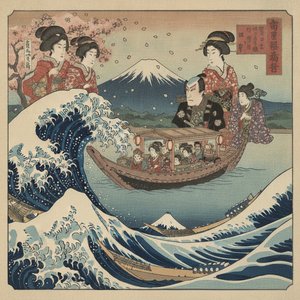
  • Subject Matter: The print depicts two figures seated beneath an umbrella in what appears to be a courtyard setting. These individuals are engaged in calligraphy or painting, representing the pursuit of artistic endeavor and intellectual contemplation – core values within Japanese culture during Hokusai’s time.
  • Style & Technique: “Making Umbrellas” exemplifies the hallmark aesthetic of Ukiyo-e—a style characterized by bold outlines, simplified forms, and a deliberate restraint in color palette. The artist skillfully employs woodblock printing techniques to achieve remarkable textural detail despite the monochrome presentation.

The meticulous carving process involved transferring a detailed design onto a wooden block, followed by applying ink – typically Prussian blue – multiple times to produce layered impressions on washi paper. This technique allowed Hokusai to convey depth and atmosphere through subtle shading and tonal variations, creating an illusion of realism that belies the apparent simplicity of the composition.

Historical Context: Produced during the Edo period (1603-1868), “Making Umbrellas” reflects Japan’s flourishing artistic traditions and its fascination with capturing fleeting moments of beauty. The print speaks to a broader cultural preoccupation with harmony between humanity and nature – a theme prevalent throughout Hokusai's work.

Symbolism & Emotional Impact: Beyond its depiction of daily activity, “Making Umbrellas” carries symbolic weight. The umbrella itself represents protection from adversity—both physical and spiritual—while simultaneously symbolizing resilience and adaptability. Viewing this print evokes a sense of serenity and contemplation, inviting the viewer to appreciate the quiet dignity of human endeavor amidst the grandeur of Mount Fuji’s presence in the background.

  • Composition: The central figures dominate the frame, positioned against a backdrop of stylized Mt. Fuji—a motif frequently utilized by Hokusai to convey sublimity and spiritual significance.
  • Line Work & Texture: Precise linework defines shapes and contours, creating an impression of solidity and stability. Simultaneously, subtle shading suggests fabric texture, enhancing the visual richness of the print without resorting to color.

“Making Umbrellas” isn’t merely a beautiful image; it's a window into the artistic soul of Katsushika Hokusai—a master who captured the essence of Japanese culture and continues to inspire admiration centuries later.

Questions & Answers

What is the overall mood of "Making Umbrellas" by Katsushika Hokusai?

"Making Umbrellas" by Katsushika Hokusai is described as calm in mood. This classification can help match the work to a setting.

Who is the author of "Making Umbrellas", and in which movement?

"Making Umbrellas" was created by Katsushika Hokusai in the Ukiyo-e style. Artist and movement identify the work's tradition.

Where can I see a preview of "Making Umbrellas"?

The Preview page of "Making Umbrellas" lets you preview the artwork before ordering.

More about this painting

Preview AR preview Switch to Print Switch to Digital Image Send
Details Guide Add to favorites Download Similars X-Ray Diaporama Q&A Stats

In numbers

  • 29frames to choose from
  • standard sizes, in its own proportions
  • 5weeks to paint and deliver it
Katsushika Hokusai

Katsushika Hokusai

1760 - 1849, Japan

Quick facts about Katsushika Hokusai

  • Full Name: Katsushika Hokusai
  • Nationality: Japanese
  • Date Of Birth: 1760
  • Date Of Death: 1849
  • Place Of Birth: Tokyo, Japan
  • Notable Artworks:
    • The Great Wave off Kanagawa
    • Thirty-six Views of Mt. Fuji
    • Hokusai Manga
    • Fireworks at Ryōgoku Bridge
  • Artistic Movement Or Style: Ukiyo-e
  • Artists Who Influenced This Artist: ['Chinese landscape painting']
  • Artists Or Movements Influenced By This Artist:
    • Impressionism
    • Vincent van Gogh
    • Claude Monet

Artist Biography

A Life Etched in Ink: The World of Katsushika Hokusai

Katsushika Hokusai, a name synonymous with Japanese art and the iconic image of *The Great Wave off Kanagawa*, was far more than just a printmaker. Born in Edo (modern-day Tokyo) around 1760, his life was a restless pursuit of artistic mastery, a constant evolution marked by shifting names and an insatiable curiosity. From humble beginnings as the son of a mirror maker, Hokusai’s early inclination towards art wasn't immediately encouraged; yet, he relentlessly honed his skills, reportedly beginning to draw at the age of six. This dedication would define a career spanning nearly nine decades, leaving behind a legacy that continues to resonate with audiences worldwide. His father, Nakajima Ise, though not an artist himself, recognized and perhaps fostered this nascent talent, laying the groundwork for a journey that would transform Japanese visual culture. Hokusai’s early life wasn't one of privilege, but rather a steady climb fueled by ambition and a deep-seated passion to capture the essence of the world around him.

From Apprenticeship to Innovation: The Blossoming of a Style

Hokusai’s formal artistic training began at twelve when he entered the studio of Katsukawa Shunshō, a leading master of *ukiyo-e* – “pictures of the floating world.” This genre, popular during the Edo period, depicted scenes from everyday life: actors, courtesans, landscapes, and glimpses into the vibrant urban culture. Under Shunshō’s guidance, Hokusai mastered the techniques of woodblock printing, a demanding process requiring precision and artistry. However, he wasn't content to simply replicate his teacher’s style. Even in his early work, a restless spirit was evident, a desire to push boundaries and explore new avenues of expression. He experimented with different subjects, from book illustrations to single-sheet prints, constantly refining his skills and developing a unique visual language. This period also saw the first of many name changes – a common practice among *ukiyo-e* artists signifying periods of artistic reinvention or affiliation with different schools. He initially focused on illustrating books, which provided him with steady work and allowed him to develop his compositional skills. But it was his move towards single-sheet prints that truly unleashed his creative potential.

Mount Fuji and the Floating World: Defining Masterpieces

Hokusai’s artistic output was astonishingly prolific; thousands of woodblock prints, paintings, and illustrated books bear his signature. While he explored a wide range of subjects, it was his series *Thirty-six Views of Mount Fuji* (circa 1831) that cemented his fame. This collection, featuring the now-iconic *The Great Wave off Kanagawa*, wasn’t merely a depiction of a landscape; it was a masterful exploration of perspective, composition, and the power of nature. The wave itself, a towering force about to crash down on tiny boats, embodies both the beauty and the terror of the sea. Beyond *Fuji*, works like *Fireworks at Ryōgoku Bridge* (1790) demonstrated his ability to capture dynamic scenes of daily life with remarkable energy and detail. His *Hokusai Manga* – a collection of sketches and studies encompassing people, animals, landscapes, and fantastical creatures – was groundbreaking in its scope and influence, foreshadowing the development of modern manga as an art form. These works weren’t isolated achievements; they were milestones in a continuous artistic journey, each building upon the last to create a body of work that is both deeply rooted in Japanese tradition and remarkably innovative.

A Legacy Beyond Borders: Hokusai's Enduring Influence

Hokusai’s impact extended far beyond Japan. In the late 19th century, as Japan opened its doors to the West, *ukiyo-e* prints flooded European markets, sparking a phenomenon known as *Japonisme*. Artists like Claude Monet, Edgar Degas, and Vincent van Gogh were captivated by Hokusai’s bold compositions, vibrant colors, and unconventional perspectives. Van Gogh, in particular, was deeply influenced by *The Great Wave*, even recreating it in his own paintings. Hokusai's influence wasn't limited to Impressionism; it permeated various modern art movements, shaping the way artists approached composition, color, and subject matter. His emphasis on capturing fleeting moments, his dynamic use of line, and his ability to find beauty in everyday life resonated with a generation of artists seeking new forms of expression. Even today, Hokusai’s work continues to inspire and challenge artists around the world, solidifying his place as one of the most important figures in art history. He continued painting until his death in 1849 at the age of 89, leaving behind a vast body of work that remains a testament to his unwavering dedication and artistic genius.

The Old Man Mad About Painting

Hokusai’s life was one of constant reinvention, marked by numerous name changes – over thirty throughout his career – each reflecting a new phase in his artistic development. He often referred to himself as “Gakyō Rōjin,” or "Old Man Crazy to Paint," a fitting title for an artist who remained passionately devoted to his craft well into his eighties. This relentless pursuit of perfection, coupled with his innovative spirit and profound understanding of both Japanese tradition and the wider world, cemented Hokusai’s legacy as a true master of *ukiyo-e* and a pivotal figure in the history of art. His work continues to captivate audiences, reminding us of the power of art to transcend cultural boundaries and connect us to something larger than ourselves.
  • Major Influences: Ukiyo-e traditions, Chinese landscape painting, everyday life in Edo.
  • Key Characteristics: Bold lines, vibrant colors, dynamic compositions, keen observation of nature.

Quick Facts

  • Location: Private Collection
  • Subject or theme: Daily Life; Calligraphy/Painting
  • Influences: Japanese Tradition
  • Medium: Woodblock Print
  • Movement: Edo Period Art