
 Preview
 Send
Send Share
Share
 Details

 Download
 Similars
 X-Ray
X-Ray Diaporama


 Read More
Purchase a high-resolution, enhanced digital image, far superior to the online preview.
Each file is meticulously prepared by our in-house specialists using advanced tools and expert manual retouching. We ensure every image has exceptional clarity, precise color accuracy, and fine detail.
The final file is delivered via email within 72 hours, optimized for immediate use in professional, editorial, and print environments. This is the same quality trusted by top-tier design studios, publishers, and galleries.
Digital Image
Download a high-resolution file for personal display, printing, and creative projects. ( Switch to Print Switch to hand made Painting)
Included in Every Digital Image Order
Expert Digital Delivery, Guaranteed
When you choose OriginalUniqueArt.com, you're not just getting an image - you're receiving a professionally enhanced digital artwork, crafted with precision and backed by a satisfaction guarantee. Here's everything that comes with your order, automatically:

Fast Email Delivery
Your high-resolution digital image file will be emailed to you within 72 hours of ordering - ready for immediate use.

AI-Enhanced Digital File
Your artwork is professionally optimized using advanced AI tools and manual editing, ensuring maximum detail, clarity, and color accuracy.

Free Lifetime Re-Delivery
Accidentally deleted or lost your file? No worries - we'll resend it to you anytime, free of charge.

No Import Fees - Ever
Enjoy your artwork instantly with zero customs, duties, or delivery fees - digital downloads are always tax-free.

Color Accuracy Guarantee
We ensure your digital image reflects the original colors as closely as possible using professional tools and color management.

60-Day Satisfaction Guarantee
If you're not satisfied with your digital image, we'll revise it or refund 100% within 60 days - no questions asked.

100% Money-Back Guarantee
Not satisfied? Get a full refund within 60 days of receiving your digital file - no questions asked.

Bulk Order Discounts
Buy 3 images, save 10% - Buy 5, save 15% - Buy 10+, save 20%. Great for creative projects, galleries, and agencies.
Collectible Description
A Soldier’s Salute: Jules Chéret's “Join the Army”
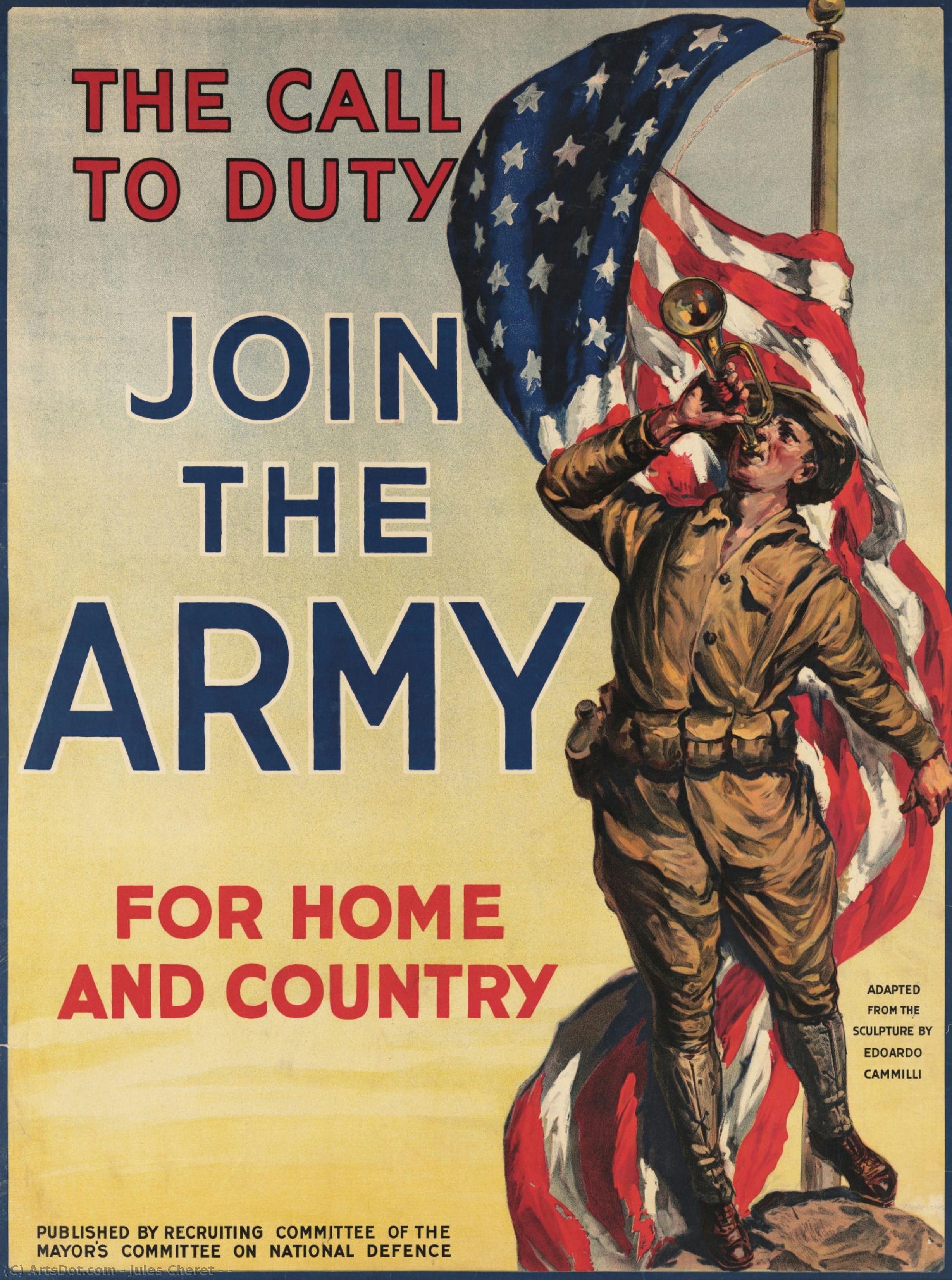
Jules Chéret’s 1918 painting, "Join the Army," is more than just a recruitment poster; it’s a vibrant snapshot of a pivotal moment in American history and a testament to the artist’s groundbreaking approach to commercial art. Captured at the National WWI Museum and Memorial in Kansas City, this work immediately draws the eye with its bold colors, dynamic composition, and the confident posture of the young soldier. It's a piece that speaks volumes about patriotism, duty, and the burgeoning spirit of modernity during a time of immense global upheaval.
The Artist and His Time: Chéret’s Parisian Innovation
Jules Chéret (1836-1932) emerged as a leading figure in the Belle Époque, a period of unprecedented artistic and cultural flourishing in Paris. Unlike many artists of his era who adhered strictly to academic traditions, Chéret embraced a more pragmatic approach, initially apprenticed to a lithographer and later developing his distinctive style through experimentation with color printing techniques. His early work focused on advertising posters for Parisian theaters and businesses – a burgeoning industry at the time. He quickly recognized the potential of the poster as a powerful medium for communication, moving beyond simple announcements to create visually arresting images that captured the essence of their subject. This shift towards graphic design, prioritizing clarity and impact over elaborate detail, was revolutionary for its time.
A Study in Composition and Color: Decoding the Image
The painting’s composition is remarkably effective. The soldier, rendered with a youthful energy and a direct gaze, dominates the foreground, his posture radiating confidence and resolve. He holds a bugle aloft, poised to salute the American flag that billows proudly behind him – a potent symbol of national identity and sacrifice. Chéret's use of color is equally striking; vibrant reds, blues, and yellows create a sense of dynamism and excitement, while the stark black lettering of “Join the Army” commands immediate attention. The background is deliberately simplified, focusing the viewer’s eye on the central figure and his symbolic gesture. Notice how Chéret utilizes loose brushstrokes and a slightly flattened perspective – a characteristic of his style that lends the image an immediacy and vitality.
Symbolism and Context: A Call to Service in Wartime
“Join the Army” is deeply rooted in the context of World War I. The United States’ entry into the conflict in 1917 created a massive demand for recruits, and posters like this were instrumental in mobilizing public support. The soldier's youthful appearance was deliberately chosen to appeal to young men eager to prove themselves. The flag itself represents not just patriotism but also the ideals of freedom and democracy that America sought to defend abroad. The bugle’s call is a direct invitation – a summons to duty and service. Beyond its immediate purpose as a recruitment tool, the painting embodies the romanticized notion of war as a noble endeavor, a sacrifice for a greater cause. It's important to remember this was created during a time when public perception of war was often idealized.
Collecting and Displaying: Bringing Chéret’s Vision Home
Reproductions of “Join the Army” offer a captivating glimpse into a pivotal moment in American history. Whether displayed as a statement piece in a study or incorporated into a broader collection of WWI memorabilia, this artwork evokes a powerful sense of patriotism and historical significance. The bold colors and dynamic composition make it an ideal choice for interior designers seeking to inject energy and visual interest into any space. Consider framing the reproduction in a vintage-inspired frame to further enhance its connection to the era. This piece is more than just decoration; it’s a conversation starter, a reminder of the sacrifices made by generations past, and a testament to the enduring power of art to shape public opinion.
Artist Biography
The Dawn of the Belle Époque: Jules Chéret and the Art of the Modern Poster
Jules Chéret, a name synonymous with the vibrant spirit of Paris during the *Belle Époque*, wasn’t merely an artist; he was a revolutionary. Born in 1836 to a family of artisans, his journey from humble beginnings to becoming “the father of the modern poster” is a testament to his innovative spirit and artistic vision. Unlike many artists constrained by formal academic training, Chéret's early education was practical – an apprenticeship with a lithographer at the age of thirteen ignited a passion that would redefine commercial art. This initial exposure wasn’t simply about learning a trade; it was an immersion into the possibilities of mass communication and visual persuasion. He honed his skills further with studies at the École Nationale de Dessin, absorbing the artistic currents of Paris, but it was his six years in London, from 1859 to 1866, that proved pivotal. There, he encountered a British poster aesthetic focused on clarity and impact, techniques he would later synthesize with his own uniquely French sensibility.From Cabarets to Cosmetics: A Flourishing Career
Upon returning to France, Chéret didn’t seek patronage from the established art world; instead, he turned to the burgeoning entertainment industry. Paris was transforming—a city of dazzling cabarets, grand music halls, and increasingly sophisticated theaters. Chéret became their visual voice. He created posters for iconic venues like the Eldorado, Olympia, Folies Bergère, Moulin Rouge, and Théâtre de l'Opéra, each advertisement a burst of color and energy designed to lure audiences into a world of spectacle. But his talent wasn’t limited to entertainment; he soon found demand from diverse businesses – beverages, perfumes, soaps, cosmetics, even railroads – recognizing the power of his art to elevate their brands. This expansion wasn't accidental. Chéret understood that advertising didn’t have to be purely functional; it could be beautiful, engaging, and a reflection of the era’s optimism. He skillfully blended artistic finesse with commercial needs, creating images that were both eye-catching and evocative. His style drew heavily from the playful, frivolous scenes favored by Rococo masters like Fragonard and Watteau, injecting a sense of elegance and lightheartedness into the urban landscape.The ‘Cherettes’ and a Changing Society
Central to Chéret's success were his depictions of women – the now-iconic “cherettes.” These weren’t the idealized goddesses or demure Victorian ladies prevalent in earlier art; they were vibrant, independent figures radiating joy and confidence. They embodied a new spirit of freedom and modernity, challenging societal norms and reflecting a changing role for women in Parisian society. Before Chéret, representations of women tended towards extremes – either saintly purity or blatant sexuality. The *cherettes* occupied a space in between, suggesting a playful sensuality without being overtly provocative. They were fashionable, active, and engaged with the world around them, enjoying activities previously considered off-limits to respectable women. This portrayal wasn’t merely artistic license; it resonated deeply with a public eager for change, contributing to a more open atmosphere where women could express themselves and participate in public life with greater autonomy. The *cherettes* became symbols of the era, influencing fashion trends and challenging conventional attitudes towards femininity.A Lasting Legacy: Innovation and Influence
Chéret’s impact extended far beyond his individual posters. In 1895, he launched *Maîtres de l'Affiche*, a groundbreaking publication featuring reproductions of works by ninety-seven Parisian artists – a deliberate effort to elevate the status of poster art and recognize its creators. This initiative not only showcased the diversity of talent within the field but also helped establish collecting posters as a legitimate pursuit. He inspired a new generation of artists, including Charles Gesmar and Henri de Toulouse-Lautrec, with Georges de Feure being one of his direct students. His technical innovations in lithography – particularly his ability to achieve vibrant colors using a limited number of stones – revolutionized the printing process and made high-quality posters more accessible. Recognized for his contributions with the Légion d'honneur in 1890, Chéret continued to work prolifically until his death in 1932 at the remarkable age of ninety-six. A posthumous exhibition at the Salon d'Automne in Paris in 1933 cemented his legacy, and his posters quickly became highly sought after by collectors worldwide – a testament to the enduring power of an art form he single-handedly transformed from commercial necessity into a celebrated artistic expression. He didn’t just create advertisements; he created a visual language for a new era, capturing the energy, optimism, and evolving social landscape of *la belle époque* for generations to come.
Jules Chéret
1836 - 1932 , France
Quick Facts
- Artistic Movement Or Style: Belle Époque, Art Nouveau
- Artists Or Movements Influenced By This Artist:
- Toulouse-Lautrec
- Gesmar
- De Feure
- Artists Who Influenced This Artist:
- Fragonard
- Watteau
- Date Of Birth: 1836
- Date Of Death: 1932
- Full Name: Jules Chéret
- Nationality: French
- Notable Artworks:
- Pan poster
- Loie Fuller poster
- Place Of Birth: Paris, France

