Preview
 Send
Send Share
Share
 Details

 Download
 Similars
 X-Ray
X-Ray Diaporama
 Stats
StatsBorgia
 1968
1968 56.0 x 76.0 cm
 Read More
Hand Made Oil Reproduction
Hand-painted oil on canvas in your size and frame, made to order by our artists. ( Switch to Print Switch to Digital Image)




































Pick from our preset sizes that match the artwork's original proportions.

You may enter your own dimensions to fit a specific frame or space. If your selected size does not match the original image's proportions, we will either crop the artwork or extend the painting with additional hand-painted elements. A digital mockup will be sent for your approval before production begins.
Please note that the on-screen preview does not reflect the actual cropping or extension. Only the mockup will accurately show the final composition.
While custom sizes are available, we recommend selecting a dimension from the predefined list to preserve the original proportions.
After order, OriginalUniqueArt.com team will email client for instructions and provide a mockup preview
Worldwide Delivery () in 3/4 weeks instead of standard 5 weeks. (12 September). No compromise on quality.

Free Worldwide Express Shipping

High-Quality Linen Canvas

Full Shipping Insurance

Customs Tax Refund Guarantee

True Color Matching Guarantee

100-Day Return Policy (Defects Only)

100% Money-Back Guarantee

Bulk Discount Offer
 Glass option is only available in size under 110 CM

Borgia
Reproduction Medium
Reproduction Size
-


Total Price
$ 300
Artistic Style and Influences
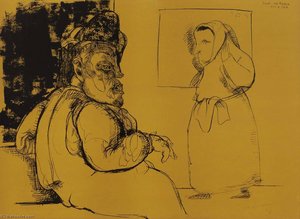
Jose Luis Cuevas' artistic style is characterized by his use of bold lines, vibrant colors, and a mix of realistic and abstract elements. His work is often described as a fusion of Mexican and European influences, reflecting his cultural heritage and artistic training. In "Borgia", Cuevas employs a range of techniques to create a sense of depth and texture, drawing the viewer into the world of the painting.Historical Context and Symbolism
The title "Borgia" refers to the infamous Borgia family, known for their power and corruption in Renaissance Italy. The painting features two figures, a man and a woman, dressed in formal attire, with the man holding a pipe and the woman looking away. The symbolism in the painting is open to interpretation, but it is believed to represent the themes of power, corruption, and mortality.- The use of dark colors and bold lines creates a sense of drama and tension, reflecting the tumultuous history of the Borgia family.
- The figures in the painting are depicted with distorted proportions, adding to the sense of unease and uncertainty.
- The pipe held by the man may symbolize the transience of life and the fleeting nature of power.
The "Borgia" painting is a testament to the enduring power of art to capture the human experience and inspire reflection on the complexities of history and culture.
Artist Biography
A Maverick Spirit: The Life and Art of José Luis Cuevas
José Luis Cuevas, born in Mexico City in 1934, emerged as a pivotal figure in Mexican art history, boldly challenging the established dominance of muralism that had defined the nation’s artistic identity for decades. His was not a rebellion rooted in mere stylistic difference, but a profound questioning of the social and political narratives embedded within those monumental works. Born amidst the hum of his family's paper and pencil factory, Cuevas’ early life was marked by both creative stimulation and physical fragility. A childhood illness forced him into prolonged periods of confinement, during which he discovered an enduring passion for drawing and engraving – skills honed under the tutelage of Lola Cueto at Mexico City College. This period of isolation proved formative, fostering a deeply personal artistic vision that would consistently prioritize introspection over grand pronouncements. He briefly attended the prestigious Escuela Nacional de Pintura, Escultura y Grabado "La Esmeralda," but his health concerns ultimately led him to forge an independent path, establishing a studio at just fourteen years old and embracing self-education as his primary mode of artistic development.Breaking with Tradition: The Generación de la Ruptura
Cuevas became a leading voice within the *Generación de la Ruptura* (Breakaway Generation), a collective of artists who rejected the overtly nationalistic and socially didactic approach of muralism, spearheaded by figures like Diego Rivera, José Clemente Orozco, and David Alfaro Siqueiros. While these masters sought to depict Mexico’s history and struggles on a grand scale, Cuevas and his contemporaries turned inward, exploring themes of alienation, existential angst, and the darker aspects of human experience. His work is characterized by distorted figures, fragmented forms, and a deliberately unsettling aesthetic that reflects a profound disillusionment with prevailing ideologies. He wasn't interested in celebrating collective identity; instead, he focused on the individual’s psychological landscape, often portraying figures wracked with inner turmoil or trapped within oppressive circumstances. This deliberate shift marked a significant turning point in Mexican art, paving the way for greater experimentation and personal expression. His early work was exhibited at the Galera Prisse in Mexico City in 1953, and soon after he began to gain international recognition.A Controversial Visionary: Themes and Techniques
Cuevas’ artistic output is remarkably diverse, encompassing painting, drawing, printmaking, sculpture, and writing. However, a consistent thread runs through his entire oeuvre: an unflinching exploration of the human condition in all its complexity and imperfection. He frequently depicted scenes of violence, decay, and moral corruption, challenging viewers to confront uncomfortable truths about themselves and society. His self-portraits, numbering in the hundreds, are particularly revealing, offering a raw and often brutally honest depiction of his own anxieties, vulnerabilities, and obsessions. He embraced a variety of techniques, demonstrating mastery in engraving, lithography, and mixed media. He was known for his meticulous draftsmanship and his ability to create powerful images with minimal means. His style evolved over time, incorporating elements of Expressionism, Surrealism, and Abstract Art, but always remained distinctly personal and recognizable. He wasn’t afraid to court controversy, often using shocking imagery and provocative statements to challenge conventional norms and provoke debate.Legacy and the Museo José Luis Cuevas
Throughout his career, José Luis Cuevas remained a fiercely independent and outspoken figure, unafraid to criticize those he perceived as compromising their artistic integrity for political or commercial gain. His uncompromising stance earned him both admirers and detractors, solidifying his reputation as a maverick within the art world. In 1982, he represented Mexico at the Venice Biennale, further cementing his international standing. Perhaps his most enduring legacy is the Museo José Luis Cuevas, established in 1992 in the historic center of Mexico City. The museum houses an extensive collection of his own work, as well as a remarkable array of pre-Hispanic artifacts and European masterpieces that he amassed over the years. It stands as a testament to his eclectic tastes and his unwavering commitment to artistic excellence. He continued working and exhibiting until his death in 2017, leaving behind a vast and influential body of work that continues to inspire and challenge audiences today. His impact on Mexican art is undeniable; he liberated a generation of artists from the constraints of tradition and encouraged them to embrace their own unique voices, even if those voices were uncomfortable or unpopular. He remains a potent symbol of artistic freedom and intellectual independence.
José Luis Cuevas
1934 - 2017 , Mexico
Quick Facts
- Artistic Movement Or Style: Generación de la Ruptura
- Date Of Birth: February 26, 1934
- Date Of Death: July 3, 2017
- Full Name: José Luis Cuevas
- Nationality: Mexican
- Notable Artworks:
- Interior
- Rasputin
- Cast of Characters
- Place Of Birth: Mexico City, Mexico