Preview
 Send
Send Share
Share
 Details
 Guide
Guide

 Download
 Similars
 X-Ray
X-Ray Diaporama
 Stats
StatsHilltop


 Read More
Giclée / Art Print
Museum-quality giclée or canvas print with fast production and flexible finish options. ( Buy Hand Made Painting Switch to Digital Image)




P118B $10

P118H $10

P118W $10

P438Z $10

P508JH $12

P508YH $12

P805H $10

P805Z $10

P919BZ $10

P919G $10

P919XJ $10

P959ZH $10

P968JZ $12

W106C $8

W218G $10

W218JH $8

W218Y $10

W307PJ $10

W316G $10

W316PJ $8

W316Y $10

W398PJ $8

W4111J $10

W500HY $15

W500JH $15

W692G $12

W849H $8

W940BG $15

W953PJ $8




Pick from our preset sizes that match the artwork's original proportions.

Type the width and the height you need, to fit your frame or your wall. A print can only be cut, never made bigger than the picture, so a size with a different shape loses a part of the image. We send you a digital mockup to approve before we print anything. The picture shown on this page does not show the real cut — only the mockup does.
Worldwide Delivery () in 2 weeks instead of standard 4/5 weeks. (23 October)

Free Worldwide Express Shipping

High-Quality Linen Canvas

Full Shipping Insurance

Customs Tax Refund Guarantee

True Color Matching Guarantee

100-Day Return Policy (Defects Only)

100% Money-Back Guarantee

Bulk Discount Offer
 Glass option is only available in size under 110 CM

Hilltop
Giclée / Art Print
Reproduction Size
-


Total Price
$ 81
The Essence of a Moment – John La Farge’s Hilltop
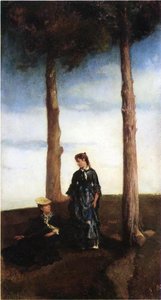
John La Farge's “Hilltop,” painted in 1862, isn’t merely a depiction of a woodland scene; it’s a carefully constructed evocation of the American spirit—a blend of Romantic idealism and burgeoning realism. The painting captures a fleeting moment within a verdant landscape, centered around two figures standing beneath a canopy of trees. The composition immediately draws the eye to this intimate tableau, suggesting a shared experience of quiet contemplation amidst nature’s grandeur. La Farge masterfully employs light and shadow to create a sense of depth and atmosphere, imbuing the scene with a palpable warmth that belies the cool tones of the palette.

Image: John La Farge, portrait by an unknown artist
A Symphony of Color and Technique
La Farge’s distinctive approach to color is immediately apparent in “Hilltop.” He eschews the stark realism favored by some contemporary artists, instead opting for a rich, luminous palette—a hallmark of his style. The greens are not uniform; they range from deep forest hues to lighter, almost ethereal shades, suggesting varying depths and textures within the foliage. The figures themselves are rendered with subtle gradations of tone, conveying a sense of volume and form without resorting to sharp outlines. La Farge’s technique is characterized by loose brushstrokes and a delicate layering of paint—a method that contributes significantly to the painting's atmospheric quality. He was particularly known for his innovative use of glass in stained-glass windows, which informed his approach to color mixing and light manipulation.
Historical Context: Japonisme and American Pastoral
“Hilltop” is deeply rooted in the artistic currents of its time—particularly the influence of Japanese art, or “Japonisme,” which was sweeping through Europe and America during the mid-19th century. La Farge’s fascination with Japan led him to incorporate elements of Japanese composition and color theory into his work. The flattened perspective, simplified forms, and emphasis on decorative patterns—all characteristic of Japanese prints—are subtly reflected in “Hilltop.” Simultaneously, the painting embodies a romanticized vision of American pastoral life—a nostalgic yearning for an idealized past rooted in rural simplicity and connection to nature. This theme resonated strongly with artists seeking to define a distinctly American artistic identity.
Symbolism and Emotional Resonance
Beyond its aesthetic qualities, “Hilltop” is rich in symbolic meaning. The two figures, seemingly engaged in conversation, represent the potential for human connection and shared experience within the natural world. Their placement beneath the trees suggests a sense of humility and reverence—a recognition of nature’s power and beauty. The dappled sunlight filtering through the foliage creates an atmosphere of tranquility and serenity, inviting the viewer to step into the scene and share in this moment of quiet contemplation. La Farge's work evokes a feeling of peacefulness and nostalgia, reminding us of the enduring appeal of simple pleasures and the restorative power of nature.
Collecting “Hilltop” – A Legacy of American Art
Reproductions of John La Farge’s “Hilltop” offer a beautiful way to bring this evocative painting into your home or office. Whether you choose a fine art print on canvas, archival paper, or a meticulously crafted hand-painted reproduction, you'll be acquiring a piece of American art history—a testament to La Farge’s artistic vision and his profound understanding of color, composition, and the human spirit. Consider framing your chosen reproduction in a style that complements its timeless appeal, allowing this captivating scene to continue inspiring for generations to come.
Questions & Answers
What placement suits the format of "Hilltop" by John La Farge?
Format (tall) and recommended space (living room) are the two placement facts recorded for "Hilltop" by John La Farge.
Is "Hilltop" by John La Farge a painting, a drawing or a print?
"Hilltop" is a wall art piece.
What is the creation date of "Hilltop" by John La Farge?
"Hilltop" dates from 1862. The date places the work within John La Farge's career and its era.
Artist Biography
A Luminary of American Art: The Life and Legacy of John La Farge
John La Farge, born in New York City in 1835 to wealthy French parents, emerged as a pivotal figure in the evolution of late 19th and early 20th-century American art. His journey was one of constant exploration and innovation, spanning painting, mural design, stained glass artistry, interior decoration, and insightful writing on his travels—particularly those to Asia. Raised bilingually, La Farge’s upbringing instilled in him a cosmopolitan sensibility that would profoundly shape his artistic vision. He initially pursued legal studies but soon gravitated towards the world of art, studying first at Mount St. Mary's University and then at St. John's College (now Fordham University). A formative period followed with training under Thomas Couture in Paris, where he absorbed European artistic traditions while simultaneously developing a uniquely American aesthetic. This early exposure to both Old World mastery and his own burgeoning originality laid the foundation for a career marked by groundbreaking techniques and a distinctive style.Pioneering Innovation Across Disciplines
La Farge’s artistic output was remarkably diverse, yet consistently characterized by an intense focus on color and light. He began to gain recognition with his illustrations and landscapes, but it was in the realm of mural painting that he first made a significant impact. Commissions for churches like Trinity Church in Boston (1873) and the Church of the Ascension in New York showcased his ability to create luminous, spiritually evocative spaces. However, La Farge’s most enduring legacy lies in his revolutionary work with stained glass. Dissatisfied with the conventional methods of the time, he pioneered a technique involving superimposing multiple layers of colored glass—a process for which he received a patent in 1880. This innovation allowed him to achieve an unprecedented richness and depth of color, transforming stained glass from a merely decorative element into a powerful medium for artistic expression. His stained-glass windows weren’t simply representations; they were immersive experiences of light and hue. Beyond these core disciplines, La Farge also excelled in interior design, creating harmonious environments that integrated his paintings, murals, and decorative arts.The Influence of the East and a Search for New Forms
A defining aspect of La Farge’s artistic development was his fascination with Japanese art and culture. His travels to Asia, beginning in the 1880s, profoundly influenced his aesthetic sensibilities. He meticulously documented his observations in writings and incorporated elements of Japanese design—such as asymmetry, flattened perspectives, and a refined sense of color—into his own work. This embrace of Eastern aesthetics was not merely imitative; La Farge synthesized these influences with his existing artistic vocabulary to create something entirely new. His studio at 51 West 10th Street in Greenwich Village became a hub for artists interested in exploring non-Western art forms, fostering a spirit of experimentation and cross-cultural exchange. He wasn’t alone in this pursuit—artists like James McNeill Whistler were also captivated by Japanese aesthetics—but La Farge distinguished himself through his ability to seamlessly integrate these influences into his diverse artistic practice. The sacred grove, a forested area in Rhode Island where he painted many mythological scenes, became a personal sanctuary reflecting his spiritual and artistic explorations.A Lasting Impact on American Art
John La Farge’s contributions extended beyond his individual artworks; he was also a dedicated advocate for the arts and a vocal critic of academic conservatism. He co-founded the Society of American Artists in 1877 as an alternative to the perceived rigidity of the National Academy of Design, championing artistic freedom and innovation. His influence can be seen in the work of subsequent generations of artists, particularly those associated with the Arts and Crafts movement and Symbolism. La Farge’s emphasis on craftsmanship, his exploration of spiritual themes, and his innovative use of color all resonated with artists seeking to break away from traditional conventions. He served as an instructor at the Metropolitan Museum of Art Schools, nurturing young talent and imparting his knowledge and passion for art. Though he faced challenges—including a protracted legal battle with Louis Comfort Tiffany over stained-glass patents—La Farge remained committed to his artistic vision until his death in 1910. His legacy endures as a testament to the power of innovation, the beauty of color, and the enduring influence of cross-cultural exchange.Beyond the Canvas: Writings and Family
- Literary Contributions: La Farge was not only a visual artist but also a gifted writer. His travelogues, particularly *An Artist’s Letters from Japan* (1897), offered insightful observations on Japanese culture and art, contributing to a growing Western appreciation for Eastern aesthetics.
- Family Legacy: The La Farge family continued to contribute to the arts and humanities. His son, Oliver Hazard Perry La Farge II, became a renowned anthropologist and writer, focusing on Native American cultures and winning a Pulitzer Prize for his novel *Laughing Boy* (1929).
- Final Years: In his later years, La Farge continued to work prolifically, creating murals even into his seventies. He died at Butler Hospital in Providence, Rhode Island, leaving behind a body of work that continues to inspire and captivate audiences today.
- His interment is at Green-Wood Cemetery in Brooklyn, New York.

John La Farge
1835 - 1910 , United States of America
Quick Facts
- Full Name: John La Farge
- Nationality: American
- Date Of Birth: 1835
- Date Of Death: 1910
- Place Of Birth: New York City, United States of America
- Notable Artworks:
- The Sacred Grove
- Trinity Church murals
- Church of the Ascension
- Artistic Movement Or Style: Symbolism, Arts & Crafts
- Artists Who Influenced This Artist: ['Thomas Couture']
- Artists Or Movements Influenced By This Artist: ['Maria Oakey Dewing']
Related Articles
John La Farge: Pioneering American Colorism & Japonisme's Influence
Explore the groundbreaking work of John La Farge, a pioneer of American colorism and stained glass. Discover his captivating Japonisme-inspired murals & lasting legacy in 19th-century art. Expert insights for collectors.

John Constable's Masterpieces: Explore 25 Iconic Landscapes for Your Home
Journey through John Constable's 25 most celebrated landscapes. Explore Romanticism, Dedham Vale & his masterful use of light in iconic paintings like 'Hay Wain'. Find museum-quality art reproductions and elevate your home decor on OriginalUniqueArt.com.

Dark Masterpieces: 10 Iconic Paintings Dominated by Black Tones |
Explore 10 iconic paintings dominated by black tones, from Rembrandt’s chiaroscuro to Goya's dark expressions. Discover the stories behind these masterpieces & find museum-quality art reproductions for your home at .

John Singer Sargent's 25 Masterpieces: Portraits & Beyond | OriginalUniqueArt
Explore 25 iconic John Singer Sargent paintings – from dazzling portraits to Impressionist landscapes. Discover the stories behind Madame X, El Jaleo & more! Find museum-quality art reproductions and elevate your home decor with OriginalUniqueArt.com.

Romantic Landscapes: 10 Masterpieces for Your Home | OriginalUniqueArt
Journey through 10 Romantic landscape masterpieces by Friedrich, Turner & Cole. Explore emotional art, sublime nature scenes & iconic 19th-century paintings. Find museum-quality reproductions for your home at OriginalUniqueArt.com – discover the full collection online!