
 Preview
 Send
Send Share
Share
 Details
 Guide
Guide

 Download
 Similars
 X-Ray
X-Ray Diaporama
 Q&A
Q&A Stats
StatsThe Lacemaker

- 24.0 x 21.0 cm


 Read More
Get a print-ready file that goes far beyond the web preview. Every digital image we sell comes from a high-resolution master in our stock database — usually 5,000 to 15,000 pixels wide — so you can print large, crop tightly, or reproduce fine detail with confidence.
No file leaves our studio untouched. A digital expert checks the colors against the original painting and corrects them if needed, then improves clarity and detail with professional retouching tools — always staying faithful to the artist's brushwork and style. The result is an image that looks like the painting, not like a filtered scan.
You approve before you're done: our expert sends the image by e-mail within 72 hours for your review. Not satisfied? Ask for improvements or corrections, or request a refund if the quality falls short.
This is the quality relied on by publishers, design studios, galleries and print shops.
Digital Image
Download a high-resolution file for personal display, printing, and creative projects. ( Switch to Print Buy Hand Made Painting)
Included in Every Digital Image Order
Expert Digital Delivery, Guaranteed
When you choose OriginalUniqueArt.com, you're not just getting an image - you're receiving a professionally enhanced digital artwork, crafted with precision and backed by a satisfaction guarantee. Here's everything that comes with your order, automatically:

Fast Email Delivery
Your high-resolution digital image file will be emailed to you within 72 hours of ordering - ready for immediate use.

AI-Enhanced Digital File
Your artwork is professionally optimized using advanced AI tools and manual editing, ensuring maximum detail, clarity, and color accuracy.

Free Lifetime Re-Delivery
Accidentally deleted or lost your file? No worries - we'll resend it to you anytime, free of charge.

No Import Fees - Ever
Enjoy your artwork instantly with zero customs, duties, or delivery fees - digital downloads are always tax-free.

Color Accuracy Guarantee
We ensure your digital image reflects the original colors as closely as possible using professional tools and color management.

100-Day Satisfaction Guarantee
If you're not satisfied with your digital image, we'll revise it or refund 100% within 100 days - no questions asked.

100% Money-Back Guarantee
Not satisfied? Get a full refund within 100 days of receiving your digital file - no questions asked.

Bulk Order Discounts
Buy 3 images, save 10% - Buy 5, save 15% - Buy 10+, save 20%. Great for creative projects, galleries, and agencies.
Johannes Vermeer’s Intimate Masterpiece: The Lacemaker
Within the hallowed halls of the Louvre resides a painting that transcends mere representation—it is an immersion into the quiet, contemplative heart of 17th-century Dutch life: Johannes Vermeer's *The Lacemaker*, completed around 1669-1670. More than just a portrait of a woman at her craft, it’s a profound meditation on domesticity, diligence, and the subtle poetry of everyday existence. This diminutive canvas—measuring a modest 24.5 x 21 centimeters—holds within its carefully rendered details an astonishing depth of observation and emotional resonance, solidifying Vermeer's place as one of art history’s most enduring masters.
Vermeer, born in Delft in 1632, navigated a world where artistry was inextricably linked to commerce. His father, a silk weaver and art dealer, instilled in him an acute awareness of materials, composition, and the delicate balance between creation and marketability. This early exposure shaped his artistic sensibility, fostering a meticulous approach to detail and a keen eye for capturing the nuances of light and shadow—qualities that are strikingly evident in *The Lacemaker*. Unlike many of his contemporaries who favored grand historical or mythological scenes, Vermeer consistently focused on intimate domestic settings, populated by ordinary people engaged in their daily routines. This deliberate choice allowed him to explore universal themes of human experience with remarkable subtlety and grace.
A Study in Light and Texture
The painting’s power lies not only in its subject matter but also in Vermeer's masterful technique. He employed a revolutionary approach to light, meticulously layering translucent glazes—thin washes of paint applied over multiple sessions—to create an ethereal luminosity that seems to emanate from within the canvas. This “tenebrism,” as it was later termed, casts a soft glow upon the woman’s face and hands, highlighting her focused expression and the delicate texture of the lace she is creating. Notice how Vermeer captures the subtle variations in color—the rich yellows of the bodice, the pristine white of the lace, the muted blues and reds of the cushion—each hue rendered with astonishing precision.
Furthermore, Vermeer’s use of texture is equally compelling. The rough weave of the linen fabric, the smooth sheen of the polished wood table, and the delicate folds of the lace are all depicted with remarkable realism. He doesn't simply paint these objects; he invites us to *feel* their surfaces—to appreciate the tactile qualities of the materials themselves. This meticulous attention to detail is a hallmark of Vermeer’s style and contributes significantly to the painting’s immersive quality.
Symbolism and Domestic Virtue
Beyond its technical brilliance, *The Lacemaker* is rich in symbolic meaning. The woman at her work represents the ideal of domestic virtue—a cornerstone of Dutch society during the 17th century. Needlework was considered a noble pursuit, embodying qualities such as patience, diligence, and industry. The presence of the Bible or prayer book on the table reinforces this association with piety and moral rectitude. The blue sewing cushion, a common object in Delft households, is not merely functional; it’s a potent symbol of female labor and domesticity.
Interestingly, Vermeer's choice to depict a young woman engaged in lace-making was somewhat unconventional at the time. While women were expected to perform household duties, including sewing, the act of creating intricate lace—a skill requiring considerable dexterity and concentration—was often associated with higher social status. The painting subtly challenges conventional notions of female roles while simultaneously celebrating the virtues of diligence and industry.
An Enduring Legacy
*The Lacemaker* is a testament to Vermeer’s extraordinary ability to capture the essence of human experience within a small, intimate space. Its quiet beauty, technical mastery, and profound symbolism continue to captivate viewers centuries after its creation. Reproductions by OriginalUniqueArt offer an unparalleled opportunity to bring this iconic masterpiece into your home or office, allowing you to appreciate its subtle nuances and timeless appeal. Consider how the soft light, the meticulous detail, and the evocative atmosphere of *The Lacemaker* can transform any room—creating a space that is both serene and inspiring.
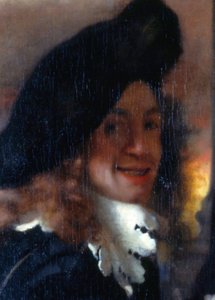
To explore this remarkable artwork in greater depth, we invite you to visit our website: The Lacemaker (detail)
Questions & Answers
How saturated is the palette of "The Lacemaker"?
The palette of "The Lacemaker" is subtle color in saturation.
What mood would "The Lacemaker" bring to a space?
The calm atmosphere of "The Lacemaker" by Johannes Vermeer matches its recommended space: a living room.
What explains the copyright situation of "The Lacemaker" by Johannes Vermeer?
"The Lacemaker" by Johannes Vermeer is in the public domain - its copyright has expired. Copyright terms are measured from the artist's death, and Johannes Vermeer died in 1675.
Artist Biography
The Light of Delft
October 1632. A child is baptized in the Nieuwe Kerk in Delft, Netherlands. Johannes Vermeer enters a world defined by the tactile textures of silk and the commerce of art. His father, Reijnier Janszoon, moves through the city as both a weaver of fine materials and an art dealer. This early exposure to the market provides a foundation of material knowledge. The young man learns the value of pigments and the mechanics of trade long before he picks up a brush.
The year 1653 brings a shift in his personal landscape. He marries Catharina Bolnes, a Catholic woman. In a largely Protestant Delft, this union necessitates a conversion. The domestic sphere expands. He moves into her house, settling into the heart of the city. His professional life remains tied to the family business, acting as an art dealer and valuer while he develops his own hand.
The Science of Sight
He does not seek the grand scale of historical battles or mythological epics. Instead, his gaze settles on the quiet corners of middle-class interiors. A woman reads a letter; a milkmaid pours liquid into an earthenware container; a lacemaker works in silence. These scenes are constructed through a meticulous, almost scientific approach to optics. He applies paint in thin glazes, building layers that allow light to penetrate and reflect from within the canvas.
The use of a camera obscura likely informs his precision. He captures how light hits a pearl, a ceramic jug, or a crust of bread with startling accuracy. He renders out-of-focus areas to suggest depth of field, creating an illusion of space that pulls the viewer into the room. His palette relies on expensive materials, including the deep blue of ultramarine derived from lapis lazuli. The light does not merely illuminate his subjects; it defines their very edges.
His technical process is slow. There are no known sketches or preparatory drawings to suggest a hurried hand. Each work is a deliberate undertaking. He focuses on:
- The precise rendering of perspective and architectural detail.
- The subtle gradations of color in domestic textiles.
- The way light interacts with different surfaces, from silk to stone.
A Quiet Obscurity
By December 1675, the light fades. Vermeer dies in Delft at the age of forty-three. He leaves behind a wife and at least eleven children, burdened by debt and the economic downturn of the 1670s. For nearly two centuries, his name recedes from the forefront of art history. He is largely forgotten, overshadowed by more prolific contemporaries. His small body of work, numbering only about thirty-four to thirty-seven paintings, remains tucked away in private collections or local registries.
The nineteenth century brings a rediscovery. Historians like Gustav Friedrich Waagen and Théophile Thoré-Bürger bring his name back to the public eye. They identify the genius in his quietude. The world begins to see the significance of his domestic scenes, recognizing that his ability to capture the essence of a single moment holds a weight that grander narratives often lack. His reputation grows from a provincial painter to a central figure of the Dutch Golden Age.
Johannes Vermeer
1632 - 1675 , Netherlands
Quick Facts
- Artistic Movement Or Style: Dutch Golden Age
- Full Name: Johannes Vermeer
- Nationality: Dutch
- Notable Artworks:
- The Milkmaid
- View of Delft
- Girl with a Pearl Earring
- The Art of Painting
- The Love Letter
- Place Of Birth: Delft, Netherlands
- Date Of Birth: 1632
- Date Of Death: 1675