Preview
 Send
Send Share
Share
 Details
 Guide
Guide

 Download
 Similars
 X-Ray
X-Ray Diaporama
 Q&A
Q&A Stats
StatsPigeon Crees
 1938
1938 44.0 x 65.0 cm
 Woodhorn Museum - Northumberland Archives
 Read More
The artwork displayed on this page is protected by copyright law, which means we cannot legally create or sell an identical reproduction. This protection is enforced under international agreements such as the Berne Convention and by national laws, including those outlined by the U.S. Copyright Law - Title 17.
This method fully complies with copyright regulations because it does not involve copying or duplicating the protected artwork. Instead, it is a creative reinterpretation - a new painting that is influenced by the original but not identical to it.
Giclée / Art Print
Museum-quality giclée or canvas print with fast production and flexible finish options. ( Buy Hand Made Painting Switch to Digital Image)




































Pick from our preset sizes that match the artwork's original proportions.

Type the width and the height you need, to fit your frame or your wall. A print can only be cut, never made bigger than the picture, so a size with a different shape loses a part of the image. We send you a digital mockup to approve before we print anything. The picture shown on this page does not show the real cut — only the mockup does.
Worldwide Delivery () in 2 weeks instead of standard 4/5 weeks. (29 October)

Free Worldwide Express Shipping

High-Quality Linen Canvas

Full Shipping Insurance

Customs Tax Refund Guarantee

True Color Matching Guarantee

100-Day Return Policy (Defects Only)

100% Money-Back Guarantee

Bulk Discount Offer
 Glass option is only available in size under 110 CM

Pigeon Crees
Giclée / Art Print
Reproduction Size
-


Total Price
$ 81
Composition and Style
The painting depicts a small town with houses, barns, and train tracks, set amidst a picturesque countryside. The scene is filled with various elements of human life and nature coexisting, including birds perched on buildings or flying around the area. The presence of an airplane flying overhead adds to the sense of movement and activity in the scene. Light and color are used effectively to create a sense of depth and atmosphere, drawing the viewer into the world of the painting.Artist and Museum
Jimmy Floyd was a talented artist who created several notable works, including The Onsetter, which is also housed at the Woodhorn Museum - Northumberland Archives. The museum offers an extensive collection of artworks that reflect the rich cultural heritage of the region. For more information on the museum and its collections, visit Discovering the Artworks of Woodhorn Museum - Northumberland Archives.- Other notable paintings by Jimmy Floyd include The Onsetter and Pigeon Crees, both available as handmade oil painting reproductions on OriginalUniqueArt.com.
- The Woodhorn Museum - Northumberland Archives also features works by other notable artists, such as Harry Wilson and Fred Laidler, whose paintings can be found on OriginalUniqueArt.com.
The painting Pigeon Crees by Jimmy Floyd is a captivating representation of rural life, showcasing the artist's skill in capturing the essence of the countryside. With its effective use of light and color, this piece is sure to delight art lovers and enthusiasts alike. For more information on Jimmy Floyd and his works, visit OriginalUniqueArt.com.
Questions & Answers
Is "Pigeon Crees" by Jimmy Floyd in the public domain?
Regarding copyright, "Pigeon Crees" is still protected by copyright.
What color leads the composition of "Pigeon Crees" by Jimmy Floyd?
The color that stands out most in "Pigeon Crees" is espresso (#68563e). The dominant color is useful when matching an artwork to an interior.
What shape and dimensions is "Pigeon Crees" by Jimmy Floyd?
The format of "Pigeon Crees" is landscape, and the original measures 44 x 65 cm. Both are useful when planning a reproduction.
Artist Biography
The Industrial Poet of Northumberland
Born in the vibrant, coal-dusted atmosphere of Newcastle upon Tyne in 1898, Jimmy Floyd emerged as a profound visual chronicler of a transformative era in British history. His life and art were inextricably linked to the rugged landscapes of Northumberland, a region defined by the rhythmic pulse of mining communities and the encroaching shadows of burgeoning factories. Floyd did not merely observe his surroundings; he inhabited them, translating the grit, toil, and quiet resilience of the working class into a poignant visual language. As a master of realism, his work serves as a bridge between the raw reality of industrial expansion and the enduring spirit of the people who fueled it.
Floyd’s artistic foundation was laid at the Newcastle Art School, where he first mastered the delicate nuances of watercolor and drawing before finding his true calling in the rich, tactile medium of oil paint. This transition allowed him to explore the heavy textures and somber tones that would become his hallmark. His early years were shaped by a Britain undergoing rapid urbanization—a period of intense social upheaval and technological advancement. These shifts deeply influenced his worldview, driving him to capture the essence of everyday life with an empathetic eye. He possessed a unique ability to find beauty within the mundane, portraying miners and their families not as mere subjects of hardship, but as figures of immense dignity and strength.
A Mastery of Texture and Atmosphere
Unlike the Impressionists, who sought to capture the fleeting dance of light across a surface, Floyd’s technique was rooted in a meticulous devotion to detail and tonal subtlety. He approached his canvas with the precision of an architect, rendering the rough, weathered stone of mineshafts and the worn faces of laborers with remarkable clarity. His palette was often muted, utilizing earthy tones to evoke the somber, heavy atmosphere of the industrial heartland. This deliberate use of color served to ground his subjects in their environment, creating a sense of permanence and weight that mirrored the gravity of the lives he depicted.
His compositions often balanced the expansive scale of the Northumberland landscape with intimate human elements. In his works, one might find:
- Industrial Landscapes: Expansive views dominated by coal pits, railways, and the skeletal structures of industry.
- Rural Intersections: Scenes where nature and man-made progress coexist, such as in Pigeon Crees (1938), where train tracks weave through picturesque countryside.
- The Human Element: Captivating representations of manual labor, exemplified by The Onsetter (1942), which captures the organized chaos of a warehouse setting.
Legacy and Historical Significance
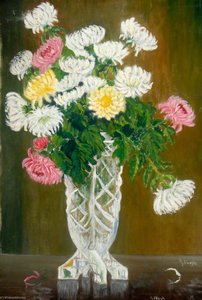
Beyond his individual technical achievements, Jimmy Floyd holds a significant place in the history of British social realism. He was a notable contributor to the spirit of the Ashington Group, a collective of artists dedicated to documenting the lived experiences of coal miners. Through his eyes, the industrial landscape became more than just a site of production; it became a character in its own right, shaped by human presence and historical momentum. His ability to weave together the textures of industry with the tenderness of domestic life—seen in works like Vase of Flowers—demonstrates the breadth of his artistic vision.
Today, Floyd’s oeuvre remains a vital historical record. His paintings, many of which are preserved in institutions such as the Woodhorn Museum - Northumberland Archives, offer a window into a vanished world of coal and iron. He leaves behind a legacy that transcends simple documentation, offering instead an emotional resonance that continues to move viewers. Through his meticulous realism, Floyd ensured that the dignity of the Northumbrian working class would never be lost to the passage of time, immortalizing the "industrial poet" within every brushstroke.

Jimmy Floyd
1898 - 1974
Quick Facts
- Full Name: Jimmy Floyd
- Nationality: British
- Date Of Birth: 1898
- Date Of Death: 1974
- Place Of Birth: Newcastle upon Tyne, England
- Notable Artworks:
- Pigeon Crees
- The Onsetter
- Vase of Flowers
- Artistic Movement Or Style: Realism