Send
Send Share
Share
 Details
 Guide
Guide

 Download
 Similars
 Diaporama
 Stats
StatsWild Boy and Puppy


 Read More
The artwork displayed on this page is protected by copyright law, which means we cannot legally create or sell an identical reproduction. This protection is enforced under international agreements such as the Berne Convention and by national laws, including those outlined by the U.S. Copyright Law - Title 17.
This method fully complies with copyright regulations because it does not involve copying or duplicating the protected artwork. Instead, it is a creative reinterpretation - a new painting that is influenced by the original but not identical to it.
Giclée / Art Print
Museum-quality giclée or canvas print with fast production and flexible finish options. ( Buy Hand Made Painting Switch to Digital Image)




































Pick from our preset sizes that match the artwork's original proportions.

Type the width and the height you need, to fit your frame or your wall. A print can only be cut, never made bigger than the picture, so a size with a different shape loses a part of the image. We send you a digital mockup to approve before we print anything. The picture shown on this page does not show the real cut — only the mockup does.
Worldwide Delivery () in 2 weeks instead of standard 4/5 weeks. (23 October)

Free Worldwide Express Shipping

High-Quality Linen Canvas

Full Shipping Insurance

Customs Tax Refund Guarantee

True Color Matching Guarantee

100-Day Return Policy (Defects Only)

100% Money-Back Guarantee

Bulk Discount Offer
 Glass option is only available in size under 110 CM

Wild Boy and Puppy
Giclée / Art Print
Reproduction Size
-


Total Price
$ 81
Wild Boy and Puppy: A Pop Art Reverie
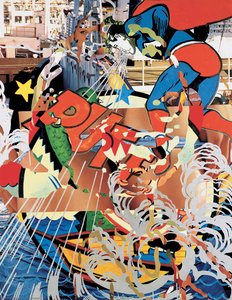
The sculpture “Wild Boy and Puppy,” created in 1988 by Jeff Koons, isn’t merely an aesthetically pleasing object; it's a deliberate provocation—a shimmering testament to the pervasive influence of popular culture within contemporary art. Produced from porcelain glazed with a high-gloss coating, this piece embodies Koons’ signature Pop Art style, seamlessly blending childlike wonder with ironic commentary on consumerism and artistic convention. Its stark white background serves as an uncompromising stage for the exuberant figures at its center—a stylized depiction of boyish innocence juxtaposed against playful animal companionship.Composition and Color Palette: Bold Simplicity
The sculpture’s central positioning immediately establishes a sense of immediacy, inviting viewers into a carefully orchestrated tableau. Symmetry plays a crucial role in balancing the visual weight, reinforcing the artwork's harmonious aesthetic. The dominant color palette—a riot of yellows, oranges, and reds punctuated by browns and creams—is deliberately artificial, mirroring the glossy finish that characterizes Koons’ work. This vibrancy isn’t accidental; it’s designed to evoke nostalgia for a simplified era of animation and toy design, referencing the visual language of childhood fantasies.Technique and Materiality: Precision Meets Illusion
Koons' meticulous craftsmanship is evident in every detail—from the precise modeling of the boy and dog figures to the painstaking application of glaze. The porcelain material lends itself beautifully to this technique, achieving a remarkable smoothness and reflectivity that contributes to an almost plastic-like appearance. Multiple layers of glaze are polished to create a surface that captures light with dazzling brilliance, furthering the illusion of dimensionality despite the sculpture’s two-dimensional representation. The inclusion of a woven basket adds textural contrast, grounding the fantastical scene in a tangible element.Symbolism and Emotional Resonance: Innocence Revisited
Beyond its visual appeal, “Wild Boy and Puppy” speaks to deeper themes—the enduring fascination with childhood innocence and the importance of companionship. The boy’s spiky red hair and expressive eyes convey youthful exuberance, while the dog's playful demeanor embodies loyalty and affection. However, Koons subtly introduces an element of irony through the sculpture’s glossy finish and its reference to Pop Art conventions. This juxtaposition invites contemplation on how art can simultaneously celebrate and critique societal values, prompting viewers to consider the role of consumer culture in shaping our perceptions of beauty and emotion.Historical Context: Embracing Kitsch and Challenging Tradition
Created during Koons' formative years as a Pop Artist—influenced by Ed Paschke’s embrace of bold color palettes and unconventional techniques—this sculpture exemplifies the movement’s desire to elevate commonplace imagery into artful expression. It stands in contrast to more formal artistic traditions, deliberately embracing “kitsch”—the aesthetic appreciation of sentimentality and decorative ornamentation—to provoke dialogue about artistic value and cultural taste. Like many of Koons' works, "Wild Boy and Puppy" serves as a reminder that art can be both joyful and unsettling, prompting viewers to reconsider their assumptions about what constitutes beauty and significance.Questions & Answers
What is the dominant hue of "Wild Boy and Puppy" by Jeff Koons?
The dominant hue of "Wild Boy and Puppy" by Jeff Koons is ochre to sepia. The hue is the underlying tone of the palette.
What color palette is used in "Wild Boy and Puppy" by Jeff Koons?
The colors of "Wild Boy and Puppy" form a neutrals palette. This classification describes the dominant color families.
Who is the author of "Wild Boy and Puppy", and in which movement?
"Wild Boy and Puppy" was created by Jeff Koons in the Pop Art style. Artist and movement identify the work's tradition.
Artist Biography
A Reflection of Our Times: The World of Jeff Koons
Born in York, Pennsylvania, in 1955, Jeff Koons emerged as a pivotal figure in the late 20th and early 21st-century art world, an artist whose work simultaneously celebrates and critiques consumer culture, kitsch, and the very notion of artistic value. His childhood, steeped in Catholic upbringing, instilled within him a fascination with imagery that would later become central to his aesthetic – a blend of innocence, spirituality, and the often-garish appeal of popular iconography. Koons’s early education at the School of the Art Institute of Chicago and then the Maryland Institute College of Art laid the groundwork for his artistic explorations, but it was his mentorship under Ed Paschke that truly ignited his passion for Pop Art techniques and philosophies. This influence would become a defining characteristic of his evolving style.From Vacuum Cleaners to Inflatables: Early Explorations
Koons’s initial foray into the art world in the 1980s was marked by a deliberate provocation, challenging conventional artistic boundaries. He began exhibiting works that featured everyday objects – vacuum cleaners, for instance – encased in pristine acrylic boxes, illuminated as if they were sacred relics. These weren't simply displays of household appliances; they were commentaries on consumer desire, the pursuit of cleanliness and perfection, and the elevation of the mundane to the realm of art. This series, titled “The New,” questioned what constituted artistic merit and forced viewers to confront their own relationship with material possessions. He didn’t create the objects themselves, but rather selected them, presenting pre-fabricated items as readymades in a manner reminiscent of Marcel Duchamp, yet infused with a distinctly American sensibility. This approach continued with his “Inflatables” series – large, brightly colored sculptures of flowers and rabbits, often placed alongside mirrors to distort reality and evoke the ephemeral joy of childhood. These works weren’t merely playful; they were explorations of perception, memory, and the fleeting nature of happiness.Stainless Steel and Monumental Scale: Achieving Icon Status
The late 1980s and 1990s witnessed Koons's ascent to international recognition with his breathtaking stainless steel sculptures. Pieces like “Rabbit” (1986), a highly polished, mirror-like representation of an inflatable bunny, and the iconic “Balloon Dog” (1994-2000) became instant symbols of contemporary art. These weren’t simply sculptures; they were feats of engineering and craftsmanship, requiring extensive teams of assistants to realize his ambitious visions. The reflective surfaces of these works blurred the lines between object and environment, inviting viewers to become part of the artwork itself. The sheer scale and flawless execution of these pieces commanded attention, solidifying Koons’s reputation as a master sculptor. “Elephant” (1994-2003) further exemplified this monumental approach, showcasing his ability to transform familiar forms into awe-inspiring spectacles. The meticulous detail and polished surfaces weren't accidental; they were deliberate choices designed to evoke a sense of wonder and challenge perceptions of value.Democratizing Art: The Gazing Ball Series and Beyond
Koons’s artistic journey didn’t end with stainless steel. In 2013, he embarked on the “Gazing Ball” series, a project that saw him placing vibrant blue glass spheres atop reproductions of famous sculptures from art history – Michelangelo's David, classical busts, and more. This wasn’t an act of appropriation but rather an attempt to democratize art, making it accessible to a wider audience and prompting viewers to reconsider their relationship with canonical artworks. The gazing ball itself acted as a portal, reflecting both the sculpture and the viewer, creating a dialogue between past and present. This series demonstrated Koons's continued willingness to experiment and challenge artistic conventions. Throughout his career, he has consistently employed a large team of assistants, raising questions about authorship and the role of the artist in the creative process – a practice he defends as integral to realizing his complex designs on a grand scale.A Lasting Legacy: Influence and Historical Significance
Jeff Koons is undeniably one of the most commercially successful living artists, with works fetching record-breaking prices at auction. However, his significance extends far beyond monetary value. He has profoundly impacted contemporary culture, influencing artists across various disciplines and sparking debates about art, consumerism, originality, and the very definition of taste.- Pop Art Heritage: Koons’s work builds upon the foundations laid by Pop Art pioneers like Andy Warhol and Roy Lichtenstein, embracing mass media and popular culture as legitimate subjects for artistic exploration.
- Conceptual Underpinnings: His emphasis on ideas and concepts aligns him with Conceptual art, challenging traditional notions of skill and craftsmanship.
- Embracing Kitsch: Koons’s willingness to embrace kitsch – often dismissed as lowbrow or sentimental – has broadened the scope of what is considered acceptable artistic subject matter.

Jeff Koons
1955 - , United States of America
Quick Facts
- Full Name: Jeff Koons
- Nationality: American
- Date Of Birth: 1955
- Place Of Birth: York, United States of America
- Notable Artworks:
- Rabbit
- Balloon Dog
- Elephant
- Gazing Ball (Bottlerack)
- Snorkel (Shotgun)
- Artistic Movement Or Style: Pop Art, Contemporary Sculpture
- Artists Who Influenced This Artist:
- Andy Warhol
- Roy Lichtenstein
- Ed Paschke
- Artists Or Movements Influenced By This Artist: Contemporary Art
Related Articles

The Enduring Form: Exploring Themes & Techniques in Sculpture Across Historical Periods
Explore the rich history of sculpture from ancient masterpieces to contemporary innovations. Discover key techniques, influential artists & investment potential for discerning art collectors.

Bronze Sculptures That Defined Art History | OriginalUniqueArt
Journey through art history with our Top 10 bronze sculptures! Explore masterpieces by Rodin, Michelangelo & more. Discover stories behind iconic statues and find museum-quality reproductions for your home decor at OriginalUniqueArt.com.
Jeff Koons: Irony, Kitsch & the Commodification of Contemporary Art
Explore the complex world of Jeff Koons with OriginalUniqueArt. Discover the irony, kitsch, and market forces behind his iconic sculptures. Expert insights for discerning collectors.

The Enduring Form: Sculpture Across History, Technique & Emotional Resonance
Explore the rich history of sculpture with OriginalUniqueArt. Discover key techniques, influential artists & investment potential for discerning collectors. Expert insights into valuing and collecting timeless masterpieces.

Bronze Age to Modern Masters: 10 Sculptures That Redefined Art | OriginalUniqueArt
Journey through art history with 10 legendary bronze sculptures – from Michelangelo's David to Rodin’s Thinker. Explore the stories, techniques & timeless beauty of these masterpieces. Find museum-quality reproductions & elevate your home decor on OriginalUniqueArt.com.