Preview
 Send
Send Share
Share
 Details
 Guide
Guide

 Download
 Similars
 X-Ray
X-Ray Diaporama
 Stats
StatsCrown
 Mixed Media
- WallArt
- Neo-expressionism
 1983
1983- Contemporary
 50.0 x 73.0 cm
 Read More
The artwork displayed on this page is protected by copyright law, which means we cannot legally create or sell an identical reproduction. This protection is enforced under international agreements such as the Berne Convention and by national laws, including those outlined by the U.S. Copyright Law - Title 17.
As a respectful and legal alternative, we offer custom, hand-painted artworks inspired by the original. Our skilled and professional artists carefully study the original's style, mood, and artistic essence to create a new, unique piece that evokes the same feeling - while remaining an original creation in its own right.
This method fully complies with copyright regulations because it does not involve copying or duplicating the protected artwork. Instead, it is a creative reinterpretation - a new painting that is influenced by the original but not identical to it.
Hand Made Oil Reproduction
Hand-painted oil on canvas in your size and frame, made to order by our artists. ( Switch to Print Switch to Digital Image)




P118B $10

P118H $10

P118W $10

P438Z $10

P508JH $12

P508YH $12

P805H $10

P805Z $10

P919BZ $10

P919G $10

P919XJ $10

P959ZH $10

P968JZ $12

W106C $8

W218G $10

W218JH $8

W218Y $10

W307PJ $10

W316G $10

W316PJ $8

W316Y $10

W398PJ $8

W4111J $10

W500HY $15

W500JH $15

W692G $12

W849H $8

W940BG $15

W953PJ $8




Pick from our preset sizes that match the artwork's original proportions.

Type the width and the height you need, to fit your frame or your wall. This is hand-painted, so for a size with a different shape the artist can paint a bit more around the picture, or cut a bit — you choose. We send you a digital mockup to approve before the painting starts. The picture shown on this page does not show the real result — only the mockup does.
After order, OriginalUniqueArt.com team will email client for instructions and provide a mockup preview
Worldwide Delivery () in 3/4 weeks instead of standard 5 weeks. (21 October). No compromise on quality.

Free Worldwide Express Shipping

High-Quality Linen Canvas

Full Shipping Insurance

Customs Tax Refund Guarantee

True Color Matching Guarantee

100-Day Return Policy (Defects Only)

100% Money-Back Guarantee

Bulk Discount Offer
 Glass option is only available in size under 110 CM

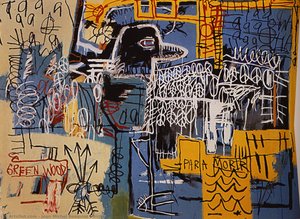
Crown
Reproduction Medium
Reproduction Size
-


Total Price
$ 300
The Raw Pulse of Neo-Expressionism
In the electric, often turbulent atmosphere of the 1980s New York art scene, few figures emerged with as much visceral impact as Jean-Michel Basquiat. His 1983 masterpiece, Crown, serves as a profound testament to this era of creative upheaval. The artwork presents a captivatingly chaotic composition where a large, stylized crown, rendered in thick, unapologetic black lines, commands the viewer's attention. This central icon does not sit peacefully upon the canvas; rather, it seems to struggle for dominance against a dense, frenetic backdrop of handwritten text and fragmented imagery. It is a work that refuses to be ignored, pulling the observer into a visual whirlwind of urgency and raw, unrefined energy.
The technique employed in Crown is a masterclass in spontaneous mark-making and layered storytelling. Utilizing what appears to be acrylic or oil paint alongside ink, Basquiat employs a gestural application that feels both immediate and deeply intentional. The background is a tapestry of muted, earthy tones—beige, brown, and off-white—which provides a somber, parchment-like stage for the stark black silhouette of the crown. This layering technique creates a superficial yet powerful sense of depth, where the text seems to pulse beneath the surface, suggesting layers of hidden meaning waiting to be decoded by the attentive eye.
Symbolism and the Weight of Authority
Beyond its striking visual presence, Crown is heavy with symbolic resonance. The crown itself is a potent emblem of royalty, power, and status, yet in Basquiat’s hands, it becomes something far more complex. Set against a backdrop of scattered text and disarray, the symbol of authority feels both asserted and interrogated. One cannot help but sense a profound social commentary within the work; the juxtaposition of the regal icon with the chaotic, almost claustrophobic textual elements evokes themes of oppression, rebellion, and the struggle for identity in an increasingly fragmented world. It is as if the crown is attempting to impose order upon a landscape of linguistic and social confusion.
For the collector or interior designer, this piece offers more than just aesthetic value; it provides a focal point of intellectual and emotional depth. The artwork’s ability to evoke feelings ranging from unsettling tension to profound admiration makes it an extraordinary addition to any curated space. Whether placed in a modern gallery setting or as a bold statement in a sophisticated residential interior, Crown acts as a conversation starter, inviting contemplation on the nature of power and the enduring legacy of the neo-expressionist movement. Owning a high-quality reproduction of such a seminal work allows one to bring a piece of art history's most vibrant rebellion into the contemporary home.
Questions & Answers
Can I see "Crown" by Jean Michel Basquiat on my own wall before buying?
"Crown" has an augmented reality preview: the artwork's AR Preview page shows it in your own space on a compatible device.
What national origin stands behind the Neo-expressionism of "Crown"?
"Crown" connects the Neo-expressionism movement with United States of America through its creator's birthplace.
When was "Crown" created, and to which movement does it belong?
"Crown" was created in 1983 as a work of the Neo-expressionism movement. Date and movement anchor the artwork in art history.
Artist Biography
A Brooklyn Beginning and the Rise of SAMO
Jean-Michel Basquiat erupted onto the 1980s art scene as a force of raw energy and intellectual depth, an impact that continues to resonate profoundly today. Born on December 22, 1960, in Brooklyn, New York, to a Haitian father and Puerto Rican mother, his upbringing was a vibrant tapestry woven with diverse cultures and languages—Spanish, English, and French filled his childhood home. This multilingual environment, coupled with his mother’s dedication to artistic pursuits—she enrolled him as a Junior Member of the Brooklyn Museum at age six—laid an early foundation for his creative journey. However, Basquiat's life wasn’t without hardship; a car accident at eight years old resulted in a splenectomy and a period of convalescence during which he became captivated by a copy of *Gray’s Anatomy* gifted by his mother. The book’s detailed illustrations would later profoundly influence the anatomical imagery that frequently appears in his work, becoming a haunting motif throughout his career. Before achieving recognition as a painter, Basquiat made his mark under the pseudonym SAMO, alongside friend Al Diaz. Together they covered Lower Manhattan with cryptic, poetic graffiti—epigrams challenging societal norms and questioning established power structures. These weren’t mere tags; they were thought-provoking statements that captured the spirit of the burgeoning hip-hop culture and the gritty energy of 1970s New York City. SAMO was more than just street art; it was a philosophical intervention, a visual disruption designed to provoke dialogue and challenge perceptions.
Neo-Expressionism and Artistic Innovation
By the early 1980s, Basquiat transitioned from graffiti to canvas, rapidly gaining recognition within the New York art world. His paintings weren’t easily categorized; they were a unique synthesis of influences ranging from Abstract Expressionism to tribal art, comic books, and historical painting. He became a central figure in the Neo-Expressionist movement, though he resisted easy labeling. His canvases are characterized by a frenetic energy—a chaotic layering of text, symbols, figures, and colors. Basquiat’s technique was deliberately raw and improvisational, often incorporating collage, scratching, and dripping paint. He wasn't interested in technical perfection; instead, he sought to convey emotion, ideas, and social commentary with visceral immediacy. Recurring motifs—crowns, skulls, anatomical diagrams, words crossed out or repeated—became his signature visual language. The crown, perhaps his most iconic symbol, has been interpreted as a representation of aspiration, self-mythologization, and the complexities of Black identity in America. His work frequently grappled with themes of wealth versus poverty, integration versus segregation, and the internal struggles of the individual within society. Paintings like *Piscine versus the Best Hotels (or various loin)* exemplify his ability to juxtapose seemingly disparate elements—luxury and deprivation, beauty and decay—creating a powerful commentary on social inequalities. Basquiat’s art was not merely about what he depicted but how he depicted it, creating a visual language that was both deeply personal and universally resonant.
Collaboration, Recognition, and a Tragic End
Basquiat’s ascent was meteoric. In 1982, at just twenty-one years old, he participated in Documenta in Kassel, Germany, becoming the youngest artist ever to exhibit there. The following year, he showcased his work at the Whitney Biennial, further solidifying his position within the art establishment. A pivotal moment came with his friendship and artistic collaboration with Andy Warhol. The two artists pushed each other creatively, exploring themes of consumerism, celebrity, and mass media in a series of collaborative paintings. While their partnership was complex and sometimes fraught with tension, it undoubtedly elevated both artists’ profiles. Despite achieving international acclaim and financial success, Basquiat struggled with the pressures of fame and his ongoing battle with drug addiction. His work became increasingly introspective and darker as he grappled with personal demons and societal injustices. Tragically, Jean-Michel Basquiat died on August 12, 1988, at the age of twenty-seven from a heroin overdose. His untimely death cemented his status as a tragic figure—a brilliant artist whose life was cut short by addiction and the complexities of navigating the art world.
Legacy and Lasting Influence
In the years since his death, Basquiat’s reputation has only grown. His work continues to captivate audiences with its raw energy, intellectual depth, and unflinching social commentary. In 2017, *Untitled* (1982), a powerful depiction of a skull, sold for $110.5 million at Sotheby's, setting a new record for any U.S. artist at auction—a testament to the enduring value and cultural significance of his work. Basquiat’s influence can be seen in the work of countless contemporary artists, particularly those who explore themes of identity, race, and social justice. He paved the way for a more diverse and inclusive art world, challenging traditional notions of artistic expression and representation. His ability to seamlessly blend high and low culture—graffiti, fine art, music, poetry—continues to inspire artists today. He remains a potent symbol of creative rebellion, intellectual curiosity, and the power of art to challenge the status quo. His paintings are not merely aesthetic objects; they are windows into a complex mind grappling with profound questions about humanity, society, and the search for meaning in a chaotic world.
Key Works & Themes
Here are some defining works that encapsulate Basquiat’s artistic vision:
- Untitled (Skull): A powerful representation of mortality and the African diaspora, achieving record-breaking auction prices.
- Piscine versus the Best Hotels (or various loin): Exemplifies Basquiat’s juxtaposition of wealth and poverty, showcasing his unique artistic style.
- Portrait of the Artist as a Young Derelict: A self-portrait that embodies themes of identity, alienation, and societal critique.
- Hollywood Africans: Explores African American history and culture through symbolic imagery and textual elements.
Basquiat’s art consistently addressed issues of racial inequality, the legacy of colonialism, and the complexities of Black identity. He used his platform to challenge dominant narratives and give voice to marginalized communities. His work remains profoundly relevant today, prompting viewers to confront uncomfortable truths about society and their own biases. He wasn't simply an artist; he was a cultural commentator, a poet, and a visionary who left an indelible mark on the art world and beyond.

Jean Michel Basquiat
1960 - 1988 , United States of America
Quick Facts
- Full Name: Jean-Michel Basquiat
- Nationality: American
- Date Of Birth: 1960
- Date Of Death: 1988
- Place Of Birth: Brooklyn, United States of America
- Notable Artworks:
- Untitled (Skull)
- Piscine vs. Hotels
- Portrait Derelict
- Hollywood Africans
- Artistic Movement Or Style: Neo-Expressionism
- Artists Who Influenced This Artist:
- Abstract Expressionists
- Tribal art
- Comic books
- Artists Or Movements Influenced By This Artist:
- Contemporary artists
- Social justice art
Related Articles

Dark Masterpieces: 10 Iconic Paintings Dominated by Black Tones |
Explore 10 iconic paintings dominated by black tones, from Rembrandt’s chiaroscuro to Goya's dark expressions. Discover the stories behind these masterpieces & find museum-quality art reproductions for your home at .
Mars Black Masterpieces: 10 Iconic Paintings & Timeless Art Decor Ideas
Delve into the power of 'Mars Black' with 10 iconic paintings by masters like Rembrandt & Caravaggio. Explore dramatic chiaroscuro, gothic art, and timeless beauty. Find museum-quality reproductions & elevate your home decor on .

Basquiat & Raw Pop: The Electric Energy of Neo-Expressionism and the Legacy of Urban Rebellion
Explore the electric world of Jean-Michel Basquiat and Neo-Expressionism. Discover how raw urban energy and symbolic graffiti redefined contemporary art history through a deep, cultural lens.
Basquiat & Raw Pop: The Unfiltered Energy of Neo-Expressionism and the Legacy of Urban Rebellion
Explore the raw energy of Jean-Michel Basquiat and Neo-Expressionism. Discover how urban rebellion redefined modern art through a lens of luxury, identity, and profound emotional intensity for the discerning collector.
Jean-Michel Basquiat: Deconstructing Identity & Power Through Neo-Expressionist Graffiti
Explore the powerful work of Jean-Michel Basquiat & his impact on Neo-Expressionism. Discover how he deconstructed identity, challenged power structures, and left an enduring legacy in contemporary art. Expert analysis for collectors.