 Preview
 Send
Send Share
Share
 Details
 Guide
Guide

 Download
 Similars
 X-Ray
X-Ray Diaporama
 Q&A
Q&A Stats
StatsThe Bath

- 73.0 x 59.0 cm


 Read More
Giclée / Art Print
Museum-quality giclée or canvas print with fast production and flexible finish options. ( Buy Hand Made Painting Switch to Digital Image)




P118B $10

P118H $10

P118W $10

P438Z $10

P508JH $12

P508YH $12

P805H $10

P805Z $10

P919BZ $10

P919G $10

P919XJ $10

P959ZH $10

P968JZ $12

W106C $8

W218G $10

W218JH $8

W218Y $10

W307PJ $10

W316G $10

W316PJ $8

W316Y $10

W398PJ $8

W4111J $10

W500HY $15

W500JH $15

W692G $12

W849H $8

W940BG $15

W953PJ $8




Pick from our preset sizes that match the artwork's original proportions.

Type the width and the height you need, to fit your frame or your wall. A print can only be cut, never made bigger than the picture, so a size with a different shape loses a part of the image. We send you a digital mockup to approve before we print anything. The picture shown on this page does not show the real cut — only the mockup does.
Worldwide Delivery () in 2 weeks instead of standard 4/5 weeks. (5 November)

Free Worldwide Express Shipping

High-Quality Linen Canvas

Full Shipping Insurance

Customs Tax Refund Guarantee

True Color Matching Guarantee

100-Day Return Policy (Defects Only)

100% Money-Back Guarantee

Bulk Discount Offer
 Glass option is only available in size under 110 CM

The Bath
Giclée / Art Print
Reproduction Size
-


Total Price
$ 81
A Moment of Intimacy: Jean Leon Gerome Ferris’s “The Bath”
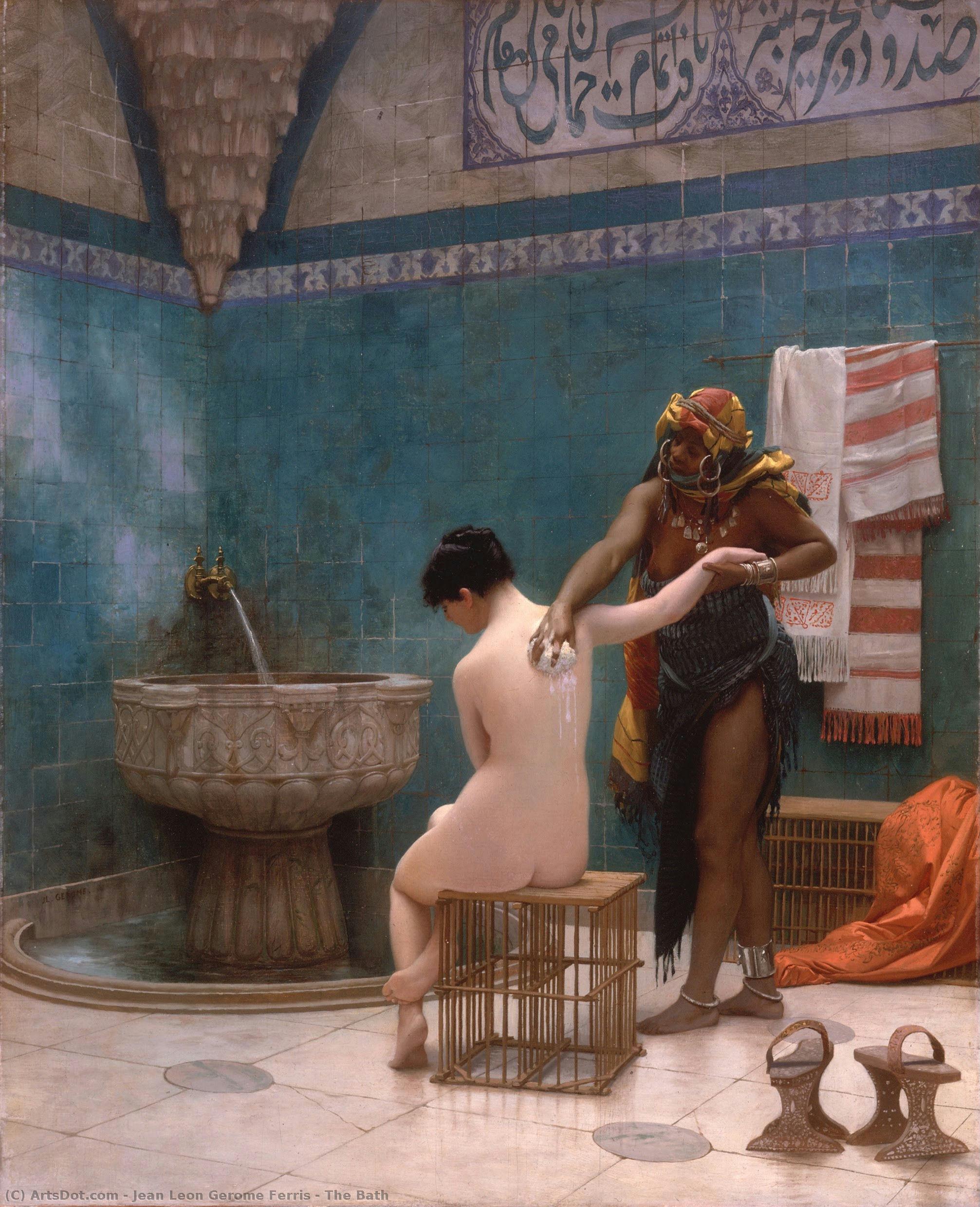
Jean Leon Gerome Ferris's "The Bath," a captivating work measuring 73 x 59 cm, offers a poignant glimpse into the late nineteenth century through its depiction of vulnerability and care. Painted around 1900, this piece transcends a simple nude scene; it’s a carefully constructed tableau brimming with historical context, symbolic resonance, and the masterful technique that defined Ferris's career. The painting portrays a woman seated in a chair, attended to by another individual – both figures unclothed, creating an atmosphere of profound intimacy and quiet contemplation. Surrounding them are other figures, some observing, others engaged in activities, suggesting a private domestic setting rich with unspoken narratives.
The Artist's Legacy: Ferris and the Pageant of a Nation
Jean Leon Gerome Ferris (1863-1930) stands as a pivotal figure in American art history, largely due to his ambitious ‘Pageant of a Nation’ series. Born in Philadelphia, he was steeped in artistic tradition, inheriting a lineage influenced by the renowned Jean-Léon Gérôme and Mariano Fortuny. This heritage profoundly shaped his approach, evident in his meticulous attention to detail, anatomical precision, and ability to evoke emotion through seemingly simple scenes. Ferris's training at the Pennsylvania Academy of Fine Arts and subsequent studies with William-Adolphe Bouguereau further honed his skills, allowing him to develop a distinctive style characterized by classical influences and a deep understanding of human form.
Technique and Composition: A Study in Light and Gesture
Ferris’s technique is immediately recognizable – a hallmark of his work. He employs a rich, warm palette dominated by ochres, browns, and reds, creating a sense of depth and realism. The modeling of the figures is exceptionally detailed, capturing the subtle curves of the body with remarkable accuracy. Note the careful rendering of light, which dramatically illuminates the woman’s form, highlighting her vulnerability while simultaneously suggesting a serene atmosphere. The composition itself is carefully balanced, drawing the viewer's eye to the central figures while subtly incorporating the surrounding activity into the narrative. The inclusion of the bowl adds a functional element, grounding the scene in a domestic reality.
Symbolism and Emotional Impact: A Portrait of Human Connection
"The Bath" is more than just a depiction of nudity; it’s an exploration of human connection and care. The act of bathing itself carries symbolic weight – purification, renewal, and vulnerability. The attendant figure represents protection and service, while the woman's pose suggests both acceptance and perhaps a touch of melancholy. Ferris masterfully captures a fleeting moment of quiet intimacy, inviting viewers to contemplate themes of domesticity, beauty, and the human condition. This painting’s enduring appeal lies in its ability to evoke empathy and a sense of timelessness, making it a compelling addition to any collection or interior space.
Questions & Answers
Does "The Bath" show strong light-dark contrasts?
"The Bath" by Jean Leon Gerome Ferris shows a balanced contrast between its light and dark areas.
What technique was used for "The Bath" by Jean Leon Gerome Ferris?
"The Bath" is executed in acrylic on canvas.
Can I examine "The Bath" in more detail?
The X-Ray page of "The Bath" by Jean Leon Gerome Ferris is an interactive viewer that lets you slide through eleven optical layers of the artwork's image, including an X-ray style view.
Artist Biography
Jean Leon Gerome Ferris: Chronicler of American History
Jean Leon Gerome Ferris (1863 – 1930) stands as a singular figure in the landscape of American art history, primarily recognized for his monumental ‘Pageant of a Nation’ series—the largest undertaking of its kind by a single artist during the late nineteenth century. Born in Philadelphia, Pennsylvania, Ferris inherited an artistic lineage steeped in tradition and nurtured by exceptional mentors; his father, Stephen James Ferris, was himself a portrait painter deeply influenced by Jean-Léon Gérôme, and equally captivated by Mariano Fortuny—a connection that profoundly shaped Ferris’s artistic trajectory. Growing up amidst this vibrant artistic milieu instilled within him an unwavering dedication to the craft, culminating in formal training at the Pennsylvania Academy of Fine Arts and subsequent studies at the Académie Julian under William-Adolphe Bouguereau. Crucially, he encountered his namesake, Jean Léon Gérôme, whose artistic vision served as a cornerstone for Ferris’s ambition to depict pivotal moments from American history. As Ferris eloquently stated, “axiom was that one would paint best that with which he is most familiar,” and he chose to immerse himself in the narrative of his nation—a decision that yielded extraordinary results.- Early Influences & Training: Ferris’s artistic education began under his father's tutelage, alongside the mentorship of his uncles Edward Moran and Thomas Moran – both celebrated marine painters who championed a distinctly Romantic aesthetic. This formative period solidified his understanding of artistic technique and instilled in him an appreciation for dramatic composition and emotive expression.
- Orientalist Beginnings: Like many artists of his era, Ferris initially pursued subjects rooted in Orientalism—a fashionable movement characterized by exotic landscapes and idealized portrayals of Eastern cultures. His painting “Feeding the Ibis” (1882), valued at $600, exemplifies this stylistic inclination and demonstrates a masterful command of color and detail.
- The Pageant of a Nation: Ferris’s magnum opus commenced in 1895 with the ambitious undertaking to chronicle American history through a series of seventy-eight paintings—a project that would define his artistic legacy. Driven by an unwavering belief in the power of visual storytelling, he meticulously researched historical events and translated them into emotionally resonant depictions.
The Pursuit of Narrative Painting & Commercial Success
Ferris’s commitment to portraying history wasn't merely aesthetic; it stemmed from a conviction that art could serve as a vehicle for educating the public and fostering patriotism. Recognizing the limitations inherent in presenting individual scenes in isolation, he strategically partnered with publishing companies to secure reproduction rights—a decision that propelled his work into widespread circulation. Lithographic prints, postcards, calendars, and trade cards featuring images from “The Pageant of a Nation” became ubiquitous advertising mediums throughout the 1920s and beyond, ensuring that Ferris’s artistic vision reached audiences far beyond the confines of the art world. Remarkably, laminated reproductions of his paintings were still available for sale as late as 1984—a testament to the enduring appeal of his historical narratives and their ability to transcend time.Notable Works & Artistic Style
Ferris’s artistic style was characterized by a meticulous attention to detail, informed by Bouguereau's academic tradition yet infused with an expressive dynamism reminiscent of Gérôme’s influence. His paintings captured idealized representations of significant historical events—scenes from the American Revolution, Civil War battles, and explorations of the West—presented with unwavering realism and imbued with moral grandeur. Among his most celebrated pieces are “Napoleon in Egypt,” “Dancer with an Apple,” and “Painting Breathes Life into Sculpture”—each demonstrating Ferris’s exceptional skill in conveying emotion through gesture and posture, alongside masterful rendering of texture and light.Legacy & Historical Significance
Jean Leon Gerome Ferris's contribution to American art history extends beyond his artistic achievements; he established a precedent for ambitious historical painting projects—a genre that had largely faded from prominence by the early twentieth century. His ‘Pageant of a Nation’ series remains an unparalleled achievement in visual storytelling, capturing the spirit of its time and cementing Ferris’s place as one of America's foremost chroniclers of history. Furthermore, his success in securing commercial reproductions ensured that his artwork continued to inspire generations of artists and viewers alike—a remarkable feat considering the challenges faced by artists attempting to disseminate their vision during a period marked by shifting artistic tastes and evolving cultural priorities.
Jean Leon Gerome Ferris
1863 - 1930 , United States of America
Quick Facts
- Full Name: Jean Leon Gerome Ferris
- Nationality: American
- Date Of Birth: 1863
- Date Of Death: 1930
- Place Of Birth: Philadelphia, United States of America
- Notable Artworks:
- Napoleon in Egypt
- Dancer with an Apple
- Painting Breathes Life into Sculpture
- Artistic Movement Or Style: Academic Painting
- Artists Who Influenced This Artist:
- Jean Leon Gerome
- Mariano Fortuny
- Artists Or Movements Influenced By This Artist: ['Orientalism']
Related Articles

The Enduring Legacy of Fine Art Prints: Technique, History & Aesthetic Impact
Explore the rich history & techniques of fine art prints. Discover investment potential, assess authenticity, and learn how to preserve your collection with expert guidance. Trusted insights for discerning collectors.

Echoes of Time: Exploring the Enduring Appeal & Historical Context of Vintage Art Prints
Explore the captivating world of vintage art prints! Discover their history, collecting tips & enduring appeal. Expert insights on chromolithography and building a legacy collection with OriginalUniqueArt.

Giclée Prints: Archival Quality & Aesthetic Nuances for the Discerning Collector
Explore the world of giclée prints with OriginalUniqueArt. Learn about archival quality, aesthetic nuances & investment potential. Expert guidance for discerning art collectors seeking museum-quality reproductions and lasting value.

The Enduring Allure of the Nude: A Historical & Artistic Exploration of the Human Form
Explore the captivating history of nude art! Discover iconic paintings & artists from classical to modern eras. Uncover symbolism, techniques & find museum-quality reproductions at OriginalUniqueArt.
Neo-Classicism's Greatest Hits: 10 Masterpieces for Your Home |
Journey through Neo-Classicism's finest! Explore 10 iconic masterpieces by David, Ingres & Canova. Discover art history, techniques & timeless beauty – perfect for inspiring your home decor. Find museum-quality reproductions at