() ·

A painting made for you, by hand

Soap Bubbles

Hand Made Oil Reproduction

Hand-painted oil on canvas in your size and frame, made to order by our artists. ( Switch to Print Switch to Digital Image)

Collectible Description

A profound meditation on ephemeral beauty, Jean-Baptiste-Siméon Chardin's Rococo masterpiece Soap Bubbles captures a fleeting moment of childhood wonder through exquisite light and texture, inviting you to explore its magic.

Artist Biography

Discover Jean-Baptiste-Siméon Chardin’s serene still lifes & genre scenes capturing everyday life with quiet elegance and masterful detail. Explore his timeless art.

from ·

Chapter 1

How large should it be?

Slide to change the size; the picture on the left shows the frame at its real width. The proportions of the original are kept.

Standard
custom
CM
INCH

Pick from our preset sizes that match the artwork's original proportions.

width
height

Type the width and the height you need, to fit your frame or your wall. This is hand-painted, so for a size with a different shape the artist can paint a bit more around the picture, or cut a bit — you choose. We send you a digital mockup to approve before the painting starts. The picture shown on this page does not show the real result — only the mockup does.

Chapter 2

How should it arrive?

Choose the edges of the stretched canvas

Choose your frame

Corner sample of the WhiteWrap canvas edge finish, stretched on solid wood bars
White $1
Corner sample of the BlurSideWrap canvas edge finish, stretched on solid wood bars
Blurside $1
Corner sample of the ExtendedWrap canvas edge finish, stretched on solid wood bars
Extended $1
Corner sample of the P118B picture frame: moulded polystyrene, 5 cm wide and 3 cm thick
P118B $10
Corner sample of the P118H picture frame: moulded polystyrene, 5 cm wide and 3 cm thick
P118H $10
Corner sample of the P118W picture frame: moulded polystyrene, 5 cm wide and 3 cm thick
P118W $10
Corner sample of the P438Z picture frame: moulded polystyrene, 5.5 cm wide and 3.5 cm thick
P438Z $10
Corner sample of the P508JH picture frame: moulded polystyrene, 7 cm wide and 3.5 cm thick
P508JH $12
Corner sample of the P508YH picture frame: moulded polystyrene, 7 cm wide and 3.5 cm thick
P508YH $12
Corner sample of the P805H picture frame: moulded polystyrene, 5 cm wide and 3.5 cm thick
P805H $10
Corner sample of the P805Z picture frame: moulded polystyrene, 5 cm wide and 3.5 cm thick
P805Z $10
Corner sample of the P919BZ picture frame: moulded polystyrene, 7 cm wide and 3.5 cm thick
P919BZ $10
Corner sample of the P919G picture frame: moulded polystyrene, 7 cm wide and 3.5 cm thick
P919G $10
Corner sample of the P919XJ picture frame: moulded polystyrene, 7 cm wide and 3.5 cm thick
P919XJ $10
Corner sample of the P959ZH picture frame: moulded polystyrene, 5 cm wide and 3 cm thick
P959ZH $10
Corner sample of the P968JZ picture frame: moulded polystyrene, 6 cm wide and 4 cm thick
P968JZ $12
Corner sample of the W106C picture frame: solid wood, 5 cm wide and 3 cm thick
W106C $8
Corner sample of the W218G picture frame: solid wood, 5 cm wide and 3 cm thick
W218G $10
Corner sample of the W218JH picture frame: solid wood, 5 cm wide and 3 cm thick
W218JH $8
Corner sample of the W218Y picture frame: solid wood, 5 cm wide and 3 cm thick
W218Y $10
Corner sample of the W307PJ picture frame: solid wood, 6 cm wide and 3 cm thick
W307PJ $10
Corner sample of the W316G picture frame: solid wood, 6 cm wide and 3 cm thick
W316G $10
Corner sample of the W316PJ picture frame: solid wood, 6 cm wide and 3 cm thick
W316PJ $8
Corner sample of the W316Y picture frame: solid wood, 6 cm wide and 3 cm thick
W316Y $10
Corner sample of the W398PJ picture frame: solid wood, 5 cm wide and 3 cm thick
W398PJ $8
Corner sample of the W4111J picture frame: solid wood, 6.5 cm wide and 3.5 cm thick
W4111J $10
Corner sample of the W500HY picture frame: solid wood, 7 cm wide and 5 cm thick
W500HY $15
Corner sample of the W500JH picture frame: solid wood, 7 cm wide and 5 cm thick
W500JH $15
Corner sample of the W692G picture frame: solid wood, 8 cm wide and 4 cm thick
W692G $12
Corner sample of the W849H picture frame: solid wood, 5 cm wide and 3 cm thick
W849H $8
Corner sample of the W940BG picture frame: solid wood, 7.5 cm wide and 4.5 cm thick
W940BG $15
Corner sample of the W953PJ picture frame: solid wood, 6 cm wide and 3.5 cm thick
W953PJ $8
Corner sample of the H24-GOLD picture frame: carved wood with gesso, 10 cm wide and 6 cm thick
H24-GOLD $30
Corner sample of the H24-SILVER picture frame: carved wood with gesso, 10 cm wide and 6 cm thick
H24-SILVER $30
Corner sample of the H36-GOLD picture frame: carved wood with gesso, 15 cm wide and 6.5 cm thick
H36-GOLD $45
Corner sample of the H36-SILVER picture frame: carved wood with gesso, 15 cm wide and 6.5 cm thick
H36-SILVER $45
Frame preview
Framed

Moulding: . Overall size with the frame: .

Chapter 3

Who paints it, and should anything change?

Examples of what can be changed: Replace face with customer photo; Add pet (e.g., replace cat with dog); Include hidden message in background; Change background landscape or elements.
After order, OriginalUniqueArt.com team will email client for instructions and provide a mockup preview

Worldwide Delivery () in 3/4 weeks instead of standard 5 weeks. (5 November). No compromise on quality.

Chapter 4

The finishing touches

A nameplate, as in a museum?

Engraved Bronze Plaque Details

This elegant plaque features the artist's name and the title of the artwork, finely engraved for a timeless presentation.

It is made from bronze with a refined, elegant finish. The text is precisely laser-engraved for a sharp and permanent result. Measuring 9x2 cm, the plaque is compact yet easy to read. It's built to be durable and scratch-resistant, offering a professional, museum-quality look. Mounting is simple thanks to the included adhesive backing.

Transparent Acrylic Plaque Details

The plaque includes essential engraved details such as the artist's name, the title of the artwork, the date it was created, the type of media used-like oil on canvas or watercolor-a brief description of the piece, and a QR code that links to the complete artwork information.

It is crafted from clear acrylic, offering a sleek, modern appearance. The text is UV-engraved in black to ensure strong visual contrast. With a size of 10x15 cm, it ensures optimal readability. It comes equipped with two metal hooks for secure wall mounting. The plaque is designed to be weather-resistant, making it suitable for various environments, and it includes interactive features that work seamlessly with smartphone scanning.

Black Acrylic Plaque Details

This elegant plaque includes engraved information such as the artist's name, the title of the artwork, the date it was created, the type of media used (like oil on canvas or watercolor), a short description of the artwork, and a QR code for quick access to more information.

The plaque itself is made from refined black acrylic with a premium finish. The text is laser-engraved in white for high contrast and readability. Its size is 10x15 cm, designed to be easy to read. It comes with two metal hooks for professional mounting. The design is sleek and fits any interior style. It is also weather-resistant and durable, with built-in digital integration for mobile compatibility.

A protective varnish?

When do you need it?

Chapter 5

Your painting, as you ordered it

Soap Bubbles

Reproduction Medium

Reproduction Size

-

Elite Senior Artist

More detail, finesse, and extra production time

-

Reproduction Frame

-

-

For artworks or reproductions larger than 105 cm (approximately 41 inches) on any side, the frame will be shipped as a kit, disassembled. This method ensures safe delivery and prevents damage during transport.

Professional assembly required - this is not a DIY product.
The kit must be assembled and the canvas stretched by an experienced professional framer, using wood glue (not supplied), a canvas stretching plier and clamps to hold the bars square while the glue dries. Incorrect assembly or uneven canvas tension can permanently damage the artwork and is not covered by our warranty.

  • All solid wood bars are included, precisely cut to size.

  • Assembled with the screws provided, plus wood glue for the corner joints, which is not supplied and must be sourced by your framer.

  • Professional tools are required and not included: a canvas stretching plier (tensioner) and clamps to hold the bars square while the glue dries.

Important:
The corner joints require wood glue, the bars must be held with clamps until the glue is fully dry, and tightening the canvas on the assembled frame requires a canvas stretching plier. None of these are included in the kit. Please arrange an experienced professional framer before ordering this size.

Nameplate

-

-

Protective Varnish

Glossy Varnish (enhances colors, protects against light/moisture)

-

Customize My Artwork

Examples of what can be changed: Replace face with customer photo; Add pet (e.g., replace cat with dog); Include hidden message in background; Change background landscape or elements.

-

Urgent

Worldwide Delivery () in 3/4 weeks instead of standard 5 weeks. (5 November). No compromise on quality.

-

Express Shipping

Worldwide Delivery () in 5 weeks. (12 November).

Included

Total Price

$ 300

Total Price $ 300

Glass option is only available in size under 110 CM

Included with every order

  • Free Worldwide Express Shipping
  • High-Quality Linen Canvas
  • Full Shipping Insurance
  • Customs Tax Refund Guarantee
  • True Color Matching Guarantee
  • 100-Day Return Policy (Defects Only)
  • 100% Money-Back Guarantee
  • Bulk Discount Offer

The Painting's Significance

Jean-Baptiste Simeon Chardin's Soap Bubbles, created in 1735, is a remarkable example of Rococo art. This oil on canvas painting measures 93 x 74 cm and is currently housed at the National Gallery of Art in Washington, United States.

Composition and Symbolism

The painting depicts a woman blowing bubbles in a glass bowl, seemingly engrossed in her activity. Her reflection can be seen in a mirror placed nearby, adding an element of self-awareness to the scene. The setting is near an open window, allowing natural light to illuminate the room. This use of light is a significant aspect of the painting, as it highlights the subject's actions and creates a sense of depth. Other objects in the painting include bottles, cups, a chair, and a vase, which contribute to the overall atmosphere of domestic tranquility. The woman's engagement with blowing bubbles symbolizes the fleeting nature of life and the joy found in simple pleasures.

Lighting Techniques

Chardin's mastery of light is evident in Soap Bubbles. The play of light on the subject and objects creates a sense of volume and texture, drawing the viewer into the scene. This technique is reminiscent of the Renaissance period, where artists like Leonardo da Vinci used chiaroscuro to create dramatic effects.

Artistic Influences

Chardin's work was influenced by various artistic movements, including Rococo and Baroque. His use of light and shadow reflects the techniques employed by artists such as Caravaggio and Rembrandt. The emphasis on everyday life and domestic scenes is also characteristic of Dutch Realism.

Relevance in Modern Art

The significance of Soap Bubbles extends beyond its historical context. It continues to inspire contemporary artists who explore themes of light, shadow, and the human experience. The painting's enduring appeal lies in its ability to capture a moment of quiet contemplation, inviting viewers to reflect on their own relationship with time and beauty.

Conclusion

Jean-Baptiste Simeon Chardin's Soap Bubbles is a masterpiece that showcases the artist's skill in capturing light and shadow. The painting's themes of domesticity, self-awareness, and the fleeting nature of life continue to resonate with audiences today. As a testament to the power of art, Soap Bubbles remains an important work in the history of painting.

Questions & Answers

What is the format of "Soap Bubbles"?

"Soap Bubbles" by Jean-Baptiste-Siméon Chardin is a portrait composition. The proportions are worth checking before choosing a print size.

What atmosphere does "Soap Bubbles" have?

"Soap Bubbles" has a serene atmosphere.

Is "Soap Bubbles" by Jean-Baptiste-Siméon Chardin a bright or a dark artwork?

Overall, "Soap Bubbles" is recorded as deep_shadow. Perceived brightness describes how light or dark the work appears.

More about this painting

Preview AR preview Switch to Print Switch to Digital Image Send
Details Guide Add to favorites Download Similars X-Ray Diaporama Q&A Stats

In numbers

  • 1735the year it was painted
  • 29frames to choose from
  • standard sizes, in its own proportions
  • 5weeks to paint and deliver it
Jean-Baptiste-Siméon Chardin

Jean-Baptiste-Siméon Chardin

1699 - 1779, France

Quick facts about Jean-Baptiste-Siméon Chardin

  • Full Name: Jean-Baptiste-Siméon Chardin
  • Nationality: French
  • Date Of Birth: 1699
  • Date Of Death: 1779
  • Place Of Birth: Paris, France
  • Notable Artworks:
    • The Stone Breakers
    • Basket of Peaches
    • The Young Schoolmistress
  • Artistic Movement Or Style: Still life, Genre painting
  • Artists Who Influenced This Artist:
    • Pierre-Jacques Cazes
    • Noël-Nicolas Coypel

Artist Biography

A Life Immersed in Quiet Observation

Jean-Baptiste-Siméon Chardin, born in Paris on November 2, 1699, occupies a unique and cherished position in the pantheon of French art. He wasn’t a painter of grand historical narratives or flamboyant mythological scenes; instead, he found profound beauty and meaning in the commonplace—the humble dignity of kitchen utensils, the gentle intimacy of domestic life, the fleeting grace of fruit arranged on a tabletop. His was an art born not of aristocratic patronage or academic ambition, but of quiet observation and a deeply felt empathy for the everyday experiences of ordinary people. Chardin’s father was a cabinetmaker, a trade that likely instilled in the young artist a sensitivity to form, texture, and the inherent beauty of materials – qualities that would become hallmarks of his mature style. He initially apprenticed with history painters Pierre-Jacques Cazes and Noël-Nicolas Coypel, but quickly discovered that his true calling lay elsewhere, diverging from the prevailing artistic trends toward a more personal and introspective vision. He rarely ventured beyond Paris, content to find endless inspiration within the familiar streets and modest homes of his neighborhood near Saint-Sulpice until 1757 when he was granted lodgings in the Louvre by Louis XV.

The Evolution of a Master: From Still Life to Genre Painting

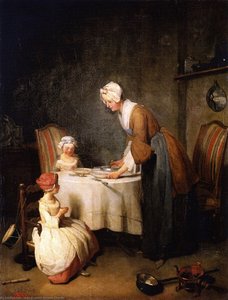
Chardin’s artistic journey began with still life, and it is here that he achieved his earliest recognition. However, these were not merely depictions of objects; they were imbued with a sense of weight, presence, and almost tactile reality. He didn't simply *represent* an object; he captured its essence, its very being. His early works, like “The Ray” (1728), demonstrate his remarkable ability to render textures – the glistening scales of the fish, the rough weave of the cloth, the cool smoothness of the stone surface. He achieved this through a masterful manipulation of light and shadow, employing a subtle impasto technique that created a palpable sense of volume and depth. His admission to the Académie Royale de Peinture et de Sculpture in 1728 with these works cemented his reputation as a rising star. As his career progressed, Chardin began to explore genre painting – scenes of everyday life featuring kitchen maids, children, and families engaged in simple activities. Works like “The Young Schoolmistress” (1740) and "Saying Grace" are poignant studies in human interaction, capturing fleeting moments of tenderness, concentration, and quiet dignity. These paintings weren’t sentimental or idealized; they were honest and unvarnished portrayals of life as it was lived by the common people of Paris.

A Technique Rooted in Tactility and Light

What truly sets Chardin apart is his unique approach to painting technique. He rejected the smooth, polished surfaces favored by many of his contemporaries, opting instead for a deliberately textured impasto – a thick application of paint that created a sense of physicality and depth. This wasn’t merely a stylistic choice; it was integral to his artistic vision. The texture allowed him to capture the subtle nuances of light and shadow, creating an atmosphere of warmth and intimacy. He built up layers of paint, often using a palette knife as much as a brush, to create surfaces that seemed to radiate light from within. His color palettes were typically muted and earthy – browns, grays, ochres, and creams – but he used these colors with extraordinary sensitivity, creating harmonies and contrasts that were both subtle and profound. He was a master of *chiaroscuro*, the dramatic interplay of light and dark, using it to sculpt forms and create a sense of atmosphere. His paintings invite viewers not just to look, but to *feel* – to experience the textures, the weight, and the presence of the objects depicted.

Legacy and Enduring Influence

Chardin’s influence on subsequent generations of artists is immeasurable. He was admired by painters as diverse as Paul Cézanne, Édouard Manet, and Henri Matisse, all of whom recognized his profound understanding of form, light, and composition. Cézanne, in particular, famously declared that Chardin was “the father of us all,” acknowledging the debt he owed to the older master’s emphasis on structure and tactile quality. Chardin's focus on everyday subjects also paved the way for Realist painters like Gustave Courbet, who sought to depict life without idealization or embellishment. Beyond his influence on painting, Chardin’s work has resonated with writers, philosophers, and art historians alike. His paintings are often seen as meditations on themes of mortality, simplicity, and the beauty of the mundane. His legacy continues to inspire artists and viewers today, reminding us that profound meaning can be found in the most ordinary of things. He died in Paris on December 6, 1779, leaving behind a body of work that stands as a testament to his artistic genius and his unwavering commitment to truth and beauty.

Exploring Chardin’s World Today

Fortunately, the opportunity to experience Chardin's artistry firsthand remains readily available. His works are prominently featured in major museums around the world, including the Musée du Louvre in Paris, the National Gallery of Art in Washington D.C., and the Hermitage Museum in Saint Petersburg. The Musée Maurice Denis in France also holds an impressive collection of French post-impressionism paintings alongside Chardin’s work, offering a fascinating context for understanding his influence on later artists. For those seeking to delve deeper into his life and art, numerous scholarly resources are available, including Georges Wildenstein's comprehensive monograph and insightful essays by Pierre Rosenberg. Furthermore, high-quality reproductions of his masterpieces can be found online at platforms like OriginalUniqueArt.com, allowing admirers to bring the quiet beauty of Chardin’s world into their own homes. His paintings continue to offer a timeless invitation to slow down, observe carefully, and appreciate the simple pleasures of life.

Quick Facts

  • Title: Soap Bubbles
  • Artistic style: Domestic tranquility
  • Medium: Oil on canvas
  • Movement: Rococo
  • Notable elements or techniques: Light and shadow play
  • Subject or theme: Fleeting beauty

Art Quiz

There is only one correct answer for each question.

Question 1:
What artistic movement is Jean-Baptiste Simeon Chardin’s ‘Soap Bubbles’ primarily associated with?
Question 2:
The painting utilizes a technique similar to what historical artistic movement known for dramatic lighting effects?
Question 3:
What is the primary symbolic representation conveyed by Chardin’s depiction of a woman blowing bubbles?
Question 4:
Where is ‘Soap Bubbles’ currently housed?
Question 5:
What element contributes to the sense of depth and volume within the painting, mirroring techniques employed by artists like Leonardo da Vinci?