Preview
 Send
Send Share
Share
 Details
 Guide
Guide

 Download
 Similars
 X-Ray
X-Ray Diaporama
 Stats
StatsLandscape
 Oil On Canvas
- WallArt
- Rococo
 Early Modern
 56.0 x 76.0 cm
 Museo del Prado
 Read More
Hand Made Oil Reproduction
Hand-painted oil on canvas in your size and frame, made to order by our artists. ( Switch to Print Switch to Digital Image)




P118B $10

P118H $10

P118W $10

P438Z $10

P508JH $12

P508YH $12

P805H $10

P805Z $10

P919BZ $10

P919G $10

P919XJ $10

P959ZH $10

P968JZ $12

W106C $8

W218G $10

W218JH $8

W218Y $10

W307PJ $10

W316G $10

W316PJ $8

W316Y $10

W398PJ $8

W4111J $10

W500HY $15

W500JH $15

W692G $12

W849H $8

W940BG $15

W953PJ $8




Pick from our preset sizes that match the artwork's original proportions.

Type the width and the height you need, to fit your frame or your wall. This is hand-painted, so for a size with a different shape the artist can paint a bit more around the picture, or cut a bit — you choose. We send you a digital mockup to approve before the painting starts. The picture shown on this page does not show the real result — only the mockup does.
After order, OriginalUniqueArt.com team will email client for instructions and provide a mockup preview
Worldwide Delivery () in 3/4 weeks instead of standard 5 weeks. (23 October). No compromise on quality.

Free Worldwide Express Shipping

High-Quality Linen Canvas

Full Shipping Insurance

Customs Tax Refund Guarantee

True Color Matching Guarantee

100-Day Return Policy (Defects Only)

100% Money-Back Guarantee

Bulk Discount Offer
 Glass option is only available in size under 110 CM

Landscape
Reproduction Medium
Reproduction Size
-


Total Price
$ 300
A Serene Escape into the Rococo Dream
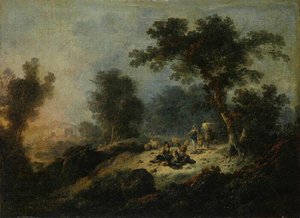
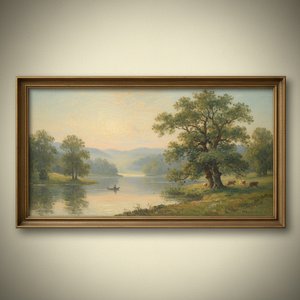
In this exquisite landscape by Jean-Baptiste Pillement, the viewer is invited to step into a world of effortless grace and pastoral tranquility. The scene unfolds as a masterclass in the Rococo aesthetic, where the boundaries between nature and artifice dissolve into a harmonious dance of light and form. At the heart of the composition, three figures rest upon rugged, textured rocks near the edge of a shimmering body of water, their presence suggesting a moment of quiet intimacy and leisurely repose. The landscape is not merely a backdrop but a living, breathing entity; fallen tree trunks and scattered branches in the foreground lend a sense of organic realism, hinting at the untamed beauty of a forest that has recently weathered a gentle storm. This delicate balance between the wildness of nature and the refined elegance of human presence creates a narrative of peace, inviting anyone who gazes upon it to pause and breathe in the stillness of an idealized era.
The technical mastery of Pillement is evident in every brushstroke, particularly in his ability to manipulate light and shadow to bestow a three-dimensional vitality upon the canvas. The middle ground is anchored by a dense, lush cluster of trees, where the artist’s skill shines through the intricate depiction of foliage catching the soft, filtered sunlight. This verdant richness provides a stunning contrast to the expansive, airy sky above, which is adorned with weightless, fluffy white clouds drifting across a brilliant blue expanse. Executed in oil on canvas, the painting possesses a luminous depth; the rich pigments and fine details allow the textures of stone, bark, and leaf to feel tactile and real.
The Artistry of Light and Atmosphere
Beyond its visual splendor, the artwork carries a profound emotional resonance. The use of light and shadow creates a three-dimensional effect, making the figures appear almost lifelike against the backdrop of nature. This interplay of color and light offers a sophisticated window into a more graceful age, where the atmosphere is one of leisurely enjoyment and natural beauty. For the discerning collector or interior designer, this piece offers a captivating way to breathe life into any room, serving as a focal point that evokes the Chinoiserie and Exotisme influences that defined the era.
The composition is thoughtfully structured to guide the eye through a journey of discovery:
- The Foreground: A textured terrain of rocks and fallen branches that grounds the viewer in a sense of organic reality.
- The Middle Ground: A lush, verdant cluster of trees that showcases Pillement's ability to capture the play of light on foliage.
- The Background: Rolling hills under an expansive, clear blue sky, providing a sense of openness and infinite freedom.
Ultimately, this landscape is more than a mere depiction of scenery; it is a poeticized vision of peace. It captures a tranquil moment where the world feels balanced, inviting the observer to lose themselves in the soft, filtered sunlight and the gentle, rhythmic beauty of the Rococo spirit.
Questions & Answers
What is "Landscape" about?
"Landscape" by Jean-Baptiste Pillement depicts: landscape, rococo, nature, figures, river, serene, trees.
Does "Landscape" show strong light-dark contrasts?
The contrast level of "Landscape" by Jean-Baptiste Pillement is statement.
Does "Landscape" have an augmented reality preview?
"Landscape" has an augmented reality preview: the artwork's AR Preview page shows it in your own space on a compatible device.
Artist Biography
The Enchanted Realms of Jean-Baptiste Pillement
In the golden twilight of the 18th century, few artists possessed the ability to transport the viewer to a world as dreamlike and exotic as Jean-Baptiste Pillement. Born in Nîmes in 1728, Pillement emerged not merely as a painter, but as a master of atmosphere, weaving together the delicate elegance of the Rococo style with a profound fascination for the distant and the unknown. While his early years remain partially veiled by the mists of history, his ascent within the French artistic hierarchy was nothing short of meteoric. Through his meticulous training under the esteemed Jean-Baptiste Huet, he mastered the subtle nuances of watercolor, a medium that allowed him to capture the ephemeral light and vibrant pigments necessary to bring his fantastical visions to life.
Pillement’s work serves as a window into the Chinoiserie and Exotisme movements that captivated the French aristocracy. Unlike the traditionalists of his era who sought solace in classical Roman ruins or somber historical portraits, Pillement looked toward the horizon. His travels through Italy and his deep engagement with Persian motifs allowed him to construct landscapes that felt both lush and otherworldly. In his hands, the natural world was reimagined; towering palms, serpentine rivers, and brilliantly feathered birds became the protagonists of a silent, beautiful drama. This mastery of the exotic made him an indispensable figure in the courts of Louis XV and Marie Antoinette, as his art provided a much-needed escape into a realm of pure, unadulterated imagination.
Technique, Influence, and the Rococo Spirit
The brilliance of Pillement’s technique lies in his ability to balance precision with a soft, ethereal glow. He utilized a delicate sfumato technique—a masterful blending of tones through meticulous layering—that lent his landscapes an almost translucent quality. This approach allowed him to evoke the atmospheric depth of masters like Claude Lorrain, yet he infused these classical foundations with a uniquely whimsical energy. His compositions were never static; they pulsed with a rhythmic vitality, often characterized by:
- Intricate Botanical Detail: A profound focus on flora that felt both scientifically inspired and mythically heightened.
- Chromatic Vibrancy: The use of bold, saturated colors to represent the lushness of tropical and oriental environments.
- Decorative Fluidity: An ability to bridge the gap between fine art painting and decorative design, making his work equally at home on a canvas or as part of an opulent interior mural.
His stylistic evolution was deeply shaped by the explorations of artists such as Nicolas Pocock and Gaspar Pérégrine Rigaud. By absorbing their approaches to landscape and light, Pillement was able to refine a signature aesthetic that felt both grounded in European tradition and wildly adventurous. His influence extended far beyond the canvas, as his designs permeated the very fabric of French decorative arts, informing everything from wallpaper patterns to porcelain motifs.
A Lasting Legacy in Art History
The historical significance of Jean-Baptiste Pillement cannot be overstated, particularly regarding his role in defining the visual language of late 18th-century luxury. His prestigious commissions, most notably the breathtaking murals adorning the Château de Fontainebleau and the Petit Trianon, stand as testaments to his status as a favorite of the French royalty. These works were not merely decorations; they were immersive environments that helped define the aesthetic identity of an era.
As the art world transitioned from the playful exuberance of the Rococo toward the more structured discipline of Neoclassicism, Pillement’s work remained a cherished bridge between these two worlds. He left behind a legacy of wonder, reminding future generations that art possesses the unique power to transcend geographical boundaries and transport the human spirit to lands of infinite beauty and mystery. Today, his name remains synonymous with the exquisite, the exotic, and the eternal charm of the French Rococo.

Jean-Baptiste Pillement
1728 - 1808 , France
Quick Facts
- Full Name: Jean-Baptiste Pillement
- Nationality: French
- Date Of Birth: 1728
- Date Of Death: 1808
- Place Of Birth: Nimes, France
- Notable Artworks:
- Chinois pêchant à la ligne
- Untitled (AQQNCU)
- Mountainous Landscape
- Artistic Movement Or Style: Rococo & Neoclassical
- Artists Who Influenced This Artist:
- François Boucher
- Jean-Honoré Fragonard
Related Articles
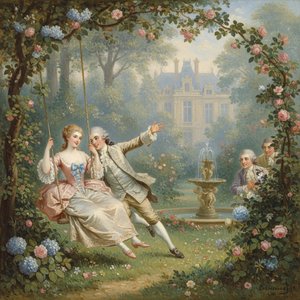
The Rococo Reverie of Fragonard: Love, Leisure & Pleasure in 18th-Century France
Explore the captivating world of Jean-Honoré Fragonard! Discover his Rococo masterpieces, intimate portraits & the allure of 18th-century French art. Learn about 'The Progress of Love' and more at OriginalUniqueArt.
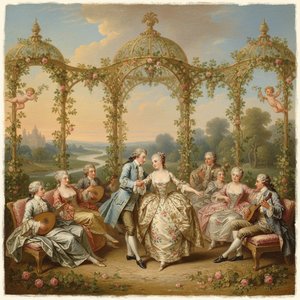
Jean-Baptiste Pater: Rococo Charm & Ephemeral Beauty of 18th-Century France
Explore the captivating world of Jean-Baptiste Pater, a master of Rococo painting. Discover his elegant *fête galante* scenes and shimmering portraits – a glimpse into 18th-century French aristocracy. Learn about his legacy & find high-quality reproductions.

The Rococo Aesthetic: Opulence, Rebellion & the Pursuit of Pleasure in 18th-Century Art
Explore the opulent world of Rococo art! Discover its origins, key artists like Watteau & Boucher, and lasting influence on design. Expert insights for collectors & enthusiasts.

Rococo's Radiant Legacy: 10 Masterpieces for Your Home |
Indulge in the elegance of Rococo! Explore 10 masterpieces by Fragonard, Boucher & Watteau. Discover the stories behind these iconic paintings and bring timeless art to your home with museum-quality reproductions from .
Master of Light: Exploring the Timeless Landscapes and Atmospheric Brilliance of Jean-Baptiste-Camille Corot
Discover the ethereal beauty of Jean-Baptiste-Camille Corot. Explore how this master of light bridged Neoclassicism and Impressionism through his atmospheric landscapes, capturing the timeless essence of the French countryside with unparalleled poetic brilliance.