Send
Send Share
Share
 Details
 Guide
Guide

 Download
 Similars
 Diaporama
 Q&A
Q&A Stats
StatsKul-e Farah relief I


 Read More
The artwork displayed on this page is protected by copyright law, which means we cannot legally create or sell an identical reproduction. This protection is enforced under international agreements such as the Berne Convention and by national laws, including those outlined by the U.S. Copyright Law - Title 17.
This method fully complies with copyright regulations because it does not involve copying or duplicating the protected artwork. Instead, it is a creative reinterpretation - a new painting that is influenced by the original but not identical to it.
Giclée / Art Print
Museum-quality giclée or canvas print with fast production and flexible finish options. ( Buy Hand Made Painting Switch to Digital Image)




































Pick from our preset sizes that match the artwork's original proportions.

Type the width and the height you need, to fit your frame or your wall. A print can only be cut, never made bigger than the picture, so a size with a different shape loses a part of the image. We send you a digital mockup to approve before we print anything. The picture shown on this page does not show the real cut — only the mockup does.
Worldwide Delivery () in 2 weeks instead of standard 4/5 weeks. (11 November)

Free Worldwide Express Shipping

High-Quality Linen Canvas

Full Shipping Insurance

Customs Tax Refund Guarantee

True Color Matching Guarantee

100-Day Return Policy (Defects Only)

100% Money-Back Guarantee

Bulk Discount Offer
 Glass option is only available in size under 110 CM

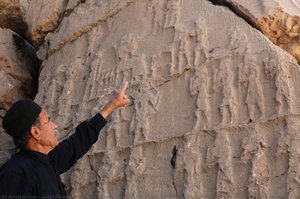
Kul-e Farah relief I
Giclée / Art Print
Reproduction Size
-


Total Price
$ 81
A Silent Witness to Elamite Grandeur
Perched high above the landscape, carved into a vertical niche some five and a half meters from the ground, the Kul-e Farah relief I stands as a profound testament to the enduring spirit of the Elamite highland tradition. This ancient masterpiece is not merely a carving on stone; it is a monumental dialogue between man and nature, frozen in time since approximately 500 BC. The relief serves as a vital historical link, embodying the sophisticated artistic language of an era that flourished in the ancient Near East. To gaze upon this work is to witness the intersection of political authority and artistic devotion, where every line etched into the rock face speaks of a civilization deeply rooted in its rugged, mountainous terrain.
The composition of the relief is both intricate and commanding, showcasing a scene of figures positioned with a deliberate sense of hierarchy and presence. The artistry lies in the way the carver utilized the natural contours of the rock to breathe life into the subjects, creating a sense of depth that invites the viewer to contemplate the lives of those depicted. Within the vertical niche, the relief integrates multiple elements of elite representation, drawing from much older traditions of valley carvings to assert the prestige of its creators. For the discerning collector or lover of antiquity, this piece offers a window into a world where art was used to solidify the identity of rulers and the sanctity of their lands.
The Language of Power and Inscription
Beyond its visual majesty, the Kul-e Farah relief I is a literary treasure, housing a complex narrative written in stone. The surface is adorned with twenty-four horizontal registers of an inscription that remains one of the most significant, yet enigmatic, archaeological finds of the region. This text provides a rare glimpse into the political landscape of the time, identifying the local ruler Hanni, son of Tahhi, who served as the "caretaker, protector, and ruler" of Ayapir. His role as a vassal to the Elamite king Shutur-Nahhunte highlights the intricate web of loyalty and governance that defined the period between 625 and 585 BC. The presence of nine additional epigraphs, delicately inscribed over the skirts of the carved figures, adds a layer of rhythmic detail that enhances the relief's textural complexity.
For interior designers and curators of historical reproductions, this artwork offers an unparalleled opportunity to introduce a sense of profound history and intellectual depth into a space. The interplay between the rugged texture of the stone and the precise, delicate epigraphs creates a visual tension that is both intellectually stimulating and aesthetically grounding. A high-quality reproduction of this relief does more than decorate a wall; it anchors a room with the weight of millennia, providing a conversation piece that bridges the gap between modern luxury and ancient heritage.
An Eternal Legacy in Stone
The emotional impact of the Kul-e Farah relief I stems from its sheer resilience. Despite the passage of over two thousand years, the figures and their stories remain remarkably well-preserved, offering a hauntingly beautiful connection to the Elamite civilization. The way the light plays across the carved surfaces—mimicking the natural sunlight that has illuminated this niche for centuries—creates an ever-changing aesthetic experience. It is a work that celebrates the concept of permanence in an impermanent world.
Owning or displaying a tribute to this relief allows one to participate in the preservation of human memory. Whether integrated into a contemporary gallery setting or used as a focal point in a sophisticated study, the piece evokes a sense of awe and reverence. It invites the observer to look upward, much like the original viewers did, and to find inspiration in the enduring strength of the Elamite spirit and the masterful hands that carved it into the very bones of the earth.
Questions & Answers
How is the mood of "Kul-e Farah relief I" by Javier Álvarez Mon described?
"Kul-e Farah relief I" by Javier Álvarez Mon is described as earthy in mood. This classification can help match the work to a setting.
What feeling is "Kul-e Farah relief I" associated with?
"Kul-e Farah relief I" is associated with a mysterious feeling. The emotional tone describes the impression the work gives.
How can I get a print of "Kul-e Farah relief I" by Javier Álvarez Mon?
A print of "Kul-e Farah relief I" by Javier Álvarez Mon can be ordered directly on its Fine Art Print page: a fine art print on cotton canvas or archival canvas paper.
Artist Biography
The Chronicler of Ancient Sands
In the vast, dusty corridors of human history, few figures possess the ability to breathe life into the silent relics of the past quite like Javier Álvarez-Mon. Born in Madrid in 1969, his journey has not been one of a traditional painter wielding a brush, but rather that of an archaeologist and historian meticulously reconstructing the lost grandeur of the ancient Near East. Through his scholarly lens, the fragmented pottery, weathered reliefs, and forgotten inscriptions of the Elamite civilization are transformed from mere artifacts into vibrant narratives of human existence. His life’s work serves as a bridge between the modern world and the enigmatic shadows of the Bronze and Iron Ages.
The foundation of his intellectual prowess was laid at the Universidad Complutense de Madrid, where he earned his doctorate in archaeology in 2001. This rigorous academic training instilled in him a profound respect for the material evidence of antiquity. As his career progressed, Álvarez-Mon became a vital voice within the Spanish National Research Council (CSIC) and took on the mantle of director for the Elamite Studies Group at the University of Barcelona. His approach is characterized by a deep, almost poetic immersion into the culture of Elam, seeking to understand not just the dates of conquests, but the very soul of a civilization that flourished between 4200 and 525 BC.
Unearthing the Elamite Legacy
The essence of Álvarez-Mon’s contribution lies in his ability to synthesize archaeological data with historical storytelling. His research focuses heavily on the Elamite culture, a pivotal yet often overlooked precursor to the Persian Empire. Through his extensive excavations and meticulous analysis, he has illuminated the complex social structures, artistic expressions, and political intricacies of this ancient Near Eastern power. His work does not merely document; it interprets the aesthetic and symbolic language used by ancient peoples to communicate their identity and their relationship with the divine.
His literary contributions serve as essential pillars for anyone seeking to understand the origins of Persian history. Some of his most profound scholarly achievements include:
- The Elamite World (2018): A sweeping exploration that brings the breadth of Elamite influence to light.
- Elam: History, Art, and Archaeology (2021): A comprehensive study that blends the physical remains of the earth with the artistic legacy of its people.
- The Elamite Culture (2015): An intimate look at the societal nuances of this ancient civilization.
- Elam: A History of the Region (2012): A foundational text tracing the geographical and political evolution of the territory.
A Legacy of Discovery and Collaboration
Beyond his individual publications, the significance of Javier Álvarez-Mon is found in his collaborative spirit and his dedication to international research projects. He has been a driving force behind initiatives such as the Elamite Project, funded by the CSIC, which seeks to push the boundaries of what we know about the ancient Near East. His archaeological endeavors in Iran have allowed him to connect directly with the soil where these civilizations once thrived, bringing a sense of tactile reality to his academic findings.
His work is characterized by an unwavering commitment to uncovering the truth behind the legends of the ancient world. By studying artifacts like the Kul-e Farah reliefs and other precious remnants of early Persian history, he ensures that the voices of the Elamites are not lost to the sands of time. Through his tireless research, Álvarez-Mon has secured his place as a vital custodian of human heritage, ensuring that the art, culture, and history of the ancient Near East continue to inspire and educate generations to come.

Javier Álvarez Mon
1969 - , Spain
Quick Facts
- Date Of Birth: 1969
- Full Name: Javier Álvarez Mon
- Nationality: Spanish
- Notable Artworks:
- The Elamite World (2018)
- Elam: History, Art and Archaeology (2021)
- Place Of Birth: Madrid, Spain
Related Articles

Mastering the Woodcut: A Definitive Guide to the Art of Relief Printing and its Historical Legacy
Explore the profound history and technical mastery of woodcut relief printing. From ancient origins to German Expressionism, discover how artists use the subtractive process to create iconic works. A definitive guide for art students, collectors, and historians.
Mastering Dimension: An Art Historian's Guide to the Elegance of Sculptural Relief Art
Explore the profound beauty of sculptural relief art. From classical bas-relief to modern geometric textures, discover how depth and light transform spaces through an expert guide on art history and sophisticated curation for discerning collectors.

Sculpting with Soul: The Ultimate Guide to Mastering Bas-Relief and Plaster Artistry
Master the intricate art of plaster bas-relief with our expert guide for art students. Learn professional techniques in material selection, texture carving, and pigment integration to create soulful, dimensionally rich sculptural masterpieces.
Sculpting with Soul: An Expert Guide to the Tactile Elegance of Plaster Relief Art
Discover the captivating world of plaster relief art. Our expert guide explores the history, techniques, and curation of textured bas-relief, helping collectors bring depth, light, and soulful dimension to their modern interiors through sophisticated sculptural masterpieces.
Stone & Canvas: 10 Masterpieces of Timeless Art |
Explore 10 iconic paintings dominated by 'stone' tones – from Caravaggio’s drama to Rembrandt’s depth. Discover art history, techniques & find museum-quality reproductions for your home at .