
 Send
Send Share
Share
 Details
 Guide
Guide

 Download
 Similars
 Diaporama
 Stats
StatsPainted Bronze

 Read More
The artwork displayed on this page is protected by copyright law, which means we cannot legally create or sell an identical reproduction. This protection is enforced under international agreements such as the Berne Convention and by national laws, including those outlined by the U.S. Copyright Law - Title 17.
This method fully complies with copyright regulations because it does not involve copying or duplicating the protected artwork. Instead, it is a creative reinterpretation - a new painting that is influenced by the original but not identical to it.
Giclée / Art Print
Museum-quality giclée or canvas print with fast production and flexible finish options. ( Buy Hand Made Painting Switch to Digital Image)




































Pick from our preset sizes that match the artwork's original proportions.

Type the width and the height you need, to fit your frame or your wall. A print can only be cut, never made bigger than the picture, so a size with a different shape loses a part of the image. We send you a digital mockup to approve before we print anything. The picture shown on this page does not show the real cut — only the mockup does.
Worldwide Delivery () in 2 weeks instead of standard 4/5 weeks. (22 October)

Free Worldwide Express Shipping

High-Quality Linen Canvas

Full Shipping Insurance

Customs Tax Refund Guarantee

True Color Matching Guarantee

100-Day Return Policy (Defects Only)

100% Money-Back Guarantee

Bulk Discount Offer
 Glass option is only available in size under 110 CM

Painted Bronze
Giclée / Art Print
Reproduction Size
-


Total Price
$ 81
The Genesis of a Simple Object
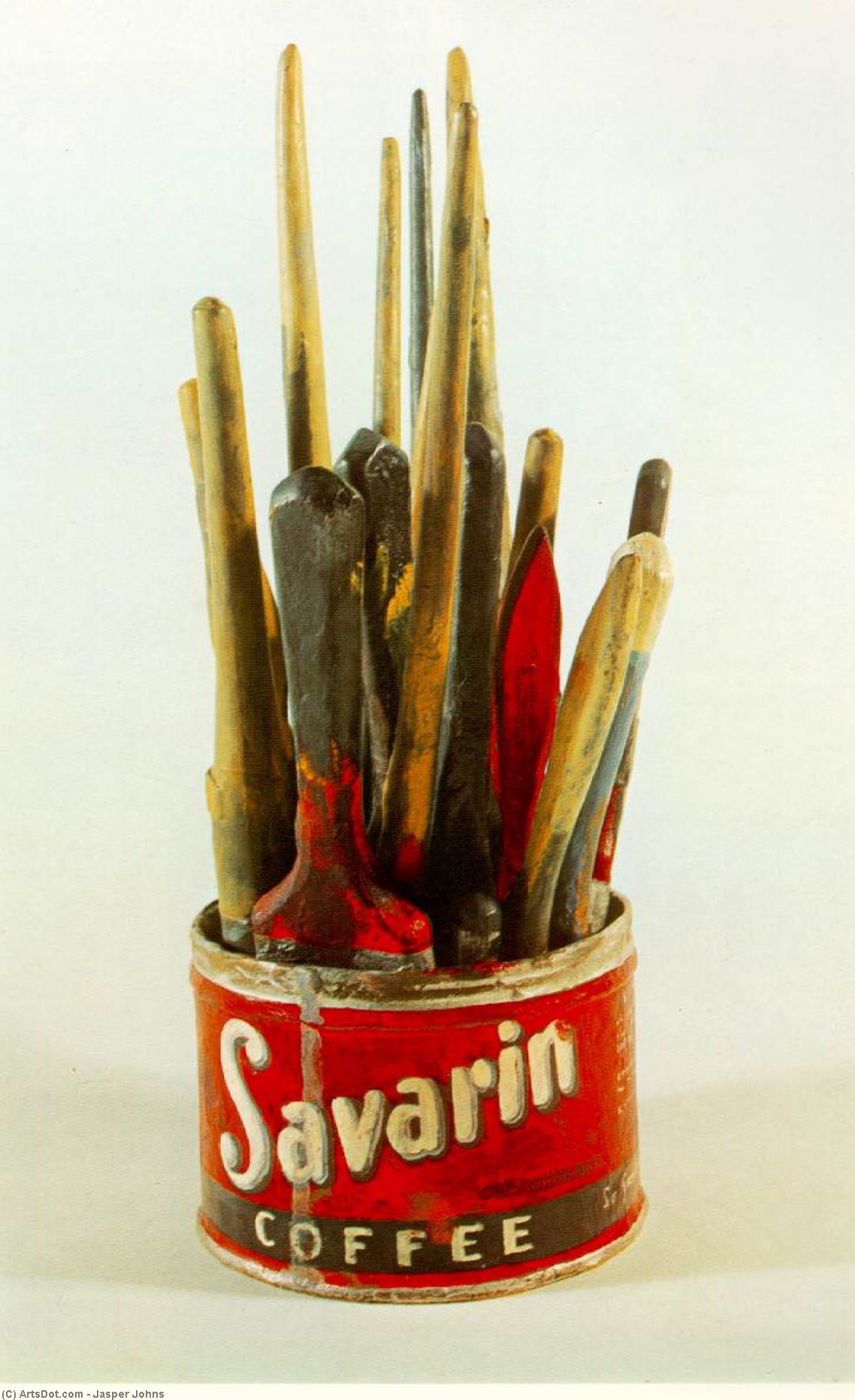
Jasper Johns' Painted Bronze, created in 1960 but cast and painted the following year, is deceptively simple. At first glance, it presents as two unassuming twelve-ounce beer cans – rendered in bronze and meticulously painted to mimic their metallic counterparts – resting upon a stark, rectangular base. Yet, this apparent banality belies a profound engagement with American iconography, artistic tradition, and the very nature of representation. The genesis of this work is famously attributed to a seemingly offhand remark from Willem de Kooning, a fellow Abstract Expressionist, who reportedly suggested Johns “give that son-of-a-bitch two beer cans” – an observation that highlighted the burgeoning commercialization of art and the potential for transforming everyday objects into compelling subjects.
The anecdote, though perhaps embellished, underscores a key element of Johns’s artistic strategy: his ability to elevate the mundane to the level of significance. He wasn't interested in grand narratives or abstract explorations; instead, he sought to distill meaning from the familiar – the commonplace objects that populate our daily lives. This approach aligns with a broader shift within American art during the 1960s, moving away from the emotionally charged landscapes and figures of Abstract Expressionism towards a more direct engagement with recognizable imagery.
Technique and Materiality: A Dialogue Between Paint and Metal
The technical execution of Painted Bronze is remarkably precise. Johns meticulously cast the beer cans in bronze, ensuring their form was faithfully replicated. However, rather than leaving them to their inherent materiality, he then applied a layer of paint – a muted gold-brown hue – that deliberately obscures and distorts the metallic surface. This act of painting isn’t merely decorative; it's a deliberate disruption of the material’s natural appearance, creating a fascinating dialogue between the cold solidity of bronze and the ephemeral qualities of paint.
The choice of bronze itself is significant. Bronze, historically associated with antiquity and permanence, lends an air of gravitas to the seemingly trivial subject matter. It elevates the beer cans from mere consumer goods to objects imbued with a sense of historical weight and symbolic resonance. The uneven application of paint further emphasizes this tension – suggesting a process of deliberate imperfection, mirroring the artist’s own approach to representation.
Symbolism and American Identity
Beyond its technical merits, Painted Bronze is deeply rooted in American iconography. Beer cans, ubiquitous symbols of post-war prosperity and consumer culture, immediately evoke a specific historical context. The reference to “ale” – a term associated with a more refined and established social class – adds another layer of meaning, subtly referencing the hierarchies and distinctions that defined American society at the time.
Furthermore, Johns’s decision to depict beer cans rather than, say, flags or maps—other recurring motifs in his work—is particularly revealing. Flags and maps are inherently symbolic, representing national identity and geopolitical power. Beer cans, on the other hand, represent a more intimate and personal experience – a shared ritual of consumption that connects individuals across diverse social groups. In this way, Johns transforms an everyday object into a potent symbol of American culture and its complex relationship with commerce and consumerism.
Emotional Resonance and Artistic Legacy
Despite its seemingly simple composition, Painted Bronze possesses a remarkable emotional resonance. The work invites contemplation on the nature of representation, the blurring of boundaries between art and life, and the enduring power of everyday objects to evoke profound meaning. It’s a testament to Johns's ability to distill complex ideas into deceptively straightforward forms, leaving the viewer with a lingering sense of ambiguity and wonder.
Painted Bronze stands as a pivotal work in Jasper Johns’s oeuvre, exemplifying his innovative approach to subject matter and technique. It remains a compelling example of American art's engagement with contemporary culture and its exploration of the symbolic potential within the mundane.
Questions & Answers
Does "Painted Bronze" have an augmented reality preview?
"Painted Bronze" has an augmented reality preview: the artwork's AR Preview page shows it in your own space on a compatible device.
Is there a guide for "Painted Bronze" by Jasper Johns?
The guide to "Painted Bronze" is the artwork's Guide page - a printable factsheet showing the artwork with its caption, credit line and identity table (artist, dates, medium, original size, collection).
What underlying hue runs through "Painted Bronze" by Jasper Johns?
An ochre to sepia hue runs through "Painted Bronze" by Jasper Johns.
Artist Biography
A Life Painted in Symbols: The World of Jasper Johns
Jasper Johns emerged as a pivotal figure in the landscape of American art, bridging the emotive intensity of Abstract Expressionism with the burgeoning Pop Art movement that would soon redefine artistic boundaries. Born in Augusta, Georgia, in 1930, his early life was marked by a sense of displacement following his parents’ divorce, an experience that perhaps subtly informed his later explorations of identity and belonging within the context of American iconography. His formative years unfolded across various schools before he briefly attended the University of South Carolina, but it wasn't until his move to New York City in 1949 that Johns truly began to forge his artistic path. A period of service during the Korean War further shaped his perspective, exposing him to a world far removed from the burgeoning art scene he was eager to embrace upon his return.Breaking with Abstraction: The Dawn of a New Visual Language
The post-war American art world was dominated by Abstract Expressionism—a style characterized by spontaneous gesture and deeply personal emotional expression. While initially influenced by this movement, Johns felt compelled to move beyond its purely non-representational approach. He sought a new visual language, one that incorporated recognizable imagery not as illustrations but as vehicles for deeper contemplation. This wasn’t simply about *depicting* the world; it was about questioning how we perceive and interpret symbols within it. Key influences guided his departure: Marcel Duchamp's radical readymades challenged conventional notions of art-making, while the emphasis on materiality in Abstract Expressionism informed Johns’ early techniques. However, it was the everyday objects and potent symbols of American culture—flags, targets, maps, numbers—that truly became central to his artistic vocabulary. He wasn’t interested in escaping representation; he wanted to dissect it, layer it with meaning, and ultimately reveal its inherent ambiguities.Iconic Images: Flags, Targets, and the Language of Symbols
Johns' breakthrough works arrived in the mid-1950s, instantly establishing him as a force to be reckoned with. His paintings of flags, most notably *Flag* (1954–55), were not patriotic declarations but rather investigations into the very nature of representation. Rendered in a semi-abstract style, using encaustic—pigment mixed with hot wax—and collage techniques, these flags weren’t simply images; they were textured surfaces laden with symbolic weight. The target series, beginning in 1958, further explored this fascination with recognizable forms, questioning perception and meaning through the seemingly straightforward image of a bullseye. *Map* (1961), with its fragmented and layered depictions of the United States, delved into themes of geography, identity, and the complexities of national representation. Works like *False Start* (1959) demonstrated his experimentation with language and visual codes, creating complex compositions that challenged viewers to decipher their underlying meanings. Even *White Flag* (1955), a seemingly simple monochrome canvas, prompted profound questions about absence, surrender, and the very act of seeing.A Legacy of Influence: Paving the Way for Pop Art and Beyond
Jasper Johns’ impact on the trajectory of modern art is undeniable. He played a crucial role in the transition from Abstract Expressionism to Pop Art, challenging the prevailing aesthetic norms and opening up new avenues for artistic exploration. By embracing recognizable imagery, he paved the way for artists like Andy Warhol and Roy Lichtenstein, who would further blur the lines between high art and popular culture. His close collaboration with Robert Rauschenberg was also profoundly influential, fostering a spirit of experimentation and pushing the boundaries of artistic practice. Johns’ work continues to resonate today, inspiring generations of artists to question assumptions, challenge conventions, and explore the power of symbols in shaping our understanding of the world. He remains an active artist, constantly evolving his approach and solidifying his position as one of the most important figures in 20th and 21st-century art.Recognition and Enduring Impact
Throughout his illustrious career, Jasper Johns has received numerous accolades, including a Golden Lion at the Venice Biennale in 1988, the National Medal of Arts in 1990, and the Presidential Medal of Freedom in 2011. His works are held in major museum collections worldwide—the Museum of Modern Art, the Whitney Museum of American Art, the Metropolitan Museum of Art in New York, and Tate Modern in London, to name just a few. He has been the subject of countless exhibitions, cementing his status as a master of modern art. Beyond his paintings, Johns’ contributions extend to sculpture and printmaking, demonstrating his versatility and unwavering commitment to artistic innovation. His enduring legacy lies not only in the iconic images he created but also in the profound questions he raised about the nature of representation, symbolism, and the very essence of what it means to be an artist in a rapidly changing world.
Jasper Johns
1930 - , United States of America
Quick Facts
- Artistic Movement Or Style: Pop Art, Abstract Expressionism, Neo-Dada
- Artists Or Movements Influenced By This Artist:
- Pop Art
- Andy Warhol
- Roy Lichtenstein
- Artists Who Influenced This Artist: ['Marcel Duchamp']
- Full Name: Jasper Johns
- Nationality: American
- Notable Artworks:
- Flag
- Target
- Map
- White Flag
- False Start
- Place Of Birth: Augusta, United States of America
- Date Of Birth: 1930
Related Articles

The Enduring Legacy of Bronze Sculpture: A Collector's Guide to Form & Cultural Significance
Explore the rich history & enduring appeal of bronze sculpture with expert insights for collectors at OriginalUniqueArt. Learn about casting techniques, iconic artists, and collecting tips to build a discerning art collection.

The Enduring Legacy of Bronze: A Historical & Artistic Exploration for the Collector
Explore the rich history & enduring appeal of bronze sculpture with expert insights for collectors at OriginalUniqueArt. Learn about casting techniques, iconic artists, collecting tips & contemporary interpretations.
The Enduring Legacy of Bronze: History, Technique & Artistic Expression for the Collector
Explore the rich history & enduring appeal of bronze sculpture with expert insights for collectors at OriginalUniqueArt. Learn about casting techniques, iconic artists, and collecting tips.

Bronze Sculptures That Defined Art History | OriginalUniqueArt
Journey through art history with our Top 10 bronze sculptures! Explore masterpieces by Rodin, Michelangelo & more. Discover stories behind iconic statues and find museum-quality reproductions for your home decor at OriginalUniqueArt.com.

Bronze Age to Modern Masters: 10 Sculptures That Redefined Art | OriginalUniqueArt
Journey through art history with 10 legendary bronze sculptures – from Michelangelo's David to Rodin’s Thinker. Explore the stories, techniques & timeless beauty of these masterpieces. Find museum-quality reproductions & elevate your home decor on OriginalUniqueArt.com.


