
 Preview
 Send
Send Share
Share
 Details
 Guide
Guide

 Download
 Similars
 X-Ray
X-Ray Diaporama
 Stats
StatsSmall Triptych (central panel)
 Oil
Oil- WallArt
- Early Netherlandish Painting
 1437
1437- Renaissance
 27.0 x 21.0 cm
 Gemäldegalerie
 Read More
Hand Made Oil Reproduction
Hand-painted oil on canvas in your size and frame, made to order by our artists. ( Switch to Print Switch to Digital Image)




P118B $10

P118H $10

P118W $10

P438Z $10

P508JH $12

P508YH $12

P805H $10

P805Z $10

P919BZ $10

P919G $10

P919XJ $10

P959ZH $10

P968JZ $12

W106C $8

W218G $10

W218JH $8

W218Y $10

W307PJ $10

W316G $10

W316PJ $8

W316Y $10

W398PJ $8

W4111J $10

W500HY $15

W500JH $15

W692G $12

W849H $8

W940BG $15

W953PJ $8




Pick from our preset sizes that match the artwork's original proportions.

Type the width and the height you need, to fit your frame or your wall. This is hand-painted, so for a size with a different shape the artist can paint a bit more around the picture, or cut a bit — you choose. We send you a digital mockup to approve before the painting starts. The picture shown on this page does not show the real result — only the mockup does.
After order, OriginalUniqueArt.com team will email client for instructions and provide a mockup preview
Worldwide Delivery () in 3/4 weeks instead of standard 5 weeks. (23 October). No compromise on quality.

Free Worldwide Express Shipping

High-Quality Linen Canvas

Full Shipping Insurance

Customs Tax Refund Guarantee

True Color Matching Guarantee

100-Day Return Policy (Defects Only)

100% Money-Back Guarantee

Bulk Discount Offer
 Glass option is only available in size under 110 CM

Small Triptych (central panel)
Reproduction Medium
Reproduction Size
-


Total Price
$ 300
The Intimate World of Jan van Eyck's Central Panel
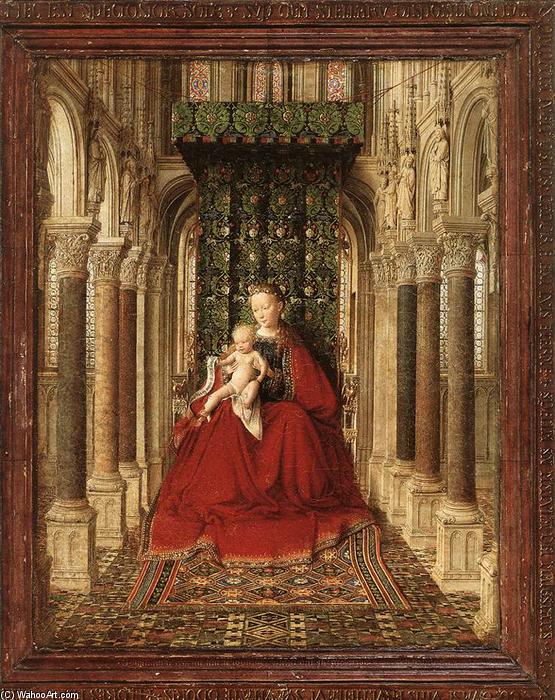
Within the confines of the ‘Small Triptych,’ a masterpiece by Jan van Eyck completed around 1437, resides a scene of profound serenity and quiet contemplation. This central panel, measuring just 27 x 21 centimeters, isn’t merely a depiction of a mother and child; it's an exquisitely rendered meditation on domesticity, faith, and the enduring bond between generations. Van Eyck, a pivotal figure in the Early Netherlandish movement, masterfully employs his revolutionary oil painting technique to capture not just the outward appearance but also the very essence of this intimate moment. The woman, seated comfortably within a simple chair, exudes an aura of gentle authority and profound love as she cradles her infant – a visual embodiment of nurturing and protection. The subtle modeling of her garments, achieved through layers of meticulously applied paint, creates a remarkable sense of tactile realism, inviting the viewer to almost feel the softness of the fabric against their fingertips.
Notice the deliberate placement of the figures within the space. They are not isolated but subtly integrated into a carefully constructed architectural setting. Three arches frame the scene, hinting at a sacred or domestic space—perhaps a chapel or a private chamber—and adding depth to the composition. Above the mother and child, a clock serves as a poignant reminder of time’s passage, anchoring the scene in both earthly reality and spiritual contemplation. The inclusion of this seemingly mundane object elevates it to a symbol of mortality and the preciousness of fleeting moments.
Light and Shadow: Van Eyck's Revolutionary Technique
What truly distinguishes Van Eyck’s work is his unparalleled mastery of light. He doesn’t simply paint light; he *creates* it, manipulating its effects to sculpt form and imbue the scene with a luminous quality. Unlike earlier painters who relied on tempera, which produced flat, lifeless surfaces, Van Eyck's use of oil paints allowed him to build up layers of color gradually, creating subtle gradations of tone and texture. This technique enabled him to achieve an astonishing level of realism – the way light catches on the woman’s hair, the delicate folds in her dress, and the soft glow around the infant are all testament to his skill.
The interplay of light and shadow is particularly evident in the modeling of the figures. Van Eyck uses highlights to accentuate their forms, creating a sense of three-dimensionality that was revolutionary for its time. The shadows, conversely, recede into the background, drawing the viewer’s eye towards the central figures and enhancing the overall sense of intimacy. This masterful control of light is not merely aesthetic; it serves to convey a profound emotional resonance, suggesting both serenity and a quiet reverence.
A Window into the Renaissance: Symbolism and Context
The ‘Small Triptych’ resides within the Gemäldegalerie Alte Meister in Dresden, Germany—a treasure trove of Early Netherlandish art. Van Eyck's work is deeply rooted in the International Gothic style, yet he pushed beyond its decorative flourishes to embrace a more naturalistic and realistic approach. His innovations in oil painting – particularly his ability to create luminous colors and incredibly detailed textures – profoundly influenced subsequent generations of artists. The triptych itself represents a shift towards private devotional art, moving away from the grand altarpieces commissioned by churches and towards smaller, more intimate works intended for domestic use.
The inclusion of elements like the clock and the arches suggests a connection to both earthly and spiritual realms. The mother-child relationship is central to Christian iconography, representing the Virgin Mary and Christ—a potent symbol of divine grace and salvation. The overall composition evokes a sense of timelessness, inviting viewers to contemplate the enduring power of family, faith, and the beauty of the everyday.
Bringing Jan van Eyck Home: A Hand-Painted Reproduction
OriginalUniqueArt offers exquisite, hand-painted reproductions of Jan van Eyck’s ‘Small Triptych (central panel)’, capturing the artist's revolutionary techniques and profound emotional depth. Each reproduction is meticulously crafted by our skilled artisans, using traditional oil painting methods to faithfully recreate Van Eyck’s luminous colors, intricate details, and masterful modeling. Owning a OriginalUniqueArt reproduction allows you to bring this iconic masterpiece into your home or office, celebrating the enduring legacy of one of art history's greatest masters. Explore our collection today and experience the magic of Van Eyck’s vision firsthand.
Questions & Answers
Who created "Small Triptych (central panel)"?
"Small Triptych (central panel)" is attributed to Jan van Eyck.
How is the color composition of "Small Triptych (central panel)" by Jan van Eyck built?
The color analysis of "Small Triptych (central panel)" by Jan van Eyck records a balanced contrast and a strong color unity harmony.
How light is "Small Triptych (central panel)" overall?
Overall, "Small Triptych (central panel)" is recorded as shadow. Perceived brightness describes how light or dark the work appears.
Artist Biography
The Alchemist of Light
To look at a Jan van Eyck painting is to witness the moment Western art stopped pretending and started observing. We often hear the myth that he invented oil paint, but the truth is more grounded and far more impressive: he mastered it. By applying thin, translucent glazes of pigment over one another, he achieved a depth of color and a precision of texture that tempera simply could not sustain. He did not just paint surfaces; he captured how light interacts with them. When you see the gleam of a single candle or the heavy weight of a velvet robe in his work, you are seeing the result of a technical revolution that changed the visual language of Europe.
His career was built on more than just brushwork. Van Eyck operated within the high-stakes environment of the Burgundian court, serving Philip the Good. This position required him to be much more than a craftsman; he functioned as a diplomat, traveling to places like Portugal and Spain on official missions. This access to power provided the financial stability necessary for his technical experiments. He was a man of intellect and discretion, qualities that allowed him to move between the worlds of high politics and fine art with ease.
The Precision of the Northern Eye
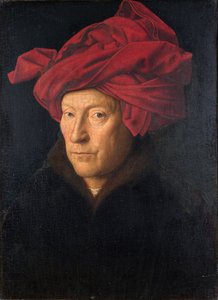
The work of Van Eyck is defined by an almost obsessive attention to the minute details of the physical world. In his portraits, he does not merely record a face; he records the texture of skin, the individual strands of hair, and the specific way light hits a turban. This level of realism was driven by a shift in focus toward the individual and the tangible. His ability to render atmospheric perspective—the way distant landscapes soften into a blue haze—showed a sophisticated understanding of how the human eye perceives depth.
His most significant technical achievements can be seen in several key works:
- The Ghent Altarpiece: A massive twelve-panel polyptych that demonstrates his ability to manage complex religious symbolism alongside realistic figures.
- The Arnolfini Portrait: A 1434 work where every object, from the dog representing fidelity to the discarded shoes on holy ground, carries specific weight. The mirror in the background reflects a whole other layer of reality.
- Portrait of a Man (Self Portrait?): A 1433 oil painting that features his personal motto, "Als ich kan" (As well as I can), etched directly onto the frame.
A Lasting Technical Standard
The influence of Jan van Eyck is not found in a vague sense of inspiration, but in the concrete standards he set for the medium. He moved the needle from the matte, flat surfaces of the medieval era toward a luminous, three-dimensional reality. His signature, "JOHANNES DE EYCK," and his frequent use of his motto served as a direct challenge to his contemporaries. He was not interested in the anonymity common to many medieval painters; he wanted his technical prowess to be recognized and attributed.
Even after his death in Bruges in 1441, the methods he perfected continued to dictate how artists approached light and texture for generations. His work remains a benchmark because it represents the successful marriage of scientific observation and artistic skill. He transformed pigments into something that feels alive, leaving behind a body of work that remains as sharp and clear today as it was in the fifteenth century.
Jan van Eyck
1390 - 1441 , Netherlands
Quick Facts
- Artistic Movement Or Style: Early Netherlandish painting
- Artists Or Movements Influenced By This Artist:
- Early Netherlandish painting
- Generations of painters
- Full Name: Jan van Eyck
- Nationality: Flemish
- Notable Artworks:
- Ghent Altarpiece
- Arnolfini Portrait
- Dresden Triptych
- Man in a Blue Turban
- Place Of Birth: Maastricht, Netherlands
- Date Of Birth: 1390
- Date Of Death: 1441
Related Articles
Early Netherlandish Masters: 10 Paintings That Revolutionized Art & Decor
Journey into the Early Netherlandish Renaissance! Explore 10 iconic paintings by Jan van Eyck, Rogier van der Weyden & more. Discover stunning detail, symbolism, and oil painting techniques. Find museum-quality art reproductions for your home at OriginalUniqueArt.com.

Illuminating Realism: A Comprehensive Exploration of the Early Netherlandish Renaissance Movement
Explore the captivating world of Early Netherlandish painting! Discover Jan van Eyck & other Flemish masters, their revolutionary techniques, hidden symbolism, and lasting legacy. A comprehensive guide for art enthusiasts.

Early Netherlandish Masters: 10 Paintings That Revolutionized Art & Decor
Journey into the world of Early Netherlandish painting! Explore 10 masterpieces by Jan van Eyck, Rogier van der Weyden & more. Discover stunning detail, symbolism & Renaissance art for your home decor. Find museum-quality reproductions on OriginalUniqueArt.com

Jan van Eyck: Innovation, Symbolism & the Dawn of Early Netherlandish Painting
Explore the revolutionary art of Jan van Eyck! Discover his groundbreaking oil painting techniques, hidden symbolism, and lasting impact on the Early Netherlandish Renaissance. A deep dive for art enthusiasts.

Early Netherlandish Renaissance: A Professional Guide to Mastering Detail and Realism for Luxury Interior Design
Expert guide for hotel designers on sourcing Early Netherlandish Renaissance reproductions. Discover how the hyper-realism of Jan van Eyck can elevate hospitality interiors through high-quality, large-scale oil paintings and custom multi-panel installations.


