

 Preview
 Send
Send Share
Share
 Details
 Guide
Guide

 Download
 Similars
 X-Ray
X-Ray Diaporama
 Stats
StatsCrucifixion


 Read More
Purchase a high-resolution, enhanced digital image, far superior to the online preview.
Each file is meticulously prepared by our in-house specialists using advanced tools and expert manual retouching. We ensure every image has exceptional clarity, precise color accuracy, and fine detail.
The final file is delivered via email within 72 hours, optimized for immediate use in professional, editorial, and print environments. This is the same quality trusted by top-tier design studios, publishers, and galleries.
Digital Image
Download a high-resolution file for personal display, printing, and creative projects. ( Switch to Print Buy Hand Made Painting)
Included in Every Digital Image Order
Expert Digital Delivery, Guaranteed
When you choose OriginalUniqueArt.com, you're not just getting an image - you're receiving a professionally enhanced digital artwork, crafted with precision and backed by a satisfaction guarantee. Here's everything that comes with your order, automatically:

Fast Email Delivery
Your high-resolution digital image file will be emailed to you within 72 hours of ordering - ready for immediate use.

AI-Enhanced Digital File
Your artwork is professionally optimized using advanced AI tools and manual editing, ensuring maximum detail, clarity, and color accuracy.

Free Lifetime Re-Delivery
Accidentally deleted or lost your file? No worries - we'll resend it to you anytime, free of charge.

No Import Fees - Ever
Enjoy your artwork instantly with zero customs, duties, or delivery fees - digital downloads are always tax-free.

Color Accuracy Guarantee
We ensure your digital image reflects the original colors as closely as possible using professional tools and color management.

100-Day Satisfaction Guarantee
If you're not satisfied with your digital image, we'll revise it or refund 100% within 100 days - no questions asked.

100% Money-Back Guarantee
Not satisfied? Get a full refund within 100 days of receiving your digital file - no questions asked.

Bulk Order Discounts
Buy 3 images, save 10% - Buy 5, save 15% - Buy 10+, save 20%. Great for creative projects, galleries, and agencies.
A Window into Early Netherlandish Devotion
Jan van Eyck’s *Crucifixion*, a small but profoundly impactful panel painting created around 1420, offers an intimate glimpse into the religious fervor and artistic innovation of the Early Netherlandish period. Measuring just 56 x 19 cm, this work—currently housed in the Metropolitan Museum of Art in New York—is part of a diptych originally paired with *The Last Judgment*, creating a powerful meditation on sin, salvation, and sacrifice.Detailed Realism & Technical Mastery
Van Eyck’s skill is immediately apparent in the meticulous detail lavished upon every element of the composition. Executed in oil on canvas—a medium he helped to pioneer—the painting showcases a remarkable level of realism previously unseen. The artist's mastery lies not only in accurately depicting textures – from the rough-hewn wood of the cross to the rich fabrics adorning the figures – but also in his nuanced rendering of human emotion. Observe the individualized expressions of grief, contemplation, and even stoicism amongst the crowd gathered at Calvary.Iconography & Symbolic Weight
The scene is densely populated with over thirteen figures, each contributing to the narrative’s emotional weight. Jesus Christ occupies the central position, his suffering palpable yet dignified. Surrounding him are mourners, Roman soldiers, and other witnesses to this pivotal moment in Christian history. The vibrant colors—deep reds, blues, and golds—are not merely decorative; they carry symbolic meaning. Red often represents sacrifice and passion, while gold signifies divinity and the heavenly realm. The careful arrangement of figures and objects isn’t accidental; it's a deliberate orchestration designed to guide the viewer’s eye and reinforce the painting’s theological message.Historical & Artistic Context
Jan van Eyck (c. 1390-1441) was a pivotal figure in the transition from Gothic to Renaissance art in Northern Europe. Born in Maastricht, he served as court painter to both John III of Bavaria and Philip the Good, Duke of Burgundy. This patronage afforded him access to resources and opportunities that allowed him to experiment with new techniques and push the boundaries of artistic representation. His work embodies the characteristics of the Early Netherlandish style: intense realism, meticulous detail, symbolic imagery, and a profound spiritual depth. He wasn’t alone; his brother Hubert also contributed significantly to this movement, notably co-creating the famed Ghent Altarpiece.Emotional Resonance & Lasting Impact
*The Crucifixion* is not simply a depiction of a historical event; it's an invitation to empathize with the suffering of Christ and contemplate the meaning of redemption. The painting’s small scale encourages intimate viewing, drawing the viewer into the scene and fostering a sense of personal connection. Its enduring power lies in its ability to evoke feelings of sorrow, reverence, and hope—emotions that transcend time and cultural boundaries.Key Details
- Artist: Jan van Eyck
- Title: Crucifixion
- Date: c. 1420
- Medium: Oil on canvas
- Dimensions: 56 x 19 cm
- Location: Metropolitan Museum of Art, New York
Questions & Answers
Where can I see a preview of "Crucifixion"?
The Preview page of "Crucifixion" lets you preview the artwork before ordering.
What mood does "Crucifixion" by Jan van Eyck express within Early Netherlandish Painting?
"Crucifixion" carries a melancholic emotional tone within the Early Netherlandish Painting movement.
What national origin stands behind the Early Netherlandish Painting of "Crucifixion"?
"Crucifixion" was created by Jan van Eyck, born in Netherlands, within the Early Netherlandish Painting movement. The artist's origin links the work to Early Netherlandish Painting as practiced by artists from Netherlands.
Artist Biography
The Alchemist of Light
To look at a Jan van Eyck painting is to witness the moment Western art stopped pretending and started observing. We often hear the myth that he invented oil paint, but the truth is more grounded and far more impressive: he mastered it. By applying thin, translucent glazes of pigment over one another, he achieved a depth of color and a precision of texture that tempera simply could not sustain. He did not just paint surfaces; he captured how light interacts with them. When you see the gleam of a single candle or the heavy weight of a velvet robe in his work, you are seeing the result of a technical revolution that changed the visual language of Europe.
His career was built on more than just brushwork. Van Eyck operated within the high-stakes environment of the Burgundian court, serving Philip the Good. This position required him to be much more than a craftsman; he functioned as a diplomat, traveling to places like Portugal and Spain on official missions. This access to power provided the financial stability necessary for his technical experiments. He was a man of intellect and discretion, qualities that allowed him to move between the worlds of high politics and fine art with ease.
The Precision of the Northern Eye
The work of Van Eyck is defined by an almost obsessive attention to the minute details of the physical world. In his portraits, he does not merely record a face; he records the texture of skin, the individual strands of hair, and the specific way light hits a turban. This level of realism was driven by a shift in focus toward the individual and the tangible. His ability to render atmospheric perspective—the way distant landscapes soften into a blue haze—showed a sophisticated understanding of how the human eye perceives depth.
His most significant technical achievements can be seen in several key works:
- The Ghent Altarpiece: A massive twelve-panel polyptych that demonstrates his ability to manage complex religious symbolism alongside realistic figures.
- The Arnolfini Portrait: A 1434 work where every object, from the dog representing fidelity to the discarded shoes on holy ground, carries specific weight. The mirror in the background reflects a whole other layer of reality.
- Portrait of a Man (Self Portrait?): A 1433 oil painting that features his personal motto, "Als ich kan" (As well as I can), etched directly onto the frame.
A Lasting Technical Standard
The influence of Jan van Eyck is not found in a vague sense of inspiration, but in the concrete standards he set for the medium. He moved the needle from the matte, flat surfaces of the medieval era toward a luminous, three-dimensional reality. His signature, "JOHANNES DE EYCK," and his frequent use of his motto served as a direct challenge to his contemporaries. He was not interested in the anonymity common to many medieval painters; he wanted his technical prowess to be recognized and attributed.
Even after his death in Bruges in 1441, the methods he perfected continued to dictate how artists approached light and texture for generations. His work remains a benchmark because it represents the successful marriage of scientific observation and artistic skill. He transformed pigments into something that feels alive, leaving behind a body of work that remains as sharp and clear today as it was in the fifteenth century.
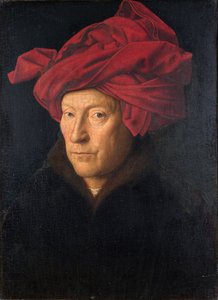
Jan van Eyck
1390 - 1441 , Netherlands
Quick Facts
- Artistic Movement Or Style: Early Netherlandish painting
- Artists Or Movements Influenced By This Artist:
- Early Netherlandish painting
- Generations of painters
- Full Name: Jan van Eyck
- Nationality: Flemish
- Notable Artworks:
- Ghent Altarpiece
- Arnolfini Portrait
- Dresden Triptych
- Man in a Blue Turban
- Place Of Birth: Maastricht, Netherlands
- Date Of Birth: 1390
- Date Of Death: 1441