
 Preview
 Send
Send Share
Share
 Details
 Guide
Guide

 Download
 Similars
 X-Ray
X-Ray Diaporama
 Q&A
Q&A Stats
StatsAnnunciation

- 39.0 x 24.0 cm


 Read More
Giclée / Art Print
Museum-quality giclée or canvas print with fast production and flexible finish options. ( Buy Hand Made Painting Switch to Digital Image)




P118B $10

P118H $10

P118W $10

P438Z $10

P508JH $12

P508YH $12

P805H $10

P805Z $10

P919BZ $10

P919G $10

P919XJ $10

P959ZH $10

P968JZ $12

W106C $8

W218G $10

W218JH $8

W218Y $10

W307PJ $10

W316G $10

W316PJ $8

W316Y $10

W398PJ $8

W4111J $10

W500HY $15

W500JH $15

W692G $12

W849H $8

W940BG $15

W953PJ $8




Pick from our preset sizes that match the artwork's original proportions.

Type the width and the height you need, to fit your frame or your wall. A print can only be cut, never made bigger than the picture, so a size with a different shape loses a part of the image. We send you a digital mockup to approve before we print anything. The picture shown on this page does not show the real cut — only the mockup does.
Worldwide Delivery () in 2 weeks instead of standard 4/5 weeks. (10 November)

Free Worldwide Express Shipping

High-Quality Linen Canvas

Full Shipping Insurance

Customs Tax Refund Guarantee

True Color Matching Guarantee

100-Day Return Policy (Defects Only)

100% Money-Back Guarantee

Bulk Discount Offer
 Glass option is only available in size under 110 CM

Annunciation
Giclée / Art Print
Reproduction Size
-


Total Price
$ 81
A Window Into Divine Revelation: Jan van Eyck’s Annunciation
Jan van Eyck's Annunciation stands as an unparalleled testament to the artistic brilliance of the Early Netherlandish Renaissance, cementing its place among the most revered paintings in Western art history. Created in 1436 for St Bavo Cathedral in Ghent, Belgium—a commission that would propel him to international fame—this monumental altarpiece transcends mere visual representation; it embodies a profound spiritual narrative meticulously crafted with groundbreaking artistic innovation.- Subject Matter: The painting depicts the pivotal moment when Gabriel announces to Mary that she will conceive Jesus Christ, marking the genesis of Christian faith and tradition. This biblical scene is rendered with breathtaking realism, capturing the serene intimacy of the Virgin’s contemplation and the angelic messenger's solemn proclamation.
- Style & Technique: Van Eyck’s mastery lies in his pioneering application of oil paint—a technique previously uncommon in Northern Europe—allowing for unprecedented levels of detail and luminosity. Layers upon layers of pigment create a palpable sense of depth, capturing textures with astonishing accuracy, from the folds of Mary's robe to the delicate feathers of Gabriel’s wings.
Compositional Genius: Linear Perspective and Architectural Framing
The painting’s composition is masterful, employing linear perspective to establish a convincing illusion of space within the cathedral interior. A doorway frames the scene, subtly dividing the space into two distinct realms—the earthly sanctuary and the divine realm—symbolizing the transition between human experience and spiritual grace. This architectural element isn't merely decorative; it serves as a crucial tool in conveying the painting’s overarching message.
Symbolism: Dove and Light – Echoes of Holy Spirit
Beyond its visual splendor, Annunciation is rich with symbolic significance. The dove perched atop Gabriel’s left shoulder represents the Holy Spirit—God’s divine presence illuminating Mary's womb and signifying the incarnation of Christ. This emblem underscores the painting’s theological core, emphasizing God’s intervention in human history and reaffirming the sanctity of faith.
Historical Context & Legacy
Jan van Eyck was a pivotal figure within the Early Netherlandish artistic movement alongside Rogier van der Weyden and Petrus Christus. His work challenged prevailing conventions, prioritizing meticulous observation and capturing the subtleties of human emotion—a departure from earlier Gothic styles. The Annunciation profoundly influenced subsequent artists, establishing standards for realism and expressive detail that would endure for centuries. Its enduring appeal lies in its ability to evoke contemplation and inspire awe, reminding viewers of the transformative power of faith.
Bringing Van Eyck’s Vision Home
A high-quality reproduction of Annunciation by Jan van Eyck offers a captivating glimpse into the artistic achievements of the Renaissance. Explore stunning reproductions at OriginalUniqueArt.com and discover how this iconic masterpiece can enrich your interior space.
- Size: 39 x 24 cm
- Date: 1436
Further Exploration
Delve deeper into Jan van Eyck’s artistic world and the broader context of Northern Renaissance art by visiting The Annunciation at The National Gallery of Art or exploring St Bavo’s Cathedral in Ghent.
Questions & Answers
Where can I see the original "Annunciation" by Jan van Eyck?
"Annunciation" by Jan van Eyck is on display at the Thyssen-Bornemisza Museum, Madrid, Spain. The museum listing refers to the original work, not to reproductions.
How does "Annunciation" fit into Jan van Eyck's themes and style?
"Annunciation" belongs to Jan van Eyck's Early Netherlandish Painting work, whose recorded themes include northern renaissance innovation, religious narrative & divine grace, symbolic depth & visual realism, triptych tradition & artistic legacy, masterpiece of detail & illusionism, influence on subsequent artists, iconography reflects medieval beliefs.
What does "Annunciation" by Jan van Eyck depict, and in what mood?
"Annunciation" shows renaissance, religion, virgin mary, angel gabriel, perspective, oil painting, symbolism, medieval art, and its recorded mood is serene.
Artist Biography
Early Life, Family and Training
Born around 1390, Jan van Eyck entered a world where the brush was a family inheritance. He was not a solitary talent emerging from nothing, but a son of a lineage of painters. He grew up alongside his brothers, Hubert and Lambert, within a household where the secrets of pigment and preparation were likely shared at the communal table. This familial bond meant that his early understanding of color and form was shaped by the collective knowledge of the van Eyck name.
Before he would ever command the attention of dukes or diplomats, Jan van Eyck and his brothers underwent a rigorous training that demanded extreme patience. They were trained as miniaturists and illuminators, working upon the delicate surfaces of manuscripts. This early discipline required a steady hand and an eye for the smallest possible detail. It was in these tiny, precious spaces that he first learned to manipulate light and shadow, a skill that would later define his approach to much larger canvases.
The family workshop was a place of shared labor and shared ambition, yet the paths of the brothers eventually diverged through the cruelty of fate. While Jan continued to refine his craft, his brother Hubert passed away in 1426. This loss left Jan to carry forward the heavy weight of the family's artistic legacy, including the completion of significant religious works that the brothers had begun together. He moved forward not merely as a craftsman, but as a man who had mastered the very essence of his medium through years of meticulous, small-scale study.
Patrons, Workshop and Commissions
The life of Jan van Eyck was shaped by the high-stakes movements of the Burgundian court. He did not merely labor in a quiet studio; he moved through the halls of power, serving Philip the Good, the Duke of Burgundy. This position brought him into the inner circles of the most influential figures of his age. Before his long tenure at the court, he found work in The Hague, serving John of Bavaria, the ruler of Holland. His presence was felt in the bustling centers of Bruges and Lille, where his reputation drew both the pious and the powerful.
His duties often extended far beyond the canvas. The Duke relied on him as a diplomat, sending him on official missions that required discretion and intellect. In 1428, he traveled to Portugal to paint Isabella of Portugal, a task that required him to navigate the complexities of foreign courts. These travels and political responsibilities provided the stability and resources necessary for his technical experiments. He was a man of the world, comfortable in the company of kings and the quietude of a chapel alike.
The demand for his skill came from every corner of society. He received many religious commissions, creating works that spoke to the deep faith of the era. At the same time, the rising merchant class and the established nobility sought his hand. He painted the faces of Burgundian courtiers, local nobles, churchmen, and wealthy merchants, capturing the likenesses of those who shaped the economy and the spirit of the fifteenth century.
Technique and Style
The way he handled light was a quiet revolution. While others struggled with the flat, matte finish of egg tempera, he found a new way to make color breathe. He mastered the oil medium by building up thin, translucent glazes of pigment, layering them one upon another. This method allowed him to capture the way light actually behaves when it hits a surface. He did not merely paint a color; he painted the way light lives within it. Through subtle shading and luminous tones, he achieved a depth that made the textures of the physical world feel tangible. You could almost feel the weight of a heavy velvet robe or the cold hardness of a polished metal vessel through his brushwork.
His eye was trained to see the smallest particulars of existence. He possessed a restless curiosity for the minute, recording the specific way light catches a single strand of hair or the subtle texture of human skin. This obsession with detail extended to the very space his figures inhabited. He utilized atmospheric perspective to create a sense of vastness, showing how distant landscapes soften into a blue haze as they recede toward the horizon. This gave his compositions a sophisticated sense of depth that drew the viewer into a believable, three-dimensional reality.
He was also a man who wished to be known by his own hand. In an era when many painters remained anonymous craftsmen, he asserted his identity by signing his works with the name "JOHANNES DE EYCK." He often accompanied this signature with his personal motto, "Als ich kan," which translates to "As well as I can." It was a bold claim of his technical skill, etched directly into the reality of his creations.
Key Works and Masterpieces
The scale of his ambition is perhaps most visible in the Ghent Altarpiece, a massive twelve-panel polyptych that he completed in 1432. This work, which features the Adoration of the Lamb, required a profound command of complex religious symbolism and realistic figures. It was a monumental undertaking that demonstrated how he could manage vast, intricate scenes while maintaining a sense of spiritual weight. His ability to render the world so clearly was not limited to the divine; he applied that same intense observation to the private lives of men.
In 1434, he painted the Arnolfini Portrait, a work signed and dated that captures a domestic scene with startling clarity. Within its frame, a dog represents fidelity and discarded shoes mark holy ground, while a mirror in the background reflects a hidden layer of reality. This precision extended to his personal studies, such as the 1433 oil painting known as Portrait of a Man, or perhaps a self-portrait. This work features his personal motto, "Als ich kan," etched prominently upon the frame, a quiet assertion of his own skill. He continued to refine these intimate observations through his later years, including the Madonna and Child with Canon van der Paele in 1436 and the Virgin of Chancellor Rolin. Even toward the end of his life, around 1440, he turned his gaze toward the divine in his Portrait of Christ.
- The Ghent Altarpiece (1432)
- Portrait of a Man (1433)
- The Arnolfini Portrait (1434)
- Madonna and Child with Canon van der Paele (1436)
- Portrait of Christ (about 1440)
Legacy and Influence
The technical brilliance Jan van Eyck brought to his craft left a mark that could not be erased by time. He was credited with originating a style of painting defined by minutely realistic depictions of surface effects and the way natural light settles upon the world. By perfecting the use of oil glazes, he provided a new way for painters to capture the specific gleam of jewelry or the soft texture of skin. His methods dictated how artists approached light and texture for generations, moving the medium away from the flat, matte surfaces of the past toward a luminous, three-dimensional reality.
This mastery of formal composition and technical skill earned him a reputation as a true innovator of Early Netherlandish painting. His influence was not confined to the northern reaches of Europe; his work served as a model to generations of painters both North and South of the Alps. Even as styles shifted, the standards he set for precision and observation remained a benchmark for those who sought to render the tangible world with absolute clarity.
- The Ghent Altarpiece
- The Arnolfini Portrait
- Portrait of a Man (Self Portrait?)
- The Virgin to Chancellor Rolin
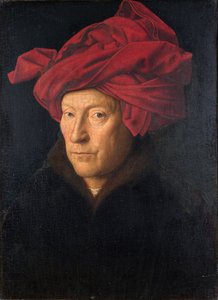
Jan van Eyck
1390 - 1441 , Netherlands
Quick Facts
- Artistic Movement Or Style: Early Netherlandish
- Artists Or Movements Influenced By This Artist: ['Generations of painters North and South']
- Full Name: Jan van Eyck
- Nationality: Flemish
- Notable Artworks:
- The Ghent Altarpiece
- The Arnolfini Portrait
- Portrait of a Man (Self Portrait?)
- The Virgin to Chancellor Rolin
- Madonna and Child with Canon van der Paele
- Place Of Birth: Maastricht, Netherlands
- Date Of Birth: 1390
- Date Of Death: 1441
Related Articles
Early Netherlandish Masters: 10 Paintings That Revolutionized Art & Decor
Journey into the world of Early Netherlandish painting! Explore 10 masterpieces by Jan van Eyck, Rogier van der Weyden & more. Discover stunning detail, symbolism & Renaissance art for your home decor. Find museum-quality reproductions on OriginalUniqueArt.com

Jan van Eyck: Innovation, Symbolism & the Dawn of Early Netherlandish Painting
Explore the revolutionary art of Jan van Eyck! Discover his groundbreaking oil painting techniques, hidden symbolism, and lasting impact on the Early Netherlandish Renaissance. A deep dive for art enthusiasts.
Late Medieval Masterpieces: 10 Artworks That Defined an Era | OriginalUniqueArt
Journey through 10 defining Late Medieval masterpieces – from Giotto's frescoes to Jan van Eyck’s realism. Explore the stories, techniques & vibrant colors of Gothic art. Find museum-quality reproductions and elevate your home decor with OriginalUniqueArt.com! Discover all masterpieces on OriginalUniqueArt.com

Masterpieces of Light: The Top 25 Artworks by Rembrandt van Rijn
Explore 25 iconic Rembrandt masterpieces from the Dutch Golden Age. Discover the genius of light and shadow. Explore the full collection online.
Early Netherlandish Masters: 10 Paintings That Revolutionized Art & Decor
Journey into the Early Netherlandish Renaissance! Explore 10 iconic paintings by Jan van Eyck, Rogier van der Weyden & more. Discover stunning detail, symbolism, and oil painting techniques. Find museum-quality art reproductions for your home at OriginalUniqueArt.com.


