Preview
 Send
Send Share
Share
 Details
 Guide
Guide

 Download
 Similars
 X-Ray
X-Ray Diaporama
 Stats
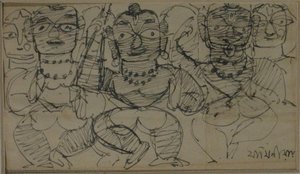
StatsUntitled
 13.0 x 10.0 cm
 Kerala Museum
 Read More
The artwork displayed on this page is protected by copyright law, which means we cannot legally create or sell an identical reproduction. This protection is enforced under international agreements such as the Berne Convention and by national laws, including those outlined by the U.S. Copyright Law - Title 17.
This method fully complies with copyright regulations because it does not involve copying or duplicating the protected artwork. Instead, it is a creative reinterpretation - a new painting that is influenced by the original but not identical to it.
Giclée / Art Print
Museum-quality giclée or canvas print with fast production and flexible finish options. ( Buy Hand Made Painting Switch to Digital Image)




































Pick from our preset sizes that match the artwork's original proportions.

Type the width and the height you need, to fit your frame or your wall. A print can only be cut, never made bigger than the picture, so a size with a different shape loses a part of the image. We send you a digital mockup to approve before we print anything. The picture shown on this page does not show the real cut — only the mockup does.
Worldwide Delivery () in 2 weeks instead of standard 4/5 weeks. (26 October)

Free Worldwide Express Shipping

High-Quality Linen Canvas

Full Shipping Insurance

Customs Tax Refund Guarantee

True Color Matching Guarantee

100-Day Return Policy (Defects Only)

100% Money-Back Guarantee

Bulk Discount Offer
 Glass option is only available in size under 110 CM

Untitled
Giclée / Art Print
Reproduction Size
-


Total Price
$ 81
Questions & Answers
Where can I buy a digital image of "Untitled" by Jamini Nath Roy?
A digital image of "Untitled" by Jamini Nath Roy can be purchased on its Digital Image page: a high-resolution digital image download.
How many people view "Untitled"?
Statistics about "Untitled" by Jamini Nath Roy are on the artwork's Stats page: monthly visits of the artwork, visits of the artist's works, and country and language breakdowns of recent visitors.
Who sells hand-painted copies of "Untitled" by Jamini Nath Roy?
You can order a hand-painted reproduction of "Untitled" by Jamini Nath Roy directly on its Hand-Painted Reproduction page: a hand-painted oil reproduction on linen canvas, made to order.
Artist Biography
The Soul of Bengal: The Life and Legacy of Jamini Roy
In the vibrant tapestry of Indian modernism, few names resonate with as much cultural authenticity and rhythmic grace as Jamini Roy. Born on April 11, 1887, in the serene landscape of Belaitore, West Bengal, Roy emerged not merely as a painter, but as a visionary who sought to reclaim the artistic identity of his nation. His journey began in a moderately prosperous household where an innate appreciation for aesthetics laid the groundwork for a life dedicated to the brush. Moving to Kolkata at the tender age of sixteen to study at the Government College of Art, he entered a world of academic rigor under the tutelage of the legendary Abanindranath Tagore. While his early training immersed him in the sophisticated traditions of the Bengal School, Roy’s true destiny lay far from the polished salons of the elite; it was found in the raw, pulsing energy of the streets and the timeless simplicity of folk traditions.
The evolution of Roy's style represents one of the most profound transformations in twentieth-century art. Initially influenced by European modernism and the academic realism taught in colonial institutions, he eventually underwent a radical aesthetic rebellion. He turned his gaze away from Western conventions, finding a deeper truth in the Kalighat paintings—a vibrant form of folk art native to the Bengal region. This departure was not merely a stylistic choice but a spiritual homecoming. By embracing the flat planes, bold outlines, and earthy palettes characteristic of rural craftsmanship, he stripped away unnecessary ornamentation to reveal the essential spirit of his subjects. His work became a celebration of the common man, the village life, and the mythological narratives that form the heartbeat of Indian culture.
A Mastery of Form and Color
To gaze upon a Jamini Roy masterpiece is to witness a masterful command over simplicity and rhythm. His technique was defined by a deliberate rejection of three-dimensional illusionism in favor of a striking, two-dimensional flatness that echoed the ancient murals of India. He utilized a palette of bold, saturated colors—deep ochres, brilliant vermillions, and stark blacks—that gave his figures an almost sculptural presence on the canvas. His brushwork, though seemingly simple, possessed an incredible fluidity, capturing the movement of a dancer or the quiet dignity of a peasant with equal prowess.
The themes within his oeuvre are as diverse as they are evocative:
- Portraiture: In works such as Portrait of a Young Girl, Roy demonstrated an uncanny ability to capture the soulful essence of his subjects through minimalist lines.
- Mythology and Folklore: He breathed new life into ancient legends, translating complex deities and folk tales into accessible, rhythmic compositions.
- Rural Life: His depictions of Santhal tribes and village scenes served as a poignant tribute to the enduring strength of India's rural heartland.
- The Artist’s Reflection: Works like Painter and his Model highlight his introspective exploration of the creative process itself.
Honors, Achievements, and Eternal Influence
The significance of Jamini Roy’s contribution to the global art canon cannot be overstated. His commitment to preserving and elevating indigenous aesthetics earned him the Padma Bhushan in 1954, one of India's highest civilian honors, recognizing his role in shaping a national artistic identity. As a fellow of the prestigious Lalit Kala Akademi, he stood at the forefront of a movement that bridged the gap between ancient tradition and modern expression.
Roy’s legacy continues to ripple through the halls of contemporary art. By proving that modernism did not require a mimicry of Western trends, he empowered generations of Indian artists to look inward toward their own cultural heritage for inspiration. Today, his paintings reside in esteemed institutions such as the National Museum of Korea and various prestigious collections worldwide, serving as a permanent testament to a man who found the universal within the local. His life remains a profound lesson in the power of authenticity, reminding us that true innovation often begins with a return to one's roots.

Jamini Nath Roy
1887 - 1972 , India
Quick Facts
- Full Name: Jamini Roy
- Nationality: Indian
- Date Of Birth: 1887
- Date Of Death: 1972
- Place Of Birth: Belaitore, India
- Notable Artworks:
- Portrait of a Young Girl
- Buste de Françoise
- Painter and His Model
- Artistic Movement Or Style: Bengali Folk Art
- Artists Who Influenced This Artist: ['Abanindranath Tagore']
- Artists Or Movements Influenced By This Artist: ['Kalighat Painting']