Preview
 Send
Send Share
Share
 Details

 Download
 Similars
 X-Ray
X-Ray Diaporama
Back Canch Man, Bedlington 'A' Pit
 1950
1950 31.0 x 40.0 cm
 Read More
Giclée / Art Print
Museum-quality giclée or canvas print with fast production and flexible finish options. ( Buy Hand Made Painting Buy Image)




































Pick from our preset sizes that match the artwork's original proportions.

You may enter your own dimensions to fit a specific frame or space. If your selected size does not match the original image's proportions, we will either crop the artwork or extend the image with a mirrored or solid-fill edge. A digital mockup will be sent for your approval before production begins.
Please note that the on-screen preview does not reflect the actual cropping or extension. Only the mockup will accurately show the final composition.
While custom sizes are available, we recommend selecting a dimension from the predefined list to preserve the original proportions.
Worldwide Delivery () in 2 weeks instead of standard 4/5 weeks. (24 August)

Free Worldwide Express Shipping

High-Quality Linen Canvas

Full Shipping Insurance

Customs Tax Refund Guarantee

True Color Matching Guarantee

60-Day Return Policy (Defects Only)

100% Money-Back Guarantee

Bulk Discount Offer
 Glass option is only available in size under 110 CM

Back Canch Man, Bedlington 'A' Pit
Giclée / Art Print
Reproduction Size
-


Total Price
$ 81
Artist Biography
The Painter of Grit and Grace
James Mackenzie, a name that resonates with both the rugged landscapes of Northern England and the dramatic stages of modern television, was an artist of profound emotional depth. Born in 1927 in the industrial heart of Dundee, Scotland, Mackenzie’s early life was steeped in the textures of a working-class heritage. This foundational experience—witnessing the raw, unvarnished reality of industrial labor and the resilient spirit of the community—would later become the heartbeat of his visual language. His artistic journey was not merely a pursuit of aesthetics but an attempt to document the dignity found within struggle, a theme that would define his enduring legacy.
While many recognize him for his commanding screen presence as Jeor Mormont in Game of Thrones or his role in River City, Mackenzie’s true vocation lay in the quiet, meticulous observation of life. His training at Queen Margaret University College provided him with a unique multidisciplinary perspective; by honing his skills in acting, he developed an acute sensitivity to visual storytelling and psychological nuance. This ability to inhabit a character translated seamlessly onto the canvas, allowing him to imbue his subjects—whether a weary miner or a rural laborer—with a palpable sense of humanity and internal life.
A Vision Rooted in Realism
Mackenzie’s stylistic evolution was deeply influenced by the masters of the Northern Renaissance. He drew inspiration from the psychological gravity of Rembrandt and the sprawling, human-centric narratives of Pieter Bruegel the Elder. From these titans, he learned to balance meticulous detail with atmospheric storytelling, a technique that allowed him to capture the heavy, damp air of the Northumberland coastline and the smoky, claustrophobic intensity of the coal pits. His work often moved between the gritty realism of industrial scenes and a more nostalgic, almost folk-art approach when depicting rural traditions.
His involvement with The Northumberland School marked a pivotal chapter in his career. As part of this collective, Mackenzie committed himself to an unflinching portrayal of the region's social fabric. His canvases became windows into the lives of those often overlooked by history: the miners and agricultural workers whose toil shaped the landscape. Through his art, the physical hardships of the 19th-century working class were transformed into something monumental. He did not shy away from the grime or the exhaustion of labor; instead, he used light and texture to elevate these moments of toil into scenes of profound grace.
Legacy of the Northumberland Landscape
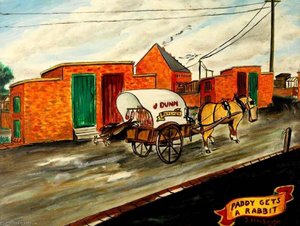
The significance of Mackenzie’s work lies in its ability to bridge the gap between historical documentation and emotional resonance. His paintings, such as Bedlington ‘A’ Pit, serve as poignant relics of a bygone era of industry, capturing the precise textures of coal and steel. Simultaneously, his more pastoral works, like Paddy Gets a Rabbit or Howicking Preparing Leeks, offer a charming, almost whimsical glimpse into the rhythms of rural life, utilizing bold lines and textured impasto to evoke a sense of warmth and nostalgia.
Ultimately, James Mackenzie left behind a body of work that serves as a visual chronicle of both landscape and soul. His mastery of evocative realism ensured that his subjects were never mere caricatures of poverty or labor, but rather icons of resilience. To look upon a Mackenzie painting is to experience the duality of his subject matter: the grit of the earth and the grace of the human spirit, forever preserved in oil and canvas.

james mackenzie
1927 - 2013
Quick Facts
- Artistic Movement Or Style: Realist Landscape
- Artists Or Movements Influenced By This Artist: ['James Stark']
- Artists Who Influenced This Artist: ['Dutch Masters']
- Date Of Death: 2013
- Full Name: James Mackenzie
- Nationality: Scottish
- Notable Artworks:
- Howicking Preparing Leeks on Show Day
- Bill's Been Hurt
- Place Of Birth: Dundee