- Home

- Print on canvas
- jacopo tintoretto
- Muse with lute

 Preview
 Buy Painting
 Send
Send Share
Share
 Details

 Download
 Similars
 X-Ray
X-Ray Diaporama
Muse with lute


 Read More
Giclée / Art Print
Museum-quality giclée or canvas print with fast production and flexible finish options.




P118B $10

P118H $10

P118W $10

P438Z $10

P508JH $12

P508YH $12

P805H $10

P805Z $10

P919BZ $10

P919G $10

P919XJ $10

P959ZH $10

P968JZ $12

W106C $8

W218G $10

W218JH $8

W218Y $10

W307PJ $10

W316G $10

W316PJ $8

W316Y $10

W398PJ $8

W4111J $10

W500HY $15

W500JH $15

W692G $12

W849H $8

W940BG $15

W953PJ $8




Pick from our preset sizes that match the artwork's original proportions.

You may enter your own dimensions to fit a specific frame or space. If your selected size does not match the original image's proportions, we will either crop the artwork or extend the image with a mirrored or solid-fill edge. A digital mockup will be sent for your approval before production begins.
Please note that the on-screen preview does not reflect the actual cropping or extension. Only the mockup will accurately show the final composition.
While custom sizes are available, we recommend selecting a dimension from the predefined list to preserve the original proportions.
Worldwide Delivery () in 2 weeks instead of standard 4/5 weeks. (25 July)

Free Worldwide Express Shipping

High-Quality Linen Canvas

Full Shipping Insurance

Customs Tax Refund Guarantee

True Color Matching Guarantee

60-Day Return Policy (Defects Only)

100% Money-Back Guarantee

Bulk Discount Offer
 Glass option is only available in size under 110 CM

Muse with lute
Giclée / Art Print
Reproduction Size
-


Total Price
-
Collectible Description
A Venetian Vision of Inspiration
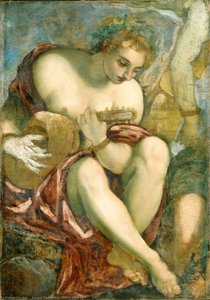
Jacopo Tintoretto’s *Muse with Lute*, completed in 1594, stands as an enduring emblem of Venetian Mannerism—a style characterized by dramatic lighting, stylized figures, and a profound preoccupation with psychological depth. More than just a portrait, it's an exploration of artistic contemplation itself, capturing the elusive essence of creativity within a meticulously crafted composition.
- The Artist’s Legacy: Tintoretto (Robusti), born around 1518, was arguably Venice’s most radical artist of his era. Rejecting the idealized forms favored by earlier Renaissance masters, he embraced expressive distortion and unsettling juxtapositions—a deliberate provocation against artistic convention.
- Style & Technique: Tintoretto's signature technique involved layering paint upon paint with astonishing speed and precision, utilizing a pyramidal composition to maximize visual impact. The masterful manipulation of chiaroscuro – the interplay between light and dark – dominates the canvas, creating an atmosphere of palpable drama and drawing the viewer’s gaze into the heart of the scene.
A Symbol of Artistic Pursuit
The central figure—a woman seated gracefully before a lute—represents the Muse of Inspiration, a concept deeply rooted in classical mythology. Traditionally associated with artistic creativity and poetic utterance, she embodies the pursuit of beauty and intellectual enlightenment. Her obscured face serves not to diminish her presence but rather to invite contemplation about inner experience – a hallmark of Mannerist psychology.
- Color Palette: Tintoretto’s palette is dominated by rich reds—particularly in the woman's dress—symbolizing passion and vitality. Accents of gold illuminate key areas, conveying prestige and spiritual significance.
- Compositional Dynamics: The pyramidal structure lends stability to the scene while simultaneously directing the viewer’s eye upwards towards the lute player, emphasizing her role as conduit for artistic inspiration.
Historical Context & Artistic Influence
Painted during a period of intense artistic ferment in Venice—a city vying for dominance amongst European capitals—*Muse with Lute* reflects the Mannerist preoccupation with emotional intensity and psychological realism. Tintoretto’s work profoundly impacted subsequent generations of artists, establishing precedents for expressive distortion and dramatic lighting that continue to inspire painters today.
- Venetian Renaissance: Tintoretto's approach diverged from the humanist ideals prevalent in Florence and Rome, prioritizing emotional resonance over rational representation. He championed a style that prioritized feeling over intellect—a bold assertion of artistic autonomy.
- Influence on Later Artists: Artists such as Rembrandt and Caravaggio drew inspiration from Tintoretto’s techniques, adopting chiaroscuro and pyramidal compositions to heighten dramatic effect and convey psychological complexity.
Emotional Resonance & Artistic Appreciation
*Muse with Lute* transcends mere visual representation; it communicates a profound sense of contemplation and artistic yearning. As a handmade oil painting reproduction, it offers an opportunity to engage with Tintoretto’s genius on a personal level—allowing viewers to savor the beauty and elegance of this unforgettable masterpiece.
For more information about Tintoretto and his remarkable oeuvre, visit OriginalUniqueArt.com. Explore high-quality images and delve into biographical details to gain a deeper understanding of the artist’s life and artistic vision.
Artist Biography
Jacopo Tintoretto: The Furious Master of Venetian Light
Jacopo Robusti, better known as Tintoretto (from the Italian word *tintore*, meaning dyer, a reference to his father’s profession), emerged in 16th-century Venice as one of the most innovative and influential figures of the Renaissance. Born around 1518, likely late September or early October, his life was a whirlwind of artistic creation, marked by both prodigious talent and a fiercely independent spirit that often clashed with established norms. Unlike many artists of his time who meticulously documented their training, Tintoretto’s early years remain shrouded in some mystery. Tradition holds he apprenticed briefly under Titian, though this is debated; what's undeniable is that he quickly forged his own path, absorbing the lessons of Venetian masters like Giorgione and Giovanni Bellini while simultaneously pushing beyond their conventions with a dynamism all his own. His nickname, *il Furioso* ("the Furious"), speaks to the intensity of his working style – a rapid, almost frenzied approach that produced an astonishing volume of work in a relatively short career, ending with his death on May 31, 1594.A Revolution in Composition and Light
Tintoretto’s genius lay not just in his technical skill but also in his revolutionary approach to composition and the use of light. He rejected the static, balanced arrangements favored by earlier Renaissance painters, opting instead for dramatic diagonals, dynamic movement, and a sense of theatricality that foreshadowed Baroque art. His figures are often caught in moments of intense action, their bodies contorted with emotion, their gestures expansive and expressive. But it was his mastery of light that truly set him apart. Unlike the soft, diffused lighting of Raphael or the carefully controlled chiaroscuro of Caravaggio, Tintoretto employed a bold, almost theatrical use of illumination. Beams of light would slash across canvases, highlighting key figures while plunging others into deep shadow, creating an atmosphere of heightened drama and spiritual intensity. This innovative approach is brilliantly exemplified in works like "The Miracle of Saint Mark," where the saint appears bathed in divine light amidst a swirling vortex of action, or his numerous depictions of “The Last Supper,” each exploring different perspectives and emotional nuances with remarkable freedom. He wasn't afraid to experiment with perspective, often employing dramatic foreshortening and unusual viewpoints to create a sense of immediacy and involvement for the viewer.Major Works and Patronage
Tintoretto’s career flourished under the patronage of Venice’s powerful institutions, particularly the Scuola Grande di San Marco and the Doge's Palace. The Scuola Grande commissions, especially the cycle of paintings depicting the life of Saint Mark, are considered among his greatest achievements, showcasing his ability to combine narrative clarity with breathtaking visual drama. These monumental canvases filled the walls of the *Scuola*, immersing viewers in scenes of miracles, processions, and moments of profound spiritual significance. His work for the Doge's Palace included vast historical paintings that celebrated Venetian power and military triumphs, demonstrating his versatility as an artist capable of tackling both religious and secular subjects with equal skill. Beyond these major commissions, Tintoretto produced countless altarpieces, portraits, and smaller works for private patrons, solidifying his reputation as the leading painter in Venice during a period of intense artistic competition. His son, Domenico Tintoretto, also became a painter, working alongside his father and continuing the family’s legacy after Jacopo's death.Influence and Legacy
Tintoretto’s impact on subsequent generations of artists was profound. He paved the way for the Baroque movement with his dramatic compositions, dynamic figures, and theatrical use of light. Artists like Rubens and Rembrandt were deeply influenced by his innovative approach to painting, adopting his techniques and adapting them to their own styles. His emphasis on emotional intensity and psychological realism also anticipated later developments in art history. While contemporaries sometimes criticized his rapid working style and unconventional methods, today Tintoretto is recognized as a pivotal figure in the transition from Renaissance to Baroque art—a visionary artist who transformed the landscape of Venetian painting and left an indelible mark on Western art history. His ability to infuse religious narratives with such palpable human emotion and dramatic visual power continues to captivate audiences centuries after his death, ensuring his place among the giants of artistic innovation.
jacopo tintoretto
1518 - 1594
Quick Facts
- Artistic Movement Or Style: Venetian School, Mannerism
- Artists Who Influenced This Artist:
- Titian
- Michelangelo
- Date Of Birth: 1518
- Date Of Death: 1594
- Full Name: Jacopo Tintoretto
- Nationality: Italian
- Notable Artworks:
- Miracle of the Slave
- Last Supper
- Portrait of Procurator Soranzo
Related Articles

The Golden Light of Innovation: Exploring the Venetian Renaissance Art Movement (1430–1580)
Explore the Golden Age of Venetian art (1430–1580). Discover Giorgione, Titian & Tintoretto's techniques, the 'colorito' revolution, and lasting influence. Expert insights for collectors & enthusiasts.
Sebastiano del Piombo: Bridging Venetian Colorism & Roman Grand Manner Portraiture
Explore the captivating art of Sebastiano del Piombo, a Renaissance master bridging Venetian colorism & Roman grandeur. Discover his iconic portraits and lasting influence on art history. Learn more at OriginalUniqueArt.

Antonio da Correggio: Innovation, Illusionism & the Poetics of Grace in Renaissance Painting
Explore the revolutionary art of Antonio da Correggio, a master of Renaissance illusionism and chiaroscuro. Discover his frescoes, mythological paintings & lasting influence on Baroque art. Expert analysis & key works featured.
Chiaroscuro & Emotional Resonance: Exploring Dramatic Light in Western Painting
Explore the captivating world of chiaroscuro & tenebrism! Discover Caravaggio's influence, Baroque masters, and the enduring power of dramatic lighting in art history. Learn about these techniques with OriginalUniqueArt.
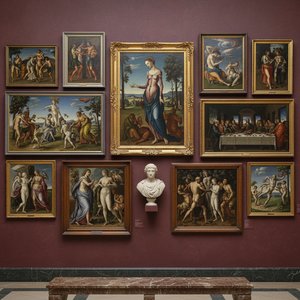
Mannerism's Masters: 10 Artworks That Redefined Renaissance Style | OriginalUniqueArt
Explore 10 defining Mannerism masterpieces – from Pontormo to El Greco. Discover the stories behind these Renaissance paintings, their unique style & symbolism. Find museum-quality art reproductions at OriginalUniqueArt.com and elevate your home decor.