 Preview
 Send
Send Share
Share
 Details

 Download
 Similars
 X-Ray
X-Ray Diaporama
 Stats
StatsSpring and Summer
 1750
1750 79.0 x 132.0 cm
 Laing Art Gallery
 Read More
Giclée / Art Print
Museum-quality giclée or canvas print with fast production and flexible finish options. ( Buy Hand Made Painting Switch to Digital Image)




































Pick from our preset sizes that match the artwork's original proportions.

You may enter your own dimensions to fit a specific frame or space. If your selected size does not match the original image's proportions, we will either crop the artwork or extend the image with a mirrored or solid-fill edge. A digital mockup will be sent for your approval before production begins.
Please note that the on-screen preview does not reflect the actual cropping or extension. Only the mockup will accurately show the final composition.
While custom sizes are available, we recommend selecting a dimension from the predefined list to preserve the original proportions.
Worldwide Delivery () in 2 weeks instead of standard 4/5 weeks. (19 September)

Free Worldwide Express Shipping

High-Quality Linen Canvas

Full Shipping Insurance

Customs Tax Refund Guarantee

True Color Matching Guarantee

100-Day Return Policy (Defects Only)

100% Money-Back Guarantee

Bulk Discount Offer
 Glass option is only available in size under 110 CM

Spring and Summer
Giclée / Art Print
Reproduction Size
-


Total Price
$ 81
Introduction to the Artist and Painting
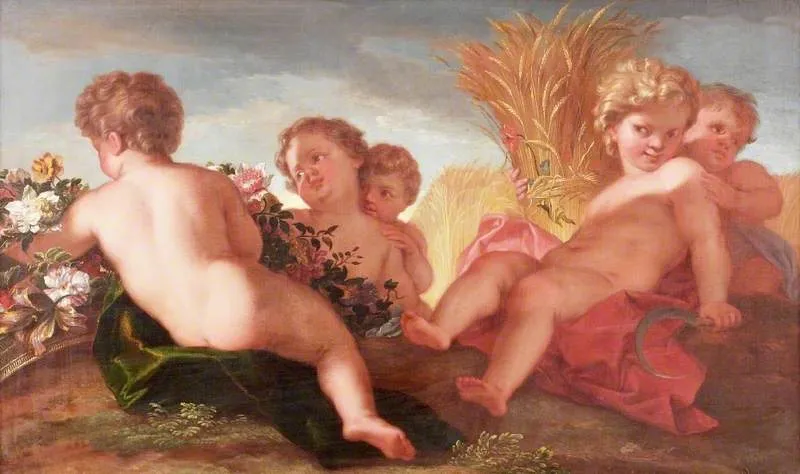
Jacob De Wit's "Spring and Summer" is a captivating oil on canvas piece that embodies the essence of the seasons. Created in 1750, this painting measures 79 x 132 cm and is currently housed at the Laing Art Gallery in Newcastle Upon Tyne, United Kingdom. As a masterpiece of Baroque art, it showcases Jacob De Wit's skill in depicting scenes of everyday life with a sense of elegance and refinement.Composition and Symbolism
The painting features four cherubs sitting on the ground in a field surrounded by flowers, symbolizing the joy and beauty of spring and summer. A large sheaf of wheat in the background adds an element of nature and agriculture to the composition, highlighting the importance of these seasons for harvest. Each cherub has a unique appearance, contributing to the overall charm of the painting. The use of oil on canvas allows for a depth and richness of color that brings the scene to life.Artistic Context and Similar Works
Jacob De Wit's work can be seen in the context of other artists who explored similar themes. For example, Autumn and Winter by Jacob De Wit is another notable piece that complements "Spring and Summer". Additionally, works like The Harvest Moon by George Faulkner Wetherbee showcase the artistic fascination with seasonal themes during this period.Conclusion and Availability
"CITE>Jacob De Wit's "Spring and Summer" is a masterpiece that invites viewers to appreciate the beauty of nature and the changing seasons. For those interested in acquiring a handmade oil painting reproduction of this piece, OriginalUniqueArt.com offers high-quality reproductions that capture the essence of the original. By exploring the works of Jacob De Wit and other artists on OriginalUniqueArt.com, art enthusiasts can delve deeper into the world of Baroque art and its captivating themes.For more information on Jacob De Wit and his works, including Allegory of the Four Seasons - Autumn, visit OriginalUniqueArt.com.
Artist Biography
The Master of Light and Shadow: The Life of Jacob de Wit
In the golden age of Dutch Rococo, few names evoke the architectural splendor of the eighteenth century quite like Jacob de Wit. Born in Amsterdam in 1695, De Wit emerged not merely as a painter, but as a visionary decorator who transformed the very bones of historic buildings. His journey began under the rigorous tutelage of masters such as Albert van Spiers and Jacob van Hal, mentors who provided him with a sturdy foundation in Baroque principles. However, it was his ability to infuse these classical structures with the light, airy, and whimsical essence of the Rococo style that would eventually define his legacy. By 1714, his admission into the prestigious St. Luke's Guild in Amsterdam signaled the arrival of a formidable talent destined to shape the interiors of the Dutch elite.
De Wit’s artistic evolution was profoundly shaped by his pilgrimage to Antwerp. It was here that he encountered the monumental legacy of Peter Paul Rubens, specifically within the breathtaking ceilings of the Carolus Borromeuskerk. This encounter was transformative; rather than merely observing, De Wit meticulously documented these masterpieces through a series of watercolors. This endeavor, later published in 1751, did more than showcase his technical precision—it established him as a vital custodian of artistic heritage, bridging the gap between the heavy grandeur of the Flemish Baroque and the delicate elegance of his own era.
The Ethereal Elegance of Grisaille
What truly distinguishes De Wit from his contemporaries is his unparalleled mastery of grisaille. While many Rococo artists sought to dazzle the eye with a riot of pastel pigments, De Wit found profound expression in the subtle manipulation of monochrome. By working within a restricted palette of greys and muted tones, he mastered the art of tonal gradation, creating illusions of depth and sculptural form that seemed to breathe within their architectural settings. This technique allowed his ceiling paintings and door panels to integrate seamlessly with stone and plaster, lending an ethereal, almost ghostly quality to his compositions.
His ability to command light and shadow turned flat surfaces into windows of spiritual and narrative depth. Whether depicting the seasonal cycles in works like Autumn and Spring and Summer, or portraying sacred moments such as Saint Philip Baptizes the Eunuch, De Wit utilized light to guide the viewer's emotion. His work possessed a unique architectural rhythm, where every brushstroke served to enhance the structural grandeur of the rooms he adorned, making him the preeminent interior artist of his generation.
A Lasting Legacy in Dutch Art
The influence of Jacob de Wit extended far beyond his own brush, as he cultivated a school of artists who would carry his stylistic vision into the next generation. His studio became a crucible of talent, producing notable pupils including:
- Jan de Groot
- Dionys van Nijmegen
- Jan Punt
- Pieter Tanjé
- The brothers Frans and Jacob Xavier
Through these disciples, the delicate balance of De Wit’s technique—the marriage of Baroque weight with Rococo grace—was preserved. Today, his works remain as enduring testaments to a period of immense decorative opulence. To walk through the historic halls of Amsterdam or Haarlem is to encounter the ghost of De Wit’s genius, where his monochrome masterpieces continue to dance with the light, reminding us of a time when painting was an inseparable part of the very air we breathe within a room.

Jacob de Wit
1695 - 1754 , Netherlands
Quick Facts
- Artistic Movement Or Style: Rococo Painting
- Artists Or Movements Influenced By This Artist: ['Jan Punt']
- Artists Who Influenced This Artist:
- Albert van Spiers
- Jacob van Hal
- Date Of Birth: Amsterdam, Netherlands (1695)
- Date Of Death: 1754
- Full Name: Jacob de Wit
- Nationality: Dutch
- Notable Artworks:
- Autumn
- Summer
- Winter
- Place Of Birth: Amsterdam