Preview
 Send
Send Share
Share
 Details
 Guide
Guide

 Download
 Similars
 X-Ray
X-Ray Diaporama
 Stats
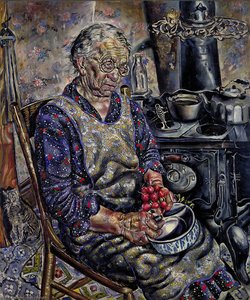
StatsPoor Room
 1963
1963 121.0 x 94.0 cm
 Read More
The artwork displayed on this page is protected by copyright law, which means we cannot legally create or sell an identical reproduction. This protection is enforced under international agreements such as the Berne Convention and by national laws, including those outlined by the U.S. Copyright Law - Title 17.
This method fully complies with copyright regulations because it does not involve copying or duplicating the protected artwork. Instead, it is a creative reinterpretation - a new painting that is influenced by the original but not identical to it.
Giclée / Art Print
Museum-quality giclée or canvas print with fast production and flexible finish options. ( Buy Hand Made Painting Switch to Digital Image)




































Pick from our preset sizes that match the artwork's original proportions.

You may enter your own dimensions to fit a specific frame or space. If your selected size does not match the original image's proportions, we will either crop the artwork or extend the image with a mirrored or solid-fill edge. A digital mockup will be sent for your approval before production begins.
Please note that the on-screen preview does not reflect the actual cropping or extension. Only the mockup will accurately show the final composition.
While custom sizes are available, we recommend selecting a dimension from the predefined list to preserve the original proportions.
Worldwide Delivery () in 2 weeks instead of standard 4/5 weeks. (12 October)

Free Worldwide Express Shipping

High-Quality Linen Canvas

Full Shipping Insurance

Customs Tax Refund Guarantee

True Color Matching Guarantee

100-Day Return Policy (Defects Only)

100% Money-Back Guarantee

Bulk Discount Offer
 Glass option is only available in size under 110 CM

Poor Room
Giclée / Art Print
Reproduction Size
-


Total Price
$ 81
Artist Biography
The Architect of Decay: The Life and Vision of Ivan Albright
Ivan Le Lorraine Albright (1897–1983) stands as a singular figure in American art history—a magician of realism whose canvases captured not just what was seen but the insidious creep of time and the unsettling beauty of disintegration. Born near Chicago to Adam Emory Albright, a landscape painter descended from gunsmiths, Albright’s artistic journey began alongside his identical twin brother, Malvin. While they both studied at the Art Institute of Chicago, their paths diverged into different dimensions of form; where Malvin sought the tactile weight of sculpture, Ivan pursued the ethereal and often harrowing depths of painting. This early immersion in the fine arts instilled in him a profound respect for craftsmanship and a precision that would later define his obsessive, microscopic approach to the canvas.
Albright's formative years were shaped by a deep fascination with European masters such as El Greco and Rembrandt, artists who possessed the ability to wrestle with themes of spirituality, mortality, and the dramatic interplay of light. However, he swiftly forged a distinctive style that moved beyond mere imitation. His technique became synonymous with an unparalleled dedication to meticulous detail and a masterful manipulation of color. Though he briefly explored architecture during his studies at the University of Illinois Urbana-Champaign, he ultimately abandoned commercial ambitions for the solitary, painstaking solace of art, driven by a need to document the textures of existence that others might overlook.
Shadows of War and the Aesthetics of Mortality
A pivotal moment in Albright's psychological and artistic development arrived during World War I. Serving as a medical illustrator in Nantes, France, he was tasked with producing images that were often unsettling in their clinical accuracy. This experience served as a grim precursor to his later preoccupations with morbidity and the fragility of life. The visceral reality of human vulnerability and the inescapable presence of death became foundational themes in his oeuvre. His work began to transcend simple representation, moving into the realm of Magic Realism, where the hyper-realistic depiction of objects served to heighten a sense of profound unease and existential dread.
As his career progressed, Albright’s fascination with the passage of time manifested in works that explored the concept of "the beautiful grotesque." He did not merely paint decay; he celebrated its intricate complexity. His canvases often feature:
- The Texture of Time: A focus on the crumbling, the weathered, and the eroded surfaces of both objects and skin.
- Chiaroscuro Mastery: The use of dramatic light and shadow to create depth and a sense of psychological tension.
- Symbolic Still Lifes: Arrangements of objects that, while seemingly mundane, carry heavy connotations of mortality and the fleeting nature of life.
A Legacy Written in Detail
Throughout his long career, Albright achieved significant recognition for his ability to blend realism with a surreal, almost hallucinatory intensity. His notable works, such as The Farmer's Kitchen (1934), demonstrate a poignant depiction of Depression-era life through a lens that is both haunting and hyper-detailed. Similarly, his explorations in pieces like That Which I Should Have Done I Did Not Do (The Door) showcase his ability to use physical thresholds as metaphors for psychological states. His self-portraits remain some of his most enduring contributions, serving as intense character studies that reveal the artist's own preoccupation with the human condition.
The historical significance of Ivan Albright lies in his refusal to look away from the uncomfortable truths of biological and material decline. In an era where many artists sought abstraction or pure decorative beauty, Albright leaned into the microscopic scrutiny of the ephemeral. He remains a master of the unsettling beautiful, leaving behind a legacy that challenges viewers to find meaning within the very processes of dissolution. His work continues to resonate with anyone moved by the profound, haunting intersection of memory, time, and the inevitable transformation of all living things.
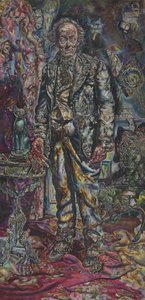
Ivan Albright
1897 - 1983 , United States of America
Quick Facts
- Full Name: Ivan Le Lorraine Albright
- Nationality: American
- Date Of Birth: 1897
- Date Of Death: 1983
- Place Of Birth: North Harvey, United States of America
- Notable Artworks:
- The Farmer’s Kitchen
- Self-Portrait
- SelfPortraitFace
- Artistic Movement Or Style: Magic Realism
- Artists Who Influenced This Artist:
- El Greco
- Rembrandt