Preview
 Send
Send Share
Share
 Details
 Guide
Guide

 Download
 Similars
 X-Ray
X-Ray Diaporama
 Stats
StatsBode Gymnastik (Poster)
 Acrylic On Canvas
- WallArt
- Pre-Raphaelite Movement
 1930
1930 44.0 x 59.0 cm
 Bauhaus Dessau Foundation
 Read More
The artwork displayed on this page is protected by copyright law, which means we cannot legally create or sell an identical reproduction. This protection is enforced under international agreements such as the Berne Convention and by national laws, including those outlined by the U.S. Copyright Law - Title 17.
This method fully complies with copyright regulations because it does not involve copying or duplicating the protected artwork. Instead, it is a creative reinterpretation - a new painting that is influenced by the original but not identical to it.
Giclée / Art Print
Museum-quality giclée or canvas print with fast production and flexible finish options. ( Buy Hand Made Painting Switch to Digital Image)




P118B $10

P118H $10

P118W $10

P438Z $10

P508JH $12

P508YH $12

P805H $10

P805Z $10

P919BZ $10

P919G $10

P919XJ $10

P959ZH $10

P968JZ $12

W106C $8

W218G $10

W218JH $8

W218Y $10

W307PJ $10

W316G $10

W316PJ $8

W316Y $10

W398PJ $8

W4111J $10

W500HY $15

W500JH $15

W692G $12

W849H $8

W940BG $15

W953PJ $8




Pick from our preset sizes that match the artwork's original proportions.

Type the width and the height you need, to fit your frame or your wall. A print can only be cut, never made bigger than the picture, so a size with a different shape loses a part of the image. We send you a digital mockup to approve before we print anything. The picture shown on this page does not show the real cut — only the mockup does.
Worldwide Delivery () in 2 weeks instead of standard 4/5 weeks. (25 October)

Free Worldwide Express Shipping

High-Quality Linen Canvas

Full Shipping Insurance

Customs Tax Refund Guarantee

True Color Matching Guarantee

100-Day Return Policy (Defects Only)

100% Money-Back Guarantee

Bulk Discount Offer
 Glass option is only available in size under 110 CM

Bode Gymnastik (Poster)
Giclée / Art Print
Reproduction Size
-


Total Price
$ 81
Bode Gymnastik (Poster): A Bauhaus Echo in Monochrome
The image presented is a striking black and white poster commemorating Bode Gymnastik, created by Irmgard Sørensen-Popitz in 1930. More than just an advertisement for the gymnastics club, this artwork embodies the core tenets of Bauhaus design—simplicity, functionality, and geometric precision—reflecting the influential artistic movement that shaped German visual culture during its formative years. The photograph itself captures a dynamic composition featuring several women engaged in gymnastic poses against a neutral backdrop. Sørensen-Popitz’s masterful use of light and shadow lends depth to the scene, emphasizing the figures' musculature and conveying an aura of athleticism and grace.Style and Technique: Constructivist Influence
Sørensen-Popitz’s artistic approach draws heavily from Constructivism, a movement that emerged in Russia shortly before Bauhaus’ establishment. Rejecting Impressionistic subjectivity, Constructivists prioritized rational organization and geometric abstraction as tools for communicating ideas effectively. This is evident in the poster's stark monochrome palette—a deliberate choice to eliminate distracting colors and focus solely on form and structure. The composition utilizes orthogonal lines – straight horizontal and vertical lines – creating a sense of stability and balance. Sørensen-Popitz’s meticulous attention to detail, particularly in rendering the women’s postures and clothing folds, underscores the Bauhaus commitment to realism achieved through stylized representation.Historical Context: Weimar Republic Aesthetics
The poster's creation coincides with the Weimar Republic (1918–1933), a period of profound social upheaval and artistic experimentation following Germany’s defeat in World War I. The Bauhaus school, founded in Dessau in 1919 by Walter Gropius, served as a beacon of modernist innovation, attracting artists, architects, designers, and craftsmen from across Europe. Sørensen-Popitz's work reflects the broader aesthetic concerns of this era—a desire to synthesize art and technology, to challenge traditional artistic conventions, and to express humanist ideals through geometric abstraction. The poster’s visual language speaks to a yearning for clarity and order amidst the turbulence of political instability.Symbolism: Movement and Idealization
Despite its austere appearance, the Bode Gymnastik poster carries subtle symbolic resonance. The gymnasts themselves represent strength, discipline, and physical prowess—values championed by Bauhaus educators who believed in fostering holistic development through artistic practice. Sørensen-Popitz’s skillful depiction of movement captures the dynamism inherent in athletic activity while simultaneously conveying an idealized vision of femininity. The geometric lines contribute to this sense of aspiration, suggesting upward trajectory and harmonious balance.Emotional Impact: Elegance Amidst Minimalism
Ultimately, Bode Gymnastik (Poster) transcends its function as advertising material; it stands as a testament to Sørensen-Popitz’s artistic prowess and the enduring legacy of Bauhaus design. The poster's monochrome aesthetic evokes feelings of serenity and contemplation—a deliberate counterpoint to the frenetic pace of modern life. Its simplicity communicates confidence and precision, mirroring the Bauhaus ethos of rationalism and innovation. Reproducing this artwork offers an opportunity to bring a touch of Bauhaus elegance into any interior space, celebrating timeless design principles that continue to inspire artists and collectors alike.Questions & Answers
What level of contrast does "Bode Gymnastik (Poster)" by Irmgard Sörensen-Popitz show?
"Bode Gymnastik (Poster)" by Irmgard Sörensen-Popitz shows a bold contrast between its light and dark areas.
What palette and what feeling does "Bode Gymnastik (Poster)" combine?
"Bode Gymnastik (Poster)" by Irmgard Sörensen-Popitz combines a neutrals palette with a calm tone.
Can I order an oil reproduction of "Bode Gymnastik (Poster)"?
"Bode Gymnastik (Poster)" is available as a hand-painted oil reproduction on linen canvas. The order can be placed on its Hand-Painted Reproduction page, with a choice of sizes.
Artist Biography
A Legacy of Form and Spirit
The artistic journey of Irmgard Sörensen-Popitz is a profound exploration of the intersection between geometric precision and emotional depth. Emerging from the vibrant German art scene, her work serves as a bridge between the structured discipline of early twentieth-century modernism and the expressive freedom of mid-century abstraction. Her aesthetic language, deeply rooted in the principles of Bauhaus design, emphasizes simplicity, functionality, and a meticulous attention to geometric form. Through her diverse repertoire—ranging from graphic posters to evocative mixed-media pieces—she captured the shifting zeitgeist of a century marked by both social upheaval and artistic revolution.
In her early endeavors, one finds a striking echo of Constructivism and the Bauhaus movement. Her 1930 poster for Bode Gymnastik stands as a testament to this period, utilizing a monochrome palette and orthogonal lines to convey strength and athletic grace. This work reflects a mastery of light and shadow, where the rigidity of straight horizontal and vertical lines meets the dynamic energy of human movement. Such pieces demonstrate her ability to utilize rational organization and structural harmony to communicate ideas with clarity and impact, mirroring the influential visual culture of the Weimar Republic.
The Evolution of Abstraction and Symbolism
As her career progressed, Sörensen-Popitz moved beyond the starker confines of graphic design into a more luminous and spontaneous realm of abstraction. Her later works, such as the 1957 painting Magical Game, reveal an artist captivated by the interplay of color and emotion. In these compositions, the canvas becomes a radiant stage where sun-drenched yellows and rhythmic purple accents dance across the surface. This period of her work suggests a liberation from strict structure, allowing for a sensory experience where geometry and feeling collide in a joyful, chromatic play.
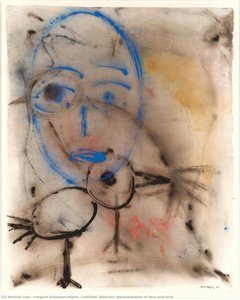
Beyond pure abstraction, Sörensen-Popitz also delved into deeply symbolic territories, blending the human element with the natural world. Her mixed-media explorations, including her 1970 work Untitled (Abstract representation of face and bird), showcase a sophisticated mastery of texture and materiality. In these pieces, she invites the viewer into an intimate dialogue between the soul and nature, using striking blue eyes and delicate avian imagery to explore themes of connection, solitude, and the wild freedom of the spirit. Her ability to layer paint and texture creates a tactile quality that breathes life into her subjects, making her work both intellectually stimulating and emotionally resonant.
Historical Significance and Recognition
The enduring relevance of Irmgard Sörensen-Popitz is preserved through her association with some of the most significant institutions of modern art. Her contributions to the visual language of German modernism have earned her a place in prestigious collections, notably within the Bauhaus Foundation Dessau. This recognition underscores her role not merely as a participant in the era's great movements, but as an artist who successfully synthesized the disciplined aesthetics of design with the profound mysteries of abstract expression.
Her artistic legacy is characterized by several key elements:
- Design Mastery: A foundational connection to the Bauhaus and Constructivist traditions, emphasizing clarity and form.
- Versatility of Medium: An ability to transition seamlessly from monochrome graphic posters to complex, textured mixed-media works.
- Emotional Depth: The capacity to use geometric shapes and vibrant palettes to evoke spontaneous joy and spiritual contemplation.
- Institutional Legacy: A lasting impact on the history of German modernism, recognized by major foundations.

Irmgard Sörensen-Popitz
1896 - 1993 , Germany
Quick Facts
- Artistic Movement Or Style:
- Bauhaus
- Constructivism
- Abstraction
- Full Name: Irmgard Sörensen-Popitz
- Nationality: German
- Notable Artworks:
- Bode Gymnastik (Poster)
- Untitled (Abstract representation of face and bird)
- Magical game
- Place Of Birth: Unknown, Germany
- Date Of Birth: 1896
- Date Of Death: 1993
Related Articles
OriginalUniqueArt.com F.A.Q.: Premium Art Poster Prints – Vivid Colors & Versatile Sizing
Discover OriginalUniqueArt.com's premium art poster prints. Featuring 12-color archival pigments for vivid color fidelity and versatile sizing for bespoke decor. Expertly crafted museum-quality reproductions designed for discerning collectors and professional decorators.