 Preview
 Send
Send Share
Share
 Details
 Guide
Guide

 Download
 Similars
 X-Ray
X-Ray Diaporama
 Q&A
Q&A Stats
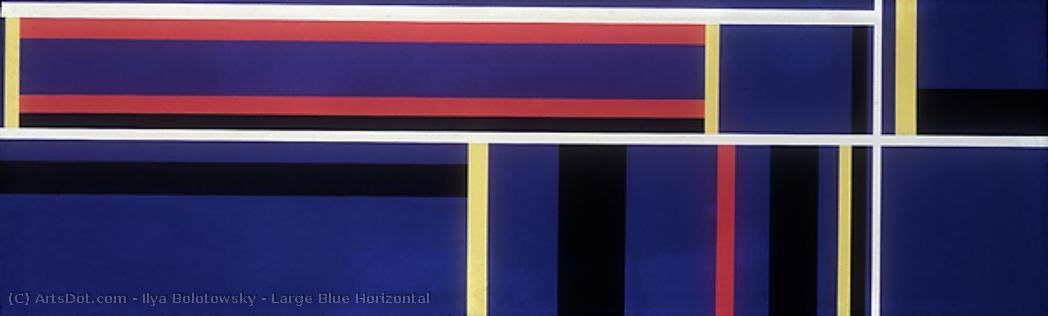
StatsLarge Blue Horizontal

- 71.0 x 229.0 cm

 Read More
The artwork displayed on this page is protected by copyright law, which means we cannot legally create or sell an identical reproduction. This protection is enforced under international agreements such as the Berne Convention and by national laws, including those outlined by the U.S. Copyright Law - Title 17.
This method fully complies with copyright regulations because it does not involve copying or duplicating the protected artwork. Instead, it is a creative reinterpretation - a new painting that is influenced by the original but not identical to it.
Giclée / Art Print
Museum-quality giclée or canvas print with fast production and flexible finish options. ( Buy Hand Made Painting Switch to Digital Image)




































Pick from our preset sizes that match the artwork's original proportions.

Type the width and the height you need, to fit your frame or your wall. A print can only be cut, never made bigger than the picture, so a size with a different shape loses a part of the image. We send you a digital mockup to approve before we print anything. The picture shown on this page does not show the real cut — only the mockup does.
Worldwide Delivery () in 2 weeks instead of standard 4/5 weeks. (16 November)

Free Worldwide Express Shipping

High-Quality Linen Canvas

Full Shipping Insurance

Customs Tax Refund Guarantee

True Color Matching Guarantee

100-Day Return Policy (Defects Only)

100% Money-Back Guarantee

Bulk Discount Offer
 Glass option is only available in size under 110 CM

Large Blue Horizontal
Giclée / Art Print
Reproduction Size
-


Total Price
$ 81
Questions & Answers
Does "Large Blue Horizontal" show strong light-dark contrasts?
"Large Blue Horizontal" by Ilya Bolotowsky shows a statement contrast between its light and dark areas.
Who created "Large Blue Horizontal" and in what year?
Ilya Bolotowsky made "Large Blue Horizontal" in 1975.
Can I use augmented reality to see "Large Blue Horizontal" by Ilya Bolotowsky in my room?
"Large Blue Horizontal" has an augmented reality preview: the artwork's AR Preview page shows it in your own space on a compatible device.
Artist Biography
Ilya Bolotowsky: Pioneer of Geometric Abstraction
Ilya Bolotowsky (1907-1981) stands as a pivotal figure in the history of 20th-century abstract art, particularly within the influential De Stijl movement. Born in Saint Petersburg, Russia, amidst the turbulent backdrop of World War I and the Russian Revolution, Bolotowsky’s early life instilled in him a profound appreciation for intellectual rigor and a yearning for visual harmony—qualities that would define his artistic trajectory.
- Early Life & Education: Bolotowsky emigrated to Baku and Constantinople before relocating to New York City in 1923, where he pursued formal training at the National Academy of Design. This formative period exposed him to classical influences alongside burgeoning modernist ideas.
- The De Stijl Influence: Bolotowsky’s artistic vision was irrevocably shaped by Piet Mondrian, whose uncompromising adherence to geometric abstraction and reductive palette—primarily horizontal and vertical lines in primary colors and neutrals—became the cornerstone of his aesthetic.
Formation of American Abstract Artists & Collaborative Vision
Bolotowsky’s commitment to fostering artistic dialogue extended beyond personal practice. Recognizing the challenges faced by abstract painters attempting to gain recognition from a predominantly figurative art world, he co-founded American Abstract Artists in 1936—a collective dedicated to championing the interests of its members and promoting understanding between abstractionists and the broader public. This endeavor exemplifies Bolotowsky’s belief that artistic progress thrives on shared exploration and mutual support.
- The Ten Whitney Dissenters: Alongside Louis Schanker, Adolph Gottlieb, Mark Rothko, and Joseph Solman, Bolotowsky formed “the Ten,” a group of artists who challenged the conventions of the academy and asserted their independence through independent exhibitions.
- Public Art Initiatives: Bolotowsky’s involvement in public art projects underscored his conviction that art could contribute to social betterment. Notably, he spearheaded the Williamsburg Housing Project mural—a landmark achievement demonstrating his ability to translate philosophical concepts into impactful visual narratives.
Exploring Intuition & Geometric Form
Despite Bolotowsky’s meticulous control over compositional elements, he insisted on prioritizing intuition alongside formal rules in determining the direction of his artworks. This approach reflects a broader humanist sensibility—a recognition that artistic creativity stems from both intellectual contemplation and spontaneous emotional response.
- Three-Dimensional Forms: Bolotowsky’s experimentation with three-dimensional sculptures – predominantly vertical and straight-sided – represents a significant departure from his earlier paintings, signaling an ongoing engagement with new artistic mediums.
- Recognition & Exhibitions: His work gained international acclaim through exhibitions at the University of New Mexico in 1970 and subsequent retrospectives at the Guggenheim Museum and the National Collection of Fine Arts, cementing his legacy as a prominent figure within the modernist canon.
Legacy & Enduring Influence
Ilya Bolotowsky’s contribution to abstract art extends beyond individual masterpieces; he established American Abstract Artists and fostered a vibrant artistic community. His unwavering dedication to Mondrian's principles, combined with his humanist perspective on creativity, continues to inspire artists today. Bolotowsky’s enduring influence is palpable in the continuing exploration of geometric abstraction and its capacity to convey profound philosophical ideas.

Ilya Bolotowsky
1907 - 1981 , Russia
Quick Facts
- Full Name: Ilya Bolotowsky
- Nationality: American
- Date Of Birth: 1907
- Date Of Death: 1981
- Place Of Birth: Saint Petersburg, Russia
- Notable Artworks:
- Interlocking Reds
- Architectural Variation
- Portrait of Ilya Bolotowsky
- Artistic Movement Or Style: Geometric abstraction
- Artists Who Influenced This Artist:
- Piet Mondrian
- De Stijl
- Artists Or Movements Influenced By This Artist: ['Black Mountain College']
Related Articles

Mastering Illusion: The Top 25 Iconic Artworks by Victor Vasarely
Immerse yourself in the hypnotic world of Victor Vasarely. Explore 25 iconic Op Art masterpieces, from geometric abstractions to optical illusions. Find inspiration for your decor with museum-quality art reproductions. Discover all masterpieces on OriginalUniqueArt.com.

Mastering Abstraction: The Top 25 Iconic Artworks by Piet Mondrian
Explore 25 iconic Piet Mondrian masterpieces of Neoplasticism. Discover the beauty of De Stijl on OriginalUniqueArt.com.

Geometric Abstraction's 10 Defining Masterpieces | Art for Your Home - OriginalUniqueArt
Explore 10 defining masterpieces of Geometric Abstraction! Discover Kandinsky, Mondrian & Malevich’s iconic works. Find museum-quality art reproductions and curated decor ideas to elevate your home at OriginalUniqueArt.com.

Mastering Illusion: The Top 25 Iconic Artworks by Victor Vasarely
Immerse yourself in the hypnotic world of Victor Vasarely. Explore 25 iconic Op Art masterpieces, from geometric abstractions to optical illusions. Find inspiration for your decor with museum-quality reproductions. Discover all masterpieces on OriginalUniqueArt.com.

Mastering Abstraction: The Top 25 Iconic Artworks by Piet Mondrian
Explore 25 iconic Piet Mondrian masterpieces of Neoplasticism. Discover the full collection online at OriginalUniqueArt.com.


