Preview
 Send
Send Share
Share
 Details
 Guide
Guide

 Download
 Similars
 X-Ray
X-Ray Diaporama
 Stats
StatsThe Great Tree
 Acrylic On Canvas
- WallArt
- Baroque
 22.0 x 28.0 cm
 Rijksmuseum
 Read More
Hand Made Oil Reproduction
Hand-painted oil on canvas in your size and frame, made to order by our artists. ( Switch to Print Switch to Digital Image)




P118B $10

P118H $10

P118W $10

P438Z $10

P508JH $12

P508YH $12

P805H $10

P805Z $10

P919BZ $10

P919G $10

P919XJ $10

P959ZH $10

P968JZ $12

W106C $8

W218G $10

W218JH $8

W218Y $10

W307PJ $10

W316G $10

W316PJ $8

W316Y $10

W398PJ $8

W4111J $10

W500HY $15

W500JH $15

W692G $12

W849H $8

W940BG $15

W953PJ $8




Pick from our preset sizes that match the artwork's original proportions.

You may enter your own dimensions to fit a specific frame or space. If your selected size does not match the original image's proportions, we will either crop the artwork or extend the painting with additional hand-painted elements. A digital mockup will be sent for your approval before production begins.
Please note that the on-screen preview does not reflect the actual cropping or extension. Only the mockup will accurately show the final composition.
While custom sizes are available, we recommend selecting a dimension from the predefined list to preserve the original proportions.
After order, OriginalUniqueArt.com team will email client for instructions and provide a mockup preview
Worldwide Delivery () in 3/4 weeks instead of standard 5 weeks. (21 September). No compromise on quality.

Free Worldwide Express Shipping

High-Quality Linen Canvas

Full Shipping Insurance

Customs Tax Refund Guarantee

True Color Matching Guarantee

100-Day Return Policy (Defects Only)

100% Money-Back Guarantee

Bulk Discount Offer
 Glass option is only available in size under 110 CM

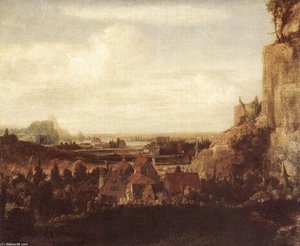
The Great Tree
Reproduction Medium
Reproduction Size
-


Total Price
$ 300
A Monumental Landscape Captured in Monochrome
Hercules Seghers’ “The Great Tree” stands as a testament to the Baroque fascination with dramatic landscapes and masterful printmaking. Executed around 1628-29, this etching offers more than just a visual depiction; it embodies an atmosphere of quiet contemplation and profound observation of nature's grandeur.
Technical Brilliance: The Art of Etching
Seghers’ skill as an engraver is immediately apparent in the artwork’s surface texture. Utilizing meticulous lines—a technique known as etching—he achieved remarkable detail, simulating bark, grass, and other natural elements with astonishing accuracy. This painstaking process involved transferring a design onto metal plate, acid etching away unwanted areas, and then applying tonal washes to create depth and luminosity within the grayscale palette.
A Vision of Baroque Landscape
The painting reflects the stylistic conventions of its time—the Baroque era—characterized by expansive vistas and an emphasis on grandeur. Unlike many contemporary landscapes that prioritized celestial skies, Seghers focused primarily on earthly forms: rolling hills punctuated by scattered trees and a distant village. This deliberate choice underscores the Baroque preoccupation with portraying the power and majesty of the natural world.
Symbolism Within Simplicity
Though devoid of overt symbolic imagery, “The Great Tree” possesses an inherent resonance. The dominant tree itself can be interpreted as representing resilience, longevity—a symbol deeply rooted in folklore and Christian tradition—and perhaps most powerfully, a connection to the fundamental forces of nature. Its solitary presence evokes a sense of solitude yet simultaneously conveys a feeling of steadfastness against time.
A Legacy of Detail and Emotion
“The Great Tree” exemplifies Seghers’ reputation as “the most inspired, experimental and original landscapist” of his generation. It's remarkable achievement in printmaking technique—combined with its evocative mood—continues to captivate viewers today. Reproductions from OriginalUniqueArt offer a chance to experience this masterpiece’s beauty and intricacy firsthand.
Artist Biography
Hercules Seghers: A Life in Landscape and Print
- Born: Haarlem, Netherlands (c. 1590)
- Died: c. 1638
Early Life and Training
- Hercules Pieterszoon Seghers was born in Haarlem, the son of a Mennonite cloth merchant originally from Flanders.
- In 1596, his family moved to Amsterdam.
- He was apprenticed to Gillis van Coninxloo, a leading Flemish landscapist, but this apprenticeship was cut short by Coninxloo's death in 1606. Seghers and his father acquired several of Coninxloo’s works after the artist passed away.
- Following his father's death in 1612, he returned to Haarlem and joined the Haarlem Guild of St. Luke.
Artistic Development and Style
- Seghers is recognized as "the most inspired, experimental and original landscapist" of his period, particularly noted for his innovative printmaking techniques.
- His paintings often feature fantastic mountainous compositions with a wide horizontal view, emphasizing earth over sky.
- He experimented extensively with etching, using drypoint, aquatint (including the "sugar-bite" technique), and other methods to create unique textural effects.
- Seghers’s prints are characterized by their use of colored paper or cloth, colored inks, and hand-coloring, often resulting in miniature paintings.
- His style shows influence from earlier artists like Joos de Momper and Gillis van Coninxloo.
Major Achievements and Innovations
- Innovative Printmaking: Seghers’s most significant contribution lies in his experimental printmaking techniques, particularly the sugar-bite aquatint. This technique was later rediscovered in England.
- Unique Landscapes: His landscapes are characterized by their starkness, originality, and often otherworldly quality. He depicted rocky formations resembling alien terrain.
- Influence on Rembrandt: Rembrandt collected Seghers’s works and reworked elements from his paintings and etchings into his own compositions, demonstrating the significant impact of Seghers' style.
- Diverse Impressions: Unlike many printmakers of his time, Seghers produced multiple impressions of each plate, varying their color schemes and adding hand-coloring to create unique artworks.
Historical Significance
- Seghers’s work was highly regarded during his lifetime, though he faced financial difficulties later in life.
- Samuel van Hoogstraten's *Inleyding tot de hooge schoole der schilderkonst* romanticized Seghers as a misunderstood genius, contributing to his posthumous reputation.
- He is considered a pioneer of landscape printmaking and an important figure in the Dutch Golden Age, known for his experimental techniques and unique artistic vision.
- His influence can be seen in later artists who adopted his innovative printing methods and appreciated his distinctive style.

Hercules Seghers
1590 - 1638 , Netherlands
Quick Facts
- Artistic Movement Or Style: Dutch Golden Age
- Artists Or Movements Influenced By This Artist: ['Rembrandt']
- Artists Who Influenced This Artist:
- Gillis van Coninxloo
- Joos de Momper
- Date Of Birth: c. 1590
- Date Of Death: c. 1638
- Full Name: Hercules Pieterszoon Seghers
- Nationality: Dutch
- Notable Artworks:
- Mountainous Landscape
- Mountain Valley with Fenced Fields
- The Great Tree
- Place Of Birth: Haarlem, Netherlands
Related Articles

Romantic Landscapes: 10 Masterpieces for Your Home | OriginalUniqueArt
Journey through 10 Romantic landscape masterpieces by Friedrich, Turner & Cole. Explore emotional art, sublime nature scenes & iconic 19th-century paintings. Find museum-quality reproductions for your home at OriginalUniqueArt.com – discover the full collection online!

Etching Masters: 10 Legendary Prints That Revolutionized Art | OriginalUniqueArt
Journey through 10 legendary etching masterpieces by Rembrandt, Dürer & Goya. Explore the history of printmaking and discover timeless art for your home. Find museum-quality reproductions at OriginalUniqueArt.com.

The Intricate World of Etching: A Historical Survey of Technique, Aesthetic Evolution, and Enduring Artistic Impact
Explore the rich history of etching, from its origins to modern practice. Discover techniques, key artists like Rembrandt, and insights for collectors. A comprehensive guide by OriginalUniqueArt.

Etching: A Historical Survey of Technique, Aesthetic Qualities & Enduring Artistic Significance
Explore the rich history of etching, from its origins to Rembrandt's masterful innovations. Discover the technique, aesthetic qualities & enduring legacy of this captivating art form. Expert insights for collectors and enthusiasts.

Hokusai's Masterpieces: 25 Iconic Prints & Paintings for Art Lovers | OriginalUniqueArt
Journey through Katsushika Hokusai’s 25 most iconic artworks, including *The Great Wave*. Explore the ukiyo-e master's history, style & timeless Japanese woodblock prints. Find museum-quality reproductions for your home at OriginalUniqueArt.com.