Modernism
Two Bulb Forms (Henry Moore)
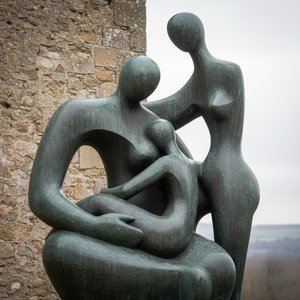
Henry Moore (1898–1986) made Two Bulb Forms. It belongs to the Modernism movement.

 Preview

 Hand Made Oil Painting
 Send
 Share
 Fact sheet


 Download
 Similars
 X-Ray
 Diaporama
 Q&A

 Stats
Two Bulb Forms, in brief
- Title
- Two Bulb Forms
- Artist
- Henry Moore (1898–1986)
- Artist born in
- Castleford, United Kingdom
- Movement
- Modernism
- Subject
- scenes
High-resolution images of Two Bulb Forms
Protected by copyright: these files are for personal reference, not a licence to republish.
Henry Moore, Two Bulb Forms.
Questions on Two Bulb Forms, answered
What subjects appear in "Two Bulb Forms" by Henry Moore?
"Two Bulb Forms" by Henry Moore depicts: scenes.
Can the image of "Two Bulb Forms" by Henry Moore be freely reproduced?
"Two Bulb Forms" by Henry Moore is still protected by copyright. This status governs how the image of the work may be reproduced.
Who created "Two Bulb Forms"?
"Two Bulb Forms" was created by Henry Moore. The information on this page describes Henry Moore's original work.
What art movement does "Two Bulb Forms" by Henry Moore belong to?
The movement associated with "Two Bulb Forms" by Henry Moore is Modernism. This classification situates the work among related artists and artworks.
Why is the copyright status of "Two Bulb Forms" what it is?
The copyright status of "Two Bulb Forms" - still protected by copyright - follows from the artist's death in 1986.
About the artist, Henry Moore

1898–1986, United Kingdom
Henry Moore
A Life Sculpted in Form: The World of Henry Moore Henry Spencer Moore, born in the Yorkshire mining town of Castleford in 1898, emerged as one of Britain’s most significant and internationally celebrated sculptors of the twentieth century. His journey from humble beginnings to global recognition is a testament to his unwavering dedication to artistic exploration and his profound connection to the human form and the natural world. Moore's father, a self-taught man with a passion for learning, instilled in him a belief in the power of education, steering him away from the life of a miner towards formal schooling. Even as a young boy, Moore demonstrated an innate talent for modeling clay and carving wood, foreshadowing the path his life would take.
Also by Henry Moore
 Reclining Figure
 Falling Warrior1957
 Sculptural Objects (Cramer 47)
 Sheep 1
Essays around Two Bulb Forms
 Masterpieces of Fernand Léger: The Top 25 Essential WorksExplore the top 25 masterpieces by Fernand Léger. Discover the essence of Cubism and modernism. Explore the full collection online at Origi…
 Henry Moore: Sculpting Modernity – Form, Emotion & the Human ConditionExplore the revolutionary sculptures of Henry Moore – abstract forms, reclining figures & powerful expressions of the human condition. Disc…
 Mastering Form: The 25 Most Iconic Artworks by Paul CézanneJourney through the revolutionary world of Paul Cézanne. Explore 25 iconic Post-Impressionist masterpieces, from his structural landscapes …