Preview
 Send
Send Share
Share
 Details
 Guide
Guide

 Download
 Similars
 X-Ray
X-Ray Diaporama
 Q&A
Q&A Stats
StatsRed Lion Square

- 38.0 x 57.0 cm


 Read More
Giclée / Art Print
Museum-quality giclée or canvas print with fast production and flexible finish options. ( Buy Hand Made Painting Switch to Digital Image)




































Pick from our preset sizes that match the artwork's original proportions.

Type the width and the height you need, to fit your frame or your wall. A print can only be cut, never made bigger than the picture, so a size with a different shape loses a part of the image. We send you a digital mockup to approve before we print anything. The picture shown on this page does not show the real cut — only the mockup does.
Worldwide Delivery () in 2 weeks instead of standard 4/5 weeks. (31 October)

Free Worldwide Express Shipping

High-Quality Linen Canvas

Full Shipping Insurance

Customs Tax Refund Guarantee

True Color Matching Guarantee

100-Day Return Policy (Defects Only)

100% Money-Back Guarantee

Bulk Discount Offer
 Glass option is only available in size under 110 CM

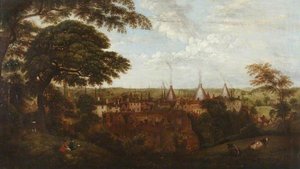
Red Lion Square
Giclée / Art Print
Reproduction Size
-


Total Price
$ 81
A Glimpse into the Past
The scene depicted in Red Lion Square transports viewers to a bygone era, where people gather in the town square, interacting with each other and going about their daily lives. The presence of a horse adds to the nostalgic atmosphere, while the surrounding buildings, including a church with a clock tower, suggest a rich history and sense of community. Key Features of the painting include:- The use of oil as the primary medium, which allows for vivid colors and textures
- The depiction of everyday life in a rural setting, showcasing the artist's attention to detail
- The sense of tranquility and peacefulness that pervades the scene, inviting viewers to step into the world of the painting
For those interested in learning more about Henry Lark I Pratt and his works, OriginalUniqueArt.com offers a range of resources, including information on the artist's life, style, and notable works. Additionally, the website provides an opportunity to explore other artworks, such as Shandaken Range, Kingston by Asher Brown Durand, which can be found at OriginalUniqueArt.com.
Questions & Answers
Which period of Henry Lark I Pratt's career does "Red Lion Square" belong to?
"Red Lion Square" belongs to the Mature Period of Henry Lark I Pratt's career. This classification relates the work to the artist's development.
Is there a factsheet about "Red Lion Square" by Henry Lark I Pratt for students?
A Guide page is available for "Red Lion Square" by Henry Lark I Pratt: a printable factsheet about the artwork, designed for students and classroom use.
How does "Red Lion Square" fit into Henry Lark I Pratt's themes and style?
"Red Lion Square" belongs to Henry Lark I Pratt's Topographical Painting work, whose recorded themes include royal commissions likely, regional newcastle focus, demonstrates skill & detail, topographical tradition, 18th-century landscape, derby porcelain detail, community life portrait, victorian era values.
Artist Biography
Henry Lark I Pratt: A Derbyshire Porcelain Painter
Henry Lark I Pratt (1805 – 1873) stands as a testament to the intersection of craft and artistic vision—a painter inextricably linked to the legacy of Derby’s porcelain industry. Born in St Peter's Parish, Derby, his early life was shaped by an apprenticeship at the prestigious Derby Manufactory, where he honed skills crucial not only for shaping clay but also for capturing its beauty on canvas. This formative experience instilled a meticulous attention to detail and a profound understanding of texture and form that would permeate his oeuvre.- Early Life & Training: Pratt’s dedication to mastering the craft began at a young age, providing him with invaluable insight into material properties and artistic representation. The Derby factory wasn't merely a workplace; it was an incubator for aesthetic sensibilities.
- Career in Porcelain & Initial Artistic Pursuits: Following his apprenticeship, Pratt worked briefly at Mintons before embarking on a solo artistic journey. His marriage to Margaret Windsor solidified his life in Stoke-on-Trent and fostered a family rooted in the region’s artistic traditions.
- Notable Paintings & Patronage: His landscapes—characterized by meticulous observation and a commitment to realism—became celebrated for their evocative portrayal of the English countryside. Commissions from aristocratic patrons underscored his reputation as a respected artist.
- Royal Recognition & Artistic Development: Pratt’s acceptance into the Royal Academy in 1867 and subsequent exhibitions with the Society of British Artists signaled a blossoming artistic career, fueled by an unwavering passion for capturing the essence of nature.
Technique & Influences
Pratt's paintings demonstrate a masterful command of oil paint—a medium favored for its ability to render subtle tonal variations and textural nuances. He meticulously blended pigments to achieve luminous effects, mirroring the delicate glaze surfaces of Derby porcelain. While biographical details remain somewhat sparse, Pratt’s artistic sensibilities clearly absorbed influences from Romantic landscape painting, prioritizing emotional resonance alongside precise topographical representation.- Derbyshire Landscape Tradition: Pratt's work aligns with Derbyshire’s burgeoning landscape tradition—a movement that sought to elevate rural vistas into subjects of artistic contemplation.
Legacy & Recognition
Today, Henry Lark I Pratt’s paintings reside in galleries across Newcastle-under-Lyme and Derby—testaments to his enduring contribution to British art history. His son, Hilton Pratt, continued the family artistic legacy, exhibiting his own work and cementing Pratt's place as a figure of considerable renown within his hometown.- Contemporary Exhibitions: Pratt’s paintings continue to inspire admiration for their beauty and technical skill—a lasting reminder of a Derbyshire artist who bridged the gap between craft and artistic expression.

Henry Lark I Pratt
1805 - 1873
Quick Facts
- Full Name: Henry Lark I Pratt
- Nationality: English
- Date Of Birth: 1805
- Date Of Death: 1873
- Place Of Birth: Derby, England
- Notable Artworks:
- Red Lion Square
- King Street, Newcastle under Lyme
- View of Stoke from Penkhull
- Artistic Movement Or Style: Landscape Painting; Porcelain Art
Related Articles

The Enduring Legacy of Oil on Canvas: Technique, History & Aesthetic Impact
Explore the rich history & techniques of oil painting – from Renaissance masters to Impressionism. Discover pigments, layering methods, and why this timeless medium endures. Expert insights for artists & art enthusiasts.

High Medieval Art: 10 Masterpieces That Shaped an Era | OriginalUniqueArt
Journey through High Medieval Art! Explore 10 iconic masterpieces – from Giotto's frescoes to stunning Gothic cathedrals. Discover the stories behind these timeless paintings, sculptures & illuminated manuscripts. Find museum-quality art reproductions at OriginalUniqueArt.com.

Color Unleashed: The Top 25 Masterpieces by Henri Matisse
Explore 25 iconic Matisse masterpieces and the vibrant world of Fauvism. Discover the full collection online at OriginalUniqueArt.com.

The Enduring Power of Painting: A Historical & Contemporary Exploration of Form and Emotion
Explore the rich history & enduring techniques of oil painting with OriginalUniqueArt. Discover masterpieces, learn about art collecting, and find authentic handmade reproductions crafted by skilled artists.

Oil on Canvas: A Historical & Technical Exploration of a Timeless Artistic Medium
Explore the rich history & enduring techniques of oil painting on canvas. Discover the science behind its longevity, conservation practices, and contemporary relevance. Expert insights for art enthusiasts.