Switch to Print
 Read More







































 For artworks or reproductions larger than 105 cm (approximately 41 inches) on any side, the frame will be shipped as a kit, disassembled. This method ensures safe delivery and prevents damage during transport.


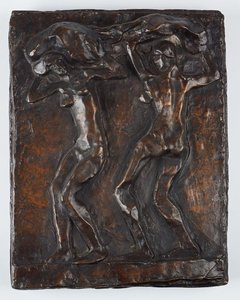
A Moment Frozen in Stone: Exploring Henri Gaudier-Brzeska’s “L”
The sculpture "L," created by Henri Gaudier-Brzeska in 1912, stands as a testament to the burgeoning avant-garde movement of early modernism and embodies a profound exploration of human intimacy. Crafted from dark stone—likely alabaster or limestone—the piece depicts two male figures engaged in an intimate embrace, capturing a fleeting gesture of connection against a stark white backdrop that serves to amplify its sculptural impact. This photograph, meticulously documented by MoMA (Museum of Modern Art), offers us not merely a visual representation but a glimpse into the artistic spirit of its time and Gaudier-Brzeska’s singular vision.The Influence of Epstein and “Direct Carving”
Gaudier's artistic trajectory was decisively shaped by his collaboration with sculptor Jacob Epstein, who championed the revolutionary technique of "direct carving." Unlike traditional methods that involved preparatory sketches and maquettes, Epstein encouraged Gaudier to sculpt directly from the stone itself—a process demanding unwavering concentration and a profound understanding of material properties. This approach prioritized immediacy and responsiveness to the inherent qualities of the medium, rejecting academic conventions in favor of an expressive idiom rooted in primal form.Stylistic Echoes of Cubism and Expressionism
“L” resonates with stylistic influences from both Cubism and Expressionism. Gaudier’s simplification of forms—evident in the stylized musculature of the figures and the flattened planes of their bodies—mirrors the geometric fragmentation characteristic of Cubist explorations. Simultaneously, the sculpture conveys a palpable emotional intensity through its dramatic interplay of light and shadow, mirroring the expressive distortions found in Expressionist art. This duality underscores Gaudier’s ambition to transcend mere representation and communicate deeper psychological truths.Symbolism Beyond Physical Form
The sculpture's symbolism extends beyond its depiction of physical intimacy. The stark white background serves as a visual counterpoint to the dark stone, highlighting the contours of the figures and emphasizing their vulnerability. The intertwined poses suggest a merging of identities—a desire for unity amidst individual experience—reflecting broader anxieties about masculinity and relationships prevalent in the early 20th century. Gaudier’s deliberate choice of material—stone—symbolizes permanence and resilience, hinting at an enduring fascination with the human condition.A Legacy of Bold Experimentation
Henri Gaudier-Brzeska tragically perished in 1915 during World War I, leaving behind a remarkably prolific body of work that continues to inspire artists today. “L,” alongside other sculptures produced during his brief but impactful career, exemplifies his unwavering commitment to artistic innovation and his refusal to compromise on his vision. Its enduring appeal lies not only in its masterful execution—the meticulous attention to detail and the skillful manipulation of light—but also in its ability to provoke contemplation about fundamental questions concerning human connection and artistic expression. The photograph’s documentation ensures that this seminal piece remains accessible to future generations, preserving Gaudier-Brzeska's legacy as a pioneer of modern sculpture.Questions & Answers
Which artistic current is "L" by Henri Gaudier-Brzeska part of?
"L" is a work of Early Modernism. The movement indicates the artistic tradition the work is part of.
Where can I buy a digital image of "L" by Henri Gaudier-Brzeska?
To get a digital file of "L" by Henri Gaudier-Brzeska, order a high-resolution digital image download on its Digital Image page.
How does the subject of "L" relate to Henri Gaudier-Brzeska's usual themes?
Among Henri Gaudier-Brzeska's recorded themes - rodin influence, sexual expression, direct carving technique, london art scene, sculptural exploration - "L" brings its own focus on sculpture, intimacy, sexuality, modernism, stone, abstraction, human form.
More about this painting
 Send
Send Share
Share
 Details
 Guide
Guide

 Download
 Similars
 Diaporama
 Q&A
Q&A Stats
Stats