Text size

() ·

A painting made for you, by hand

The Ballad

Hand Made Oil Reproduction

Hand-painted oil on canvas in your size and frame, made to order by our artists. ( Switch to Print Switch to Digital Image)

Collectible Description

Discover Gustave Moreau's 'The Ballad,' a mesmerizing Symbolist watercolor (1885). Explore intricate details, mythological themes & dreamlike beauty in this captivating masterpiece – now available as a stunning hand-painted reproduction.

Artist Biography

Explore the captivating Symbolist art of Gustave Moreau (1826-1898), famed for mythological & biblical paintings like 'Salome'. Influenced Matisse & Rouault. Discover his dreamlike world!

from ·

Chapter 1

How large should it be?

Slide to change the size; the picture on the left shows the frame at its real width. The proportions of the original are kept.

Standard
custom
CM
INCH

Pick from our preset sizes that match the artwork's original proportions.

width
height

Type the width and the height you need, to fit your frame or your wall. This is hand-painted, so for a size with a different shape the artist can paint a bit more around the picture, or cut a bit — you choose. We send you a digital mockup to approve before the painting starts. The picture shown on this page does not show the real result — only the mockup does.

Chapter 2

How should it arrive?

Choose the edges of the stretched canvas

Choose your frame

Corner sample of the WhiteWrap canvas edge finish, stretched on solid wood bars
White $1
Corner sample of the BlurSideWrap canvas edge finish, stretched on solid wood bars
Blurside $1
Corner sample of the ExtendedWrap canvas edge finish, stretched on solid wood bars
Extended $1
Corner sample of the P118B picture frame: moulded polystyrene, 5 cm wide and 3 cm thick
P118B $10
Corner sample of the P118H picture frame: moulded polystyrene, 5 cm wide and 3 cm thick
P118H $10
Corner sample of the P118W picture frame: moulded polystyrene, 5 cm wide and 3 cm thick
P118W $10
Corner sample of the P438Z picture frame: moulded polystyrene, 5.5 cm wide and 3.5 cm thick
P438Z $10
Corner sample of the P508JH picture frame: moulded polystyrene, 7 cm wide and 3.5 cm thick
P508JH $12
Corner sample of the P508YH picture frame: moulded polystyrene, 7 cm wide and 3.5 cm thick
P508YH $12
Corner sample of the P805H picture frame: moulded polystyrene, 5 cm wide and 3.5 cm thick
P805H $10
Corner sample of the P805Z picture frame: moulded polystyrene, 5 cm wide and 3.5 cm thick
P805Z $10
Corner sample of the P919BZ picture frame: moulded polystyrene, 7 cm wide and 3.5 cm thick
P919BZ $10
Corner sample of the P919G picture frame: moulded polystyrene, 7 cm wide and 3.5 cm thick
P919G $10
Corner sample of the P919XJ picture frame: moulded polystyrene, 7 cm wide and 3.5 cm thick
P919XJ $10
Corner sample of the P959ZH picture frame: moulded polystyrene, 5 cm wide and 3 cm thick
P959ZH $10
Corner sample of the P968JZ picture frame: moulded polystyrene, 6 cm wide and 4 cm thick
P968JZ $12
Corner sample of the W106C picture frame: solid wood, 5 cm wide and 3 cm thick
W106C $8
Corner sample of the W218G picture frame: solid wood, 5 cm wide and 3 cm thick
W218G $10
Corner sample of the W218JH picture frame: solid wood, 5 cm wide and 3 cm thick
W218JH $8
Corner sample of the W218Y picture frame: solid wood, 5 cm wide and 3 cm thick
W218Y $10
Corner sample of the W307PJ picture frame: solid wood, 6 cm wide and 3 cm thick
W307PJ $10
Corner sample of the W316G picture frame: solid wood, 6 cm wide and 3 cm thick
W316G $10
Corner sample of the W316PJ picture frame: solid wood, 6 cm wide and 3 cm thick
W316PJ $8
Corner sample of the W316Y picture frame: solid wood, 6 cm wide and 3 cm thick
W316Y $10
Corner sample of the W398PJ picture frame: solid wood, 5 cm wide and 3 cm thick
W398PJ $8
Corner sample of the W4111J picture frame: solid wood, 6.5 cm wide and 3.5 cm thick
W4111J $10
Corner sample of the W500HY picture frame: solid wood, 7 cm wide and 5 cm thick
W500HY $15
Corner sample of the W500JH picture frame: solid wood, 7 cm wide and 5 cm thick
W500JH $15
Corner sample of the W692G picture frame: solid wood, 8 cm wide and 4 cm thick
W692G $12
Corner sample of the W849H picture frame: solid wood, 5 cm wide and 3 cm thick
W849H $8
Corner sample of the W940BG picture frame: solid wood, 7.5 cm wide and 4.5 cm thick
W940BG $15
Corner sample of the W953PJ picture frame: solid wood, 6 cm wide and 3.5 cm thick
W953PJ $8
Corner sample of the H24-GOLD picture frame: carved wood with gesso, 10 cm wide and 6 cm thick
H24-GOLD $30
Corner sample of the H24-SILVER picture frame: carved wood with gesso, 10 cm wide and 6 cm thick
H24-SILVER $30
Corner sample of the H36-GOLD picture frame: carved wood with gesso, 15 cm wide and 6.5 cm thick
H36-GOLD $45
Corner sample of the H36-SILVER picture frame: carved wood with gesso, 15 cm wide and 6.5 cm thick
H36-SILVER $45
Frame preview
Framed

Moulding: . Overall size with the frame: .

Chapter 3

Who paints it, and should anything change?

Examples of what can be changed: Replace face with customer photo; Add pet (e.g., replace cat with dog); Include hidden message in background; Change background landscape or elements.
After order, OriginalUniqueArt.com team will email client for instructions and provide a mockup preview

Worldwide Delivery () in 3/4 weeks instead of standard 5 weeks. (1 November). No compromise on quality.

Chapter 4

The finishing touches

A nameplate, as in a museum?

Engraved Bronze Plaque Details

This elegant plaque features the artist's name and the title of the artwork, finely engraved for a timeless presentation.

It is made from bronze with a refined, elegant finish. The text is precisely laser-engraved for a sharp and permanent result. Measuring 9x2 cm, the plaque is compact yet easy to read. It's built to be durable and scratch-resistant, offering a professional, museum-quality look. Mounting is simple thanks to the included adhesive backing.

Transparent Acrylic Plaque Details

The plaque includes essential engraved details such as the artist's name, the title of the artwork, the date it was created, the type of media used-like oil on canvas or watercolor-a brief description of the piece, and a QR code that links to the complete artwork information.

It is crafted from clear acrylic, offering a sleek, modern appearance. The text is UV-engraved in black to ensure strong visual contrast. With a size of 10x15 cm, it ensures optimal readability. It comes equipped with two metal hooks for secure wall mounting. The plaque is designed to be weather-resistant, making it suitable for various environments, and it includes interactive features that work seamlessly with smartphone scanning.

Black Acrylic Plaque Details

This elegant plaque includes engraved information such as the artist's name, the title of the artwork, the date it was created, the type of media used (like oil on canvas or watercolor), a short description of the artwork, and a QR code for quick access to more information.

The plaque itself is made from refined black acrylic with a premium finish. The text is laser-engraved in white for high contrast and readability. Its size is 10x15 cm, designed to be easy to read. It comes with two metal hooks for professional mounting. The design is sleek and fits any interior style. It is also weather-resistant and durable, with built-in digital integration for mobile compatibility.

A protective varnish?

When do you need it?

Chapter 5

Your painting, as you ordered it

The Ballad

Reproduction Medium

Reproduction Size

-

Elite Senior Artist

More detail, finesse, and extra production time

-

Reproduction Frame

-

-

For artworks or reproductions larger than 105 cm (approximately 41 inches) on any side, the frame will be shipped as a kit, disassembled. This method ensures safe delivery and prevents damage during transport.

Professional assembly required - this is not a DIY product.
The kit must be assembled and the canvas stretched by an experienced professional framer, using wood glue (not supplied), a canvas stretching plier and clamps to hold the bars square while the glue dries. Incorrect assembly or uneven canvas tension can permanently damage the artwork and is not covered by our warranty.

  • All solid wood bars are included, precisely cut to size.

  • Assembled with the screws provided, plus wood glue for the corner joints, which is not supplied and must be sourced by your framer.

  • Professional tools are required and not included: a canvas stretching plier (tensioner) and clamps to hold the bars square while the glue dries.

Important:
The corner joints require wood glue, the bars must be held with clamps until the glue is fully dry, and tightening the canvas on the assembled frame requires a canvas stretching plier. None of these are included in the kit. Please arrange an experienced professional framer before ordering this size.

Nameplate

-

-

Protective Varnish

Glossy Varnish (enhances colors, protects against light/moisture)

-

Customize My Artwork

Examples of what can be changed: Replace face with customer photo; Add pet (e.g., replace cat with dog); Include hidden message in background; Change background landscape or elements.

-

Urgent

Worldwide Delivery () in 3/4 weeks instead of standard 5 weeks. (1 November). No compromise on quality.

-

Express Shipping

Worldwide Delivery () in 5 weeks. (8 November).

Included

Total Price

$ 300

Total Price $ 300

Glass option is only available in size under 110 CM

Included with every order

  • Free Worldwide Express Shipping
  • High-Quality Linen Canvas
  • Full Shipping Insurance
  • Customs Tax Refund Guarantee
  • True Color Matching Guarantee
  • 100-Day Return Policy (Defects Only)
  • 100% Money-Back Guarantee
  • Bulk Discount Offer

A Dreamscape Unveiled: Gustave Moreau’s “The Ballad”

Gustave Moreau's "The Ballad," painted in 1885, isn’t merely a depiction of a scene; it’s an immersion into a realm of potent symbolism and deeply felt emotion. This watercolor, born from the heart of Symbolism, transcends simple representation to become a visual poem—a testament to Moreau's profound engagement with mythology, literature, and the hidden currents of the human psyche. The painting immediately draws the viewer in with its vibrant palette and intricate details, creating an atmosphere that feels both familiar and profoundly strange, like stepping into a half-remembered dream.

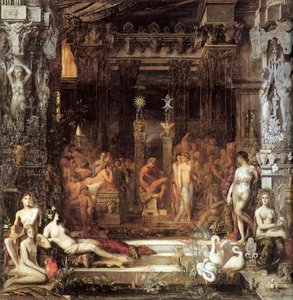
At first glance, the composition presents a striking tableau: a man, clad in armor and wielding a sword, rides atop a magnificent horse, while a woman stands before him, her hair whipped about by an unseen wind. The scene is layered with elements of nature – twisting branches, blossoming flowers—and fantastical details that hint at a world beyond the everyday. Two additional horses are present, one further back in the landscape, adding depth and suggesting a journey or procession. A soaring bird cuts across the upper portion of the canvas, injecting a sense of movement and perhaps even prophecy into the scene.

The Language of Symbolism: Moreau’s Influences

Moreau's artistic vision was deeply rooted in the intellectual currents of his time, particularly influenced by the evocative poetry of Charles Baudelaire and Stéphane Mallarmé. These writers explored themes of beauty, decay, spirituality, and the subconscious—ideas that directly informed Moreau’s approach to painting. He wasn’t interested in faithfully recreating reality; instead, he sought to distill complex emotions and philosophical concepts into visual symbols. The armor worn by the man, for instance, could represent both strength and constraint, while the woman's wind-swept hair might symbolize vulnerability or a connection to the untamed forces of nature.

The painting’s meticulous detail—the texture of the horse’s mane, the delicate folds of the woman’s gown, the intricate patterns in the background foliage—is characteristic of Moreau's style. He employed a technique that combined watercolor with gouache and other pigments to achieve a luminous quality and an almost jewel-like intensity of color. This careful layering creates a sense of depth and atmosphere, contributing significantly to the painting’s dreamlike quality.

Mythic Echoes and Emotional Resonance

"The Ballad" is rich in mythological allusions, though their precise interpretation remains open to debate. Some scholars suggest connections to ancient Greek myths, while others see echoes of medieval romances or even biblical narratives. The central figures could represent a heroic quest, a tragic love story, or perhaps a meditation on the duality of masculine and feminine power. Regardless of its specific mythological source, the painting powerfully conveys a sense of longing, mystery, and profound emotional intensity.

Moreau’s intention wasn't to provide definitive answers but rather to evoke a feeling—a visceral response in the viewer. He aimed to tap into universal human experiences – love, loss, courage, and mortality – through the evocative language of symbolism. The painting invites contemplation, encouraging us to project our own interpretations onto its enigmatic figures and symbolic landscape.

Bringing “The Ballad” Home: Reproductions for Collectors

OriginalUniqueArt offers meticulously crafted, hand-painted reproductions of Gustave Moreau’s "The Ballad," capturing the artist's unique style and emotional depth with unparalleled accuracy. These reproductions are created by skilled artisans using traditional techniques, ensuring that every detail—from the vibrant colors to the intricate textures—is faithfully reproduced. Whether you’re an art collector seeking a stunning addition to your collection or an interior designer looking for a captivating piece of artwork to enhance your space, a OriginalUniqueArt reproduction of “The Ballad” offers a beautiful and authentic way to experience the power and beauty of Moreau's vision.

Explore our selection of Gustave Moreau reproductions today and bring this timeless masterpiece into your world. Browse Now

Questions & Answers

Which color stands out most in "The Ballad"?

The color that stands out most in "The Ballad" is gray (#7d6a60). The dominant color is useful when matching an artwork to an interior.

How harmonious are the colors of "The Ballad" by Gustave Moreau?

The color harmony of "The Ballad" is recorded as softly mixed palette.

How can I view "The Ballad" by Gustave Moreau as a slideshow?

A slideshow is available: the Diaporama page of "The Ballad" by Gustave Moreau.

More about this painting

Preview AR preview Switch to Print Switch to Digital Image Send
Details Guide Add to favorites Download Similars X-Ray Diaporama Q&A Stats

In numbers

  • 1885the year it was painted
  • 29frames to choose from
  • standard sizes, in its own proportions
  • 5weeks to paint and deliver it
Gustave Moreau

Gustave Moreau

1826 - 1898, France

Quick facts about Gustave Moreau

  • Artistic Movement Or Style: Symbolism
  • Artists Or Movements Influenced By This Artist:
    • Henri Matisse
    • Georges Rouault
  • Artists Who Influenced This Artist:
    • Eugène Delacroix
    • Michelangelo
    • Leonardo da Vinci
  • Full Name: Gustave Moreau
  • Nationality: French
  • Notable Artworks:
    • Salome Dancing before Herod

    • Jupiter and Semele
    • Orpheus
    • The Apparition
    • Desdemona
  • Place Of Birth: Paris, France
  • Date Of Birth: 1826
  • Date Of Death: 1898

Artist Biography

A Dream Weaver of Symbolism: The Life and Art of Gustave Moreau

Gustave Moreau, a name synonymous with the ethereal beauty and enigmatic depths of Symbolist painting, emerged from 19th-century Paris as a singular artistic voice. Born in 1826 into a bourgeois family—his father an architect and archivist—Moreau’s early life was steeped in intellectual curiosity and aesthetic sensibility. From a young age, he displayed a remarkable gift for drawing, nurtured through traditional academic training at the École des Beaux-Arts under figures like François-Édouard Picot. However, Moreau's artistic path would diverge sharply from the prevailing Realist and Impressionist currents of his time. He wasn’t interested in capturing fleeting moments or objective reality; instead, he sought to unlock the hidden realms of myth, religion, and the human psyche through a deeply personal and symbolic visual language. His journey was one of inward exploration, translating subjective emotions and spiritual yearnings onto canvas with an obsessive attention to detail and a vibrant, often opulent palette.

The Forge of Imagination: Influences and Artistic Development

Moreau’s artistic development wasn't born in a vacuum. While rejecting the dominant trends of his era, he drew inspiration from diverse sources. The dramatic use of color and exotic subject matter found in the works of Eugène Delacroix resonated deeply with him, igniting a passion for narrative painting imbued with emotional intensity. He also held Renaissance masters like Michelangelo and Leonardo da Vinci in high esteem, admiring their mastery of composition, anatomy, and psychological insight. Yet, Moreau wasn’t merely imitating these artists; he was synthesizing their influences into something entirely new. His travels to Italy in the 1850s proved pivotal, immersing him in the art of antiquity and the Renaissance, providing a wealth of motifs and stylistic cues that would populate his future works. He meticulously copied Old Master paintings, not as an exercise in replication, but as a means of absorbing their techniques and unlocking their secrets. This dedication to craft, combined with his burgeoning interest in mythology and literature, laid the foundation for his unique artistic vision.

A World of Symbols: Themes and Techniques

Moreau’s paintings are not simply illustrations of myths or biblical stories; they are complex allegories that invite contemplation and interpretation. He delved into narratives like those of Salome, Orpheus, Jupiter and Semele, and countless others, not to retell them literally, but to explore their underlying psychological and spiritual truths. His canvases teem with symbolic imagery—serpents representing temptation, jewels signifying earthly desires, and figures embodying abstract concepts like grief, loss, or redemption. He masterfully created a dreamlike atmosphere through intricate detail, rich textures, and an often unsettling juxtaposition of light and shadow. Moreau’s technique was characterized by meticulous layering of paint, creating surfaces that shimmer with iridescent colors and evoke a sense of otherworldly beauty. His use of gold leaf further enhanced this effect, lending his works a Byzantine quality that underscored their spiritual dimension. He wasn't concerned with capturing realistic textures or perspectives; instead, he prioritized the expressive power of color and form to convey mood and meaning.

Legacy and Influence: The Enduring Power of Symbolism

Though initially met with mixed reactions, Moreau became a central figure in the burgeoning Symbolist movement during the 1890s. Unlike some of his contemporaries who actively sought public attention, he remained somewhat reclusive, preferring to work independently and avoid artistic debates. However, his influence was undeniable. In 1893, he accepted a professorship at the École des Beaux-Arts, where he profoundly impacted generations of artists, including Henri Matisse and Georges Rouault. He encouraged his students to embrace imagination, symbolism, and individual expression, urging them to break free from conventional artistic norms. While Symbolism eventually waned in popularity after Moreau’s death in 1898, his work experienced a significant reevaluation in the latter half of the 20th century. Today, he is widely regarded as one of the most important figures in the movement and a precursor to modern art. The Musée Gustave Moreau, housed in his former studio and home in Paris, stands as a testament to his enduring legacy—a sanctuary where visitors can immerse themselves in the captivating world of this extraordinary artist. His paintings continue to resonate with audiences today, offering glimpses into the hidden depths of the human soul and reminding us of the power of art to transcend the boundaries of reality.

Notable Works

  • Salome Dancing before Herod: Perhaps his most famous work, this painting exemplifies Moreau’s opulent style and fascination with biblical narratives.
  • Jupiter and Semele: A dramatic depiction of the Greek myth, showcasing Moreau's mastery of composition and color.
  • Orpheus: Several paintings by Moreau explore the myth of Orpheus, reflecting themes of loss, grief, and artistic inspiration.
  • The Apparition: Demonstrates his skill in creating ethereal and otherworldly scenes.
  • Desdemona: A poignant portrayal of Shakespeare's tragic heroine.

Quick Facts

  • Artist: Gustave Moreau
  • Title: The Ballad
  • Subject or theme: Allegorical Narrative
  • Notable elements: Myth & Symbolism
  • Location: Musée Gustave Moreau, Paris

Art Quiz

There is only one correct answer for each question.

Question 1:
What artistic movement is Gustave Moreau most closely associated with?
Question 2:
The painting ‘The Ballad’ primarily utilizes which of the following techniques to create its atmosphere?
Question 3:
What literary influence is most evident in Moreau’s approach to painting as described in the text?
Question 4:
In the image, what is the woman standing in front of the man wearing?
Question 5:
The painting ‘The Ballad’ is housed in which museum?