Preview
 Send
Send Share
Share
 Details
 Guide
Guide

 Download
 Similars
 X-Ray
X-Ray Diaporama
 Stats
StatsOsier


 Read More
Giclée / Art Print
Museum-quality giclée or canvas print with fast production and flexible finish options. ( Buy Hand Made Painting Switch to Digital Image)




































Pick from our preset sizes that match the artwork's original proportions.

Type the width and the height you need, to fit your frame or your wall. A print can only be cut, never made bigger than the picture, so a size with a different shape loses a part of the image. We send you a digital mockup to approve before we print anything. The picture shown on this page does not show the real cut — only the mockup does.
Worldwide Delivery () in 2 weeks instead of standard 4/5 weeks. (21 October)

Free Worldwide Express Shipping

High-Quality Linen Canvas

Full Shipping Insurance

Customs Tax Refund Guarantee

True Color Matching Guarantee

100-Day Return Policy (Defects Only)

100% Money-Back Guarantee

Bulk Discount Offer
 Glass option is only available in size under 110 CM

Osier
Giclée / Art Print
Reproduction Size
-


Total Price
$ 81
Description and Style
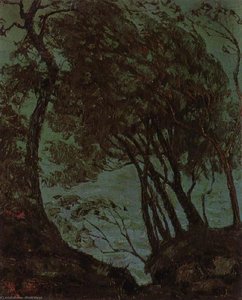
Osier is a landscape painting that features a tree with branches and leaves in red hues, set against a natural backdrop. The tree appears to be dead or dying, yet it exudes a sense of tranquility and serenity. The use of earthy tones, such as warm browns and muted greens, adds depth and texture to the painting. The brushstrokes are lively and dynamic, characteristic of Regionalism, which emphasizes the importance of capturing the everyday life and landscape of rural America.Artist and Movement
Grant Wood was a prominent American painter who played a significant role in the development of Regionalism. His works often depicted the rural American Midwest, showcasing its beauty and simplicity. Osier is one of his notable works, which demonstrates his ability to convey the essence of the natural world through his use of color and light.- The painting is available for purchase as a handmade oil painting reproduction on OriginalUniqueArt.com.
- More information about Grant Wood and his works can be found on Wikipedia.
- Regionalism is a style that emphasizes the importance of capturing the everyday life and landscape of rural America.
The beauty of Osier lies in its ability to evoke a sense of tranquility and appreciation for the natural world. As a masterpiece of Regionalism, it continues to inspire art lovers and collectors alike, offering a glimpse into the simplicity and beauty of rural America.
Questions & Answers
What luminance does "Osier" by Grant Wood have?
The luminance recorded for "Osier" by Grant Wood is soft shadow.
Does "Osier" show strong light-dark contrasts?
The light-dark contrast of "Osier" is recorded as serene. Contrast describes how strongly light and dark areas differ.
How light is "Osier" overall?
The perceived brightness of "Osier" by Grant Wood is shadow. It can be matched to the light of the intended space.
Artist Biography
Early Life and Career
Grant DeVolson Wood, an American painter, was born on February 13, 1891, in rural Iowa. His life changed dramatically after the death of his father in 1901, when his mother relocated the family to Cedar Rapids. Wood began his artistic journey as an apprentice in a local metal shop before enrolling at the Handicraft Guild in Minneapolis in 1910—an art school notable for being run by women and focused on the Arts and Crafts movement.
Artistic Influences and Style
Wood’s art was deeply influenced by Jan van Eyck, the 15th-century Flemish master renowned for his precise and luminous technique. This meticulous clarity became a hallmark of Wood’s own style, best exemplified in his most celebrated work, American Gothic. As a leading figure in the American Regionalism movement—a style emphasizing the realistic depiction of rural and small-town America—Wood developed a uniquely American voice that combined European craftsmanship with Midwestern authenticity.
Notable Works and Contributions
American Gothic (1930): A defining image of 20th-century American art, often compared to Leonardo da Vinci’s Mona Lisa and Edvard Munch’s The Scream for its cultural resonance. The Stone City Art Colony (1932): Founded by Wood near his hometown, the colony provided vital support for artists during the Great Depression. University of Iowa School of Art (1934–1941): As a teacher, Wood inspired a generation of artists to find beauty and meaning in the familiar landscapes of the American Midwest.
Legacy and Later Life
Grant Wood passed away on February 12, 1942, at the age of 51, due to pancreatic cancer. His estate was left to his sister, Nan Wood Graham—immortalized as the female figure in American Gothic. Today, his personal belongings and many of his works are preserved at the Figge Art Museum in Davenport, Iowa. Wood’s devotion to portraying the dignity of everyday American life continues to influence artists and scholars worldwide.
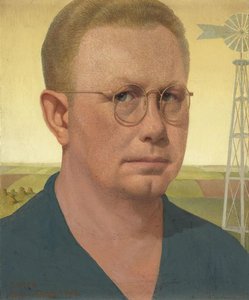
Grant Wood
1891 - 1942 , United States of America
Quick Facts
- Full Name: Grant DeVolson Wood
- Nationality: American
- Date Of Birth: 1891
- Date Of Death: 1942
- Place Of Birth: Anamosa, United States of America
- Notable Artworks:
- American Gothic
- Portrait of Nan
- The Appraisal
- Spring In Town
- Artistic Movement Or Style: American Regionalism
- Artists Who Influenced This Artist: ['Jan van Eyck']
- Artists Or Movements Influenced By This Artist: ['Regionalism']